7 Powerful Secrets of First-Order Kinetics Every Clinician Must Master for Safer Dosing
A Clinical Scenario to Begin
Imagine you are working an overnight shift in the emergency department when a 72-year-old woman arrives with confusion, nausea, and a heart rate hovering around 48 beats per minute. Her daughter hands you a medication list that includes digoxin, and the pieces start falling into place. The patient’s recent blood work shows her serum creatinine has doubled since her last visit three months ago, yet her digoxin dose was never adjusted. You order a stat digoxin level, and it returns at 3.8 ng/mL, well above the therapeutic range of 0.5 to 2.0 ng/mL.
What happened here is not simply a medication error. It is a clinical manifestation of pharmacokinetic principles operating in real time. Digoxin is primarily eliminated by the kidneys through glomerular filtration and tubular secretion, and when renal function declines, clearance falls. Because digoxin follows first-order elimination kinetics under normal circumstances, the drug’s half-life, which averages about 36 to 48 hours in patients with healthy kidneys, can extend to several days in renal impairment. The patient continued taking the same daily dose, but her body was removing a much smaller fraction of the drug each day. Over weeks, digoxin accumulated until toxic concentrations were reached.
This scenario illustrates why understanding first-order kinetics is not an abstract exercise in memorizing equations. It is the foundation upon which safe prescribing, dose adjustment, therapeutic drug monitoring, and toxicity management are built. When you grasp how drugs move through the body over time, you can predict when a patient will reach a steady state, how long a drug will linger after stopping it, and what will happen if organ function changes.
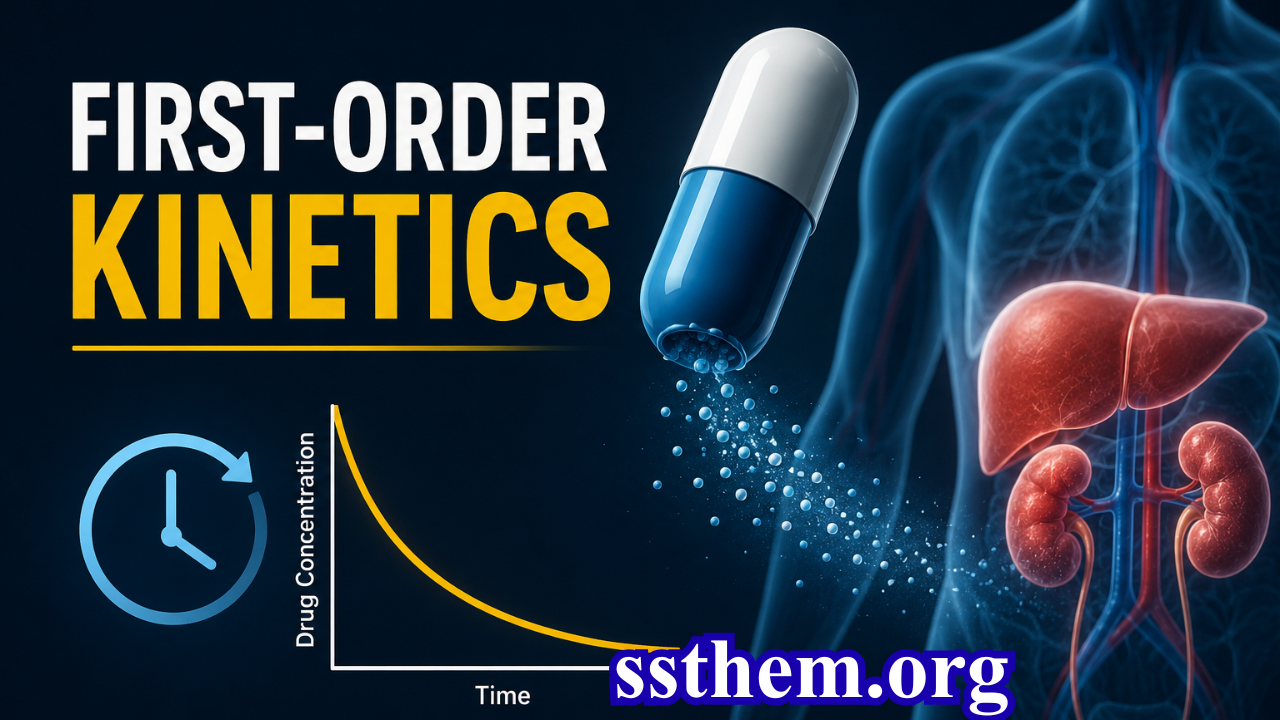
Most drugs used in clinical medicine follow first-order elimination kinetics at therapeutic concentrations. This means the body removes a constant fraction, not a constant amount, of drug per unit of time. The implications of this simple statement are profound, touching everything from antibiotic dosing intervals to chemotherapy protocols to the management of chronic conditions like epilepsy and heart failure.
In this comprehensive article, we will explore what first-order kinetics means at a molecular level, how it is described mathematically, why it matters for clinical decision-making, how it compares with zero-order and mixed-order elimination, what factors alter drug elimination in real patients, and how these principles guide therapeutic drug monitoring and dose individualization. By the end, you should have a working knowledge of first-order kinetics that you can apply at the bedside, on rounds, and in examinations.
What Is First-Order Kinetics? A Foundational Definition
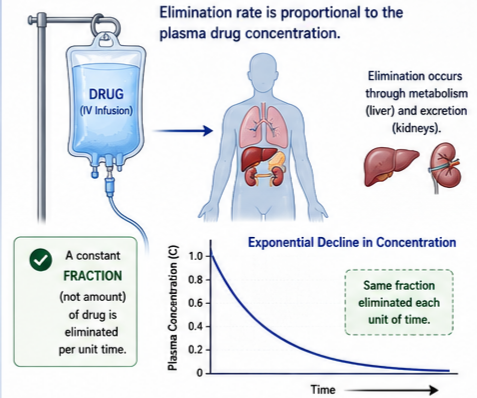
First-order kinetics describes a process in which the rate of change of a quantity is directly proportional to the quantity itself. In pharmacology, this means the rate of drug elimination from the body is proportional to the plasma drug concentration at any given moment. When the concentration is high, the elimination rate is high. When the concentration falls, the elimination rate falls proportionally.
This relationship arises because most drug elimination pathways, including hepatic metabolism and renal excretion, operate well below their maximum capacity under usual clinical conditions. Drug-metabolizing enzymes, such as those in the cytochrome P450 family, and drug transporters in the kidney and liver are not saturated at typical therapeutic concentrations. They have abundant capacity relative to the amount of substrate they encounter. Consequently, the rate of drug removal depends primarily on how much drug is presented to these systems, which is a function of plasma concentration.
To make this concrete, consider an analogy from everyday life. Imagine you have a large bucket of water with a small hole near the bottom. The rate at which water flows out depends on the height of the water column above the hole, which determines the hydrostatic pressure. When the bucket is full, water rushes out quickly. As the water level drops, the flow rate slows. The fraction of the remaining water that drains in any given minute stays roughly constant, but the absolute volume drained per minute decreases over time. This is first-order behavior.
In pharmacokinetics, the bucket represents the body, the water represents the drug, and the hole represents the combined processes of metabolism and excretion that together constitute clearance. The hydrostatic pressure is analogous to the plasma drug concentration driving elimination.
The defining feature of first-order kinetics is that a constant fraction or percentage of the drug present in the body is eliminated per unit of time. This fraction is expressed mathematically as the elimination rate constant, often denoted by the letter k with units of inverse time, such as per hour or per minute. If a drug has an elimination rate constant of 0.1 per hour, this means that approximately 10 percent of the drug remaining in the body is eliminated each hour. After one hour, 90 percent remains. After two hours, 81 percent remains, because 10 percent of the 90 percent was removed. This exponential decay continues indefinitely, with the absolute amount eliminated becoming smaller and smaller as the total amount declines.
The Molecular Basis of First-Order Elimination
To understand why most drugs exhibit first-order kinetics, we need to look at what happens at the molecular level when a drug molecule encounters the proteins responsible for its removal from the body.
Drug elimination occurs primarily through two broad mechanisms: metabolism, which chemically transforms the drug, usually in the liver, and excretion, which removes the unchanged drug or its metabolites, primarily through the kidneys or bile. Both processes rely on interactions between drug molecules and specific proteins, whether these are enzymes like CYP3A4 or transporters like P-glycoprotein and organic anion transporters.
Enzymatic reactions follow Michaelis-Menten kinetics. The rate of an enzyme-catalyzed reaction depends on the concentration of the substrate, in this case the drug, and the maximum velocity of the enzyme, known as Vmax, as well as the affinity of the enzyme for the substrate, represented by the Michaelis constant, Km. The Michaelis-Menten equation states that the reaction velocity equals Vmax multiplied by the substrate concentration, divided by the sum of Km and the substrate concentration.
At substrate concentrations far below Km, the denominator is approximately equal to Km, and the reaction velocity becomes roughly proportional to the substrate concentration. This is the first-order region of enzyme kinetics. The enzyme has abundant spare capacity, and the reaction rate scales linearly with the amount of substrate available.
Most drugs achieve plasma concentrations that are far below the Km values of the enzymes that metabolize them. For example, the Km of CYP2D6 for many of its substrates is in the micromolar range, while therapeutic plasma concentrations of drugs metabolized by CYP2D6 are often in the nanomolar range. The enzyme is operating on the linear portion of its Michaelis-Menten curve, where doubling the drug concentration roughly doubles the rate of metabolism.
This is why first-order kinetics is the rule rather than the exception in clinical pharmacology. Pharmaceutical scientists design drugs to have therapeutic concentrations well below the saturation points of the elimination pathways, because saturation leads to nonlinear pharmacokinetics that are harder to predict and manage.
Renal elimination follows similar principles. Glomerular filtration is a passive process that filters a constant fraction of plasma water, so the amount of drug filtered is directly proportional to the unbound plasma concentration. Tubular secretion involves transporters that can be saturated, but at usual clinical concentrations, these transporters operate below their maximum capacity for most drugs. Tubular reabsorption, when it occurs, is often passive and concentration-dependent.
The combined effect of these processes is that, for the vast majority of drugs at therapeutic doses, the overall elimination rate from the body is proportional to the plasma concentration. This proportionality holds until concentrations rise high enough to begin saturating the relevant enzymes or transporters, at which point the kinetics shift toward zero-order behavior.
The Mathematical Framework of First-Order Elimination
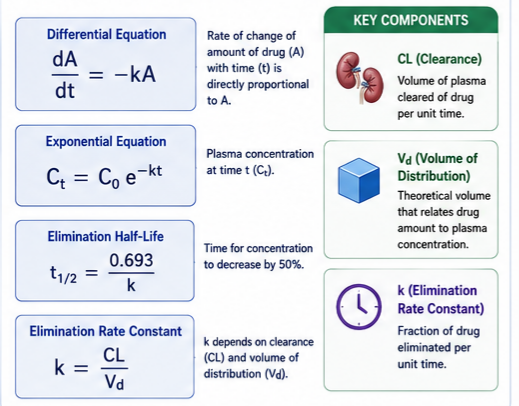
A quantitative understanding of first-order kinetics requires familiarity with a few essential equations. These equations are not merely academic exercises. They are tools that clinicians use every day, often without realizing it, to estimate dosing intervals, predict time to steady state, calculate loading doses, and interpret drug levels.
The fundamental differential equation for first-order elimination states that the rate of change of the amount of drug in the body, dA/dt, is equal to the elimination rate constant, k, multiplied by the amount of drug remaining, A, with a negative sign indicating that the amount is decreasing. In symbols, dA/dt equals negative k times A.
Integrating this equation yields the exponential decay function. The amount of drug at time t, written as A of t, equals the initial amount, A zero, multiplied by e raised to the power of negative k times t. Here, e is the base of the natural logarithm, approximately 2.718.
Dividing both sides by the volume of distribution, Vd, converts amounts to concentrations. The plasma concentration at time t, Cp of t, equals the initial concentration, Cp zero, multiplied by e to the negative k t. This is the equation that produces the characteristic exponential decay curve seen when plasma concentrations are plotted against time on a linear scale.
When the same data are plotted on a logarithmic scale, the exponential decay becomes a straight line. This is a hallmark of first-order kinetics and a useful diagnostic tool. If a semilogarithmic plot of concentration versus time yields a straight line, the drug is following first-order elimination. Deviations from linearity suggest saturation, changing clearance, or multi-compartment distribution.
The Elimination Rate Constant
The elimination rate constant, k, is the fraction of the drug in the body that is eliminated per unit of time. It is not a pure number but has dimensions of reciprocal time. If k equals 0.173 per hour, then 17.3 percent of the drug in the body is eliminated each hour.
The elimination rate constant is determined by two physiological parameters: clearance, abbreviated Cl, and volume of distribution, Vd. The relationship is k equals clearance divided by volume of distribution. A large clearance relative to the volume of distribution produces a large k and a short half-life. A small clearance relative to a large volume of distribution produces a small k and a long half-life.
Clearance is the volume of plasma from which the drug is completely removed per unit of time, expressed in units such as milliliters per minute or liters per hour. It reflects the combined efficiency of all elimination pathways. Volume of distribution is a proportionality constant relating the amount of drug in the body to the plasma concentration. It does not necessarily correspond to a real physiological volume but rather reflects the extent to which a drug distributes into tissues.
Understanding the relationship between k, clearance, and volume of distribution is essential because it explains how physiological changes alter drug half-life. Liver disease may reduce clearance, decreasing k and prolonging half-life. Obesity may increase volume of distribution for lipophilic drugs, also decreasing k and prolonging half-life. Critical illness can alter both parameters simultaneously, with complex effects on drug elimination.
Half-Life: The Clinician’s Most Practical Parameter
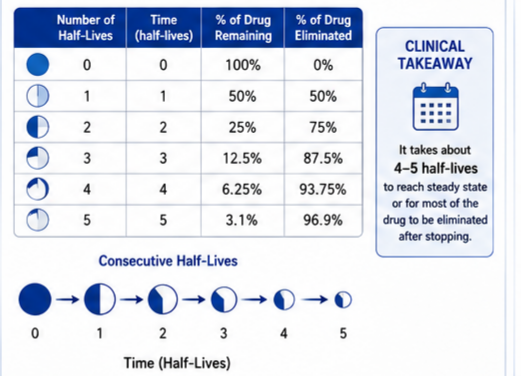 The half-life, usually denoted t with a subscript one-half, is the time required for the plasma concentration or the amount of drug in the body to decrease by 50 percent during the elimination phase. For a drug following first-order kinetics, the half-life is constant regardless of the starting concentration. Whether the initial concentration is 100 milligrams per liter or 10 milligrams per liter, the time needed for it to drop to half that value is the same.
The half-life is related to the elimination rate constant by the equation t one-half equals the natural logarithm of 2 divided by k, which is approximately 0.693 divided by k. Substituting the relationship between k, clearance, and volume of distribution gives the clinically useful formula t one-half equals 0.693 times volume of distribution divided by clearance.
This formula reveals why half-life is a hybrid parameter that depends on both drug distribution and drug elimination. A drug with a large volume of distribution, such as amiodarone, which distributes extensively into adipose tissue, will have a long half-life even if clearance is moderate. A drug with a small volume of distribution and high clearance, such as adenosine, will have an extremely short half-life measured in seconds.
The constancy of half-life in first-order kinetics has profound practical implications. It means that after one half-life, 50 percent of the drug remains. After two half-lives, 25 percent remains. After three half-lives, 12.5 percent remains. After four half-lives, 6.25 percent remains. After five half-lives, approximately 3 percent remains. For most clinical purposes, a drug is considered effectively eliminated after four to five half-lives.
This same principle applies in reverse during drug accumulation. When a patient starts a new medication at a fixed dosing interval, the drug accumulates until the rate of administration equals the rate of elimination. This steady state is reached after approximately four to five half-lives, regardless of the dose or dosing interval. This is a direct consequence of first-order kinetics and explains why drugs with long half-lives, such as fluoxetine or amiodarone, take weeks to reach their full therapeutic effect, while drugs with short half-lives, such as fentanyl or nitroglycerin, achieve steady state rapidly.
First-Order Kinetics and Dosing Principles
The clinical application of first-order kinetics extends directly to the design of dosing regimens. When a clinician prescribes a drug, the goal is usually to maintain the plasma concentration within a therapeutic window, high enough to produce the desired effect but low enough to avoid toxicity. First-order kinetics provides the tools to achieve this goal rationally.
Maintenance Dosing
Maintenance doses are designed to replace the drug that is eliminated during each dosing interval, thereby maintaining the average steady-state concentration. The average concentration at steady state, Cpss average, is given by the dosing rate divided by clearance, where the dosing rate is the dose divided by the dosing interval. This relationship derives directly from the principle that, at steady state, the rate of drug input equals the rate of drug output.
Because clearance is the parameter linking dosing rate to steady-state concentration, any factor that alters clearance will change the steady-state concentration for a given dosing regimen. A decline in renal function reduces clearance of renally eliminated drugs such as digoxin, aminoglycosides, and vancomycin, causing steady-state concentrations to rise if the dose is not adjusted. Liver disease or drug interactions that inhibit cytochrome P450 enzymes reduce clearance of hepatically metabolized drugs such as warfarin, phenytoin, and many antiretrovirals, with similar consequences.
The half-life determines how quickly a new steady state is reached, but the dose and clearance determine what that steady-state concentration will be. This distinction is important because it means that changing the dose changes the steady-state concentration without changing the time required to reach it. A higher dose produces a proportionally higher steady-state concentration, but the time to steady state, governed by the half-life, remains four to five half-lives regardless of the dose.
Loading Doses
For drugs with long half-lives, waiting four to five half-lives to achieve therapeutic concentrations may be clinically unacceptable. A patient with atrial fibrillation and a rapid ventricular response needs rate control now, not in two weeks. A patient with sepsis needs effective antibiotic concentrations immediately, not in three days. Loading doses solve this problem by rapidly filling the volume of distribution to achieve a target concentration quickly.
The loading dose is calculated by multiplying the target concentration by the volume of distribution. It does not depend on clearance or half-life because it is administered before elimination has had time to occur. After the loading dose, maintenance doses are given to replace the drug eliminated during each interval, as described above.
First-order kinetics is essential to understanding loading doses because the subsequent decline from the loading dose follows the same exponential decay curve, and the accumulation from the maintenance doses follows the same exponential approach to steady state. The loading dose effectively shifts the entire concentration-time curve upward so that therapeutic concentrations are achieved from the first dose.
Common examples of drugs for which loading doses are used include digoxin, amiodarone, phenytoin, and certain antibiotics such as vancomycin in critically ill patients. In each case, the pharmacokinetic rationale is the same: the drug’s half-life is too long relative to the clinical urgency, and the volume of distribution allows calculation of the dose needed to achieve the target concentration rapidly.
Dosing Interval Selection
The dosing interval, often denoted by the Greek letter tau, interacts with the half-life to determine the degree of fluctuation in plasma concentrations over the dosing cycle. If the dosing interval is much shorter than the half-life, concentrations will be relatively stable, with small peaks and troughs. If the dosing interval is much longer than the half-life, concentrations will fluctuate widely, potentially falling below the therapeutic threshold before the next dose.
For many drugs, the dosing interval is chosen to be approximately equal to the half-life. This provides a reasonable balance between convenience and stable concentrations. A drug with a half-life of eight hours might be dosed three times daily. A drug with a half-life of 24 hours might be dosed once daily.
Extended-release formulations exploit first-order kinetics by slowing the rate of absorption, effectively creating a prolonged input phase that smooths out the peaks and troughs. The elimination half-life remains the same, but the apparent half-life is prolonged because absorption, not elimination, becomes the rate-limiting step. This phenomenon, known as flip-flop kinetics, allows drugs with short elimination half-lives to be dosed less frequently.
First-Order Kinetics in Specific Clinical Contexts
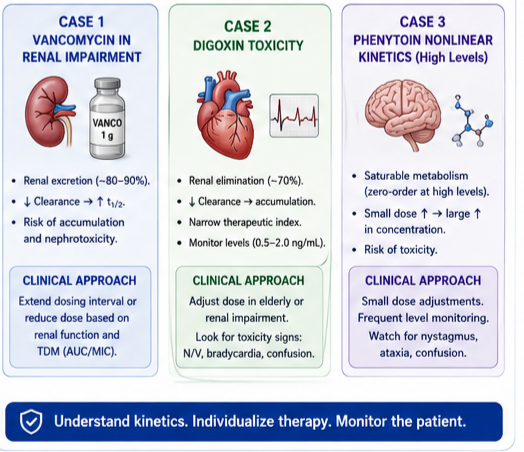
The principles of first-order elimination play out in every area of medicine, from infectious disease to cardiology to psychiatry. Understanding how these principles manifest in specific therapeutic areas strengthens clinical reasoning and improves patient care.
Antimicrobial Therapy
Antibiotic dosing relies heavily on first-order pharmacokinetics. Beta-lactams such as penicillins and cephalosporins are primarily eliminated by renal excretion, and their half-lives are typically short, often one to two hours in patients with normal renal function. This is why these drugs are usually dosed multiple times per day, and why extended or continuous infusions are sometimes used for critically ill patients to maximize the time the concentration exceeds the minimum inhibitory concentration, a pharmacodynamic parameter known as time-dependent killing.
Aminoglycosides such as gentamicin and tobramycin also follow first-order elimination and are cleared by the kidneys. Their half-lives are approximately two to three hours in patients with normal renal function. Because aminoglycosides exhibit concentration-dependent killing, with efficacy related to the peak concentration relative to the minimum inhibitory concentration, and because their toxicity, both nephrotoxicity and ototoxicity, is related to trough concentrations, the dosing strategy historically involved high doses at extended intervals. The extended interval allows the concentration to fall below toxic thresholds before the next dose, a strategy that depends entirely on first-order elimination principles.
Vancomycin elimination is primarily renal and follows first-order kinetics. The half-life of vancomycin ranges from approximately six to twelve hours in adults with normal renal function but can extend to days in patients with end-stage renal disease. Therapeutic drug monitoring of vancomycin uses the principles of first-order kinetics to estimate the area under the concentration-time curve, which is the pharmacodynamic parameter most closely associated with efficacy against methicillin-resistant Staphylococcus aureus.
In each of these cases, renal function is a primary determinant of clearance and therefore of half-life and dosing requirements. When creatinine clearance falls, the elimination rate constant decreases proportionally, the half-life increases, and dose adjustments become necessary to avoid accumulation and toxicity.
Cardiovascular Drugs
Digoxin, the drug from our opening clinical scenario, is a classic example of a cardiovascular agent whose clinical use is intimately tied to first-order kinetics. Digoxin has a volume of distribution of approximately 7 liters per kilogram, reflecting extensive tissue binding, particularly to skeletal muscle and the myocardium. Its clearance is primarily renal, with a clearance roughly equal to creatinine clearance. In patients with normal renal function, the half-life is approximately 36 to 48 hours. In anuric patients, the half-life can extend to five days or longer.
The long half-life of digoxin means that steady state is not reached for about a week in patients with normal renal function and longer in those with renal impairment. This has implications for both initiating therapy and adjusting doses. Loading doses are often used when rapid digitalization is required, as in rate control for atrial fibrillation. When renal function declines, the dose must be reduced, but the effect of the dose reduction on steady-state concentrations will not be fully realized for several half-lives, meaning that a digoxin level checked too soon after a dose adjustment may be misleading.
Amiodarone presents an extreme example of first-order kinetics with a very large volume of distribution and a correspondingly long half-life. Amiodarone is highly lipophilic and distributes extensively into adipose tissue, liver, lung, and other organs. Its volume of distribution is approximately 60 liters per kilogram, and its clearance is low. The resulting half-life averages 25 to 110 days, with some estimates ranging even higher. This extraordinarily long half-life means that loading doses are always required, typically involving a cumulative loading regimen over one to two weeks, and that after discontinuation, pharmacological effects and adverse effects can persist for months.
Antiepileptic Drugs
Phenytoin is one of the most important drugs for understanding the clinical relevance of elimination kinetics because it is one of the few drugs that commonly exhibits saturation of its elimination pathways at therapeutic concentrations, causing a shift from first-order to zero-order kinetics. This will be discussed in detail in the section on nonlinear kinetics, but it serves as a reminder that first-order kinetics is not universal and that awareness of exceptions is critical for safe prescribing.
Other antiepileptic drugs, including levetiracetam, lamotrigine, and valproic acid, generally follow first-order kinetics at therapeutic doses. Levetiracetam is primarily renally eliminated and has a half-life of approximately six to eight hours in adults with normal renal function. Lamotrigine is metabolized by glucuronidation, and its half-life is approximately 24 to 35 hours but is significantly shortened by enzyme-inducing drugs such as phenytoin and carbamazepine and prolonged by valproic acid, which inhibits glucuronidation. These drug interactions alter the elimination rate constant and therefore the half-life, requiring dose adjustments that are predictable from first-order principles.
Psychiatric Medications
Many psychiatric drugs have long half-lives, with important clinical consequences. Fluoxetine, a selective serotonin reuptake inhibitor, has a half-life of approximately four to six days, and its active metabolite norfluoxetine has a half-life of approximately four to sixteen days. The long half-life means that steady state is not reached for several weeks, and after discontinuation, the drug and its active metabolite persist in the body for more than a month. This can be advantageous in terms of minimizing withdrawal symptoms but complicates switching between antidepressants because lingering drug effects and drug interactions can occur long after the medication is stopped.
Lithium is eliminated almost entirely by the kidneys and follows first-order kinetics. Its half-life is approximately 18 to 24 hours in patients with normal renal function. Lithium has a narrow therapeutic index, and therapeutic drug monitoring is used routinely to maintain concentrations within the range of 0.6 to 1.2 milliequivalents per liter. Because lithium clearance is closely related to renal function and sodium balance, factors that alter renal lithium handling, including dehydration, diuretic use, and nonsteroidal anti-inflammatory drugs, can reduce clearance, increase half-life, and precipitate toxicity.
Zero-Order Kinetics: The Contrast That Illuminates First-Order
To fully understand first-order kinetics, it is helpful to contrast it with zero-order kinetics, the other primary elimination pattern. In zero-order kinetics, the rate of elimination is constant and independent of the plasma concentration. A fixed amount of drug is removed per unit of time, regardless of how much drug is present.
Zero-order kinetics occurs when the elimination pathways become saturated. This happens when drug concentrations approach or exceed the Km of the metabolizing enzymes or the transport maximum of renal or biliary transporters. Under these conditions, the enzymes or transporters are working at their maximum capacity, Vmax, and cannot increase their activity in response to higher concentrations. The elimination rate plateaus at Vmax and becomes constant.
The classic example of zero-order elimination is ethanol. Alcohol dehydrogenase, the enzyme primarily responsible for ethanol metabolism, has a low Km and is saturated at blood alcohol concentrations well within the range achieved by social drinking. The Vmax for ethanol metabolism in an average adult is approximately 10 grams per hour, equivalent to about one standard drink. Drinking more than this does not significantly increase the rate of elimination. Instead, the excess ethanol accumulates, and the blood alcohol concentration rises linearly until metabolism catches up. This is why drinking coffee, taking a cold shower, or engaging in other purported sobering strategies does not accelerate ethanol clearance. The enzyme is already working as fast as it can.
In pharmacokinetic terms, ethanol elimination follows zero-order kinetics, with a constant elimination rate of approximately 10 to 15 milligrams per deciliter per hour in most individuals, corresponding to a decrease in blood alcohol concentration of about 0.015 grams per deciliter per hour. There is no true half-life for ethanol because the elimination rate does not depend on the concentration. Instead, the time to eliminate a given amount depends linearly on the dose.
Several clinically important drugs can exhibit saturation kinetics at high therapeutic concentrations or in overdose. Phenytoin is the most prominent example. The hepatic enzymes that hydroxylate phenytoin, primarily CYP2C9 and to a lesser extent CYP2C19, have Km values that are within or near the therapeutic range of 10 to 20 milligrams per liter. At low concentrations, phenytoin elimination approximates first-order kinetics. As the concentration rises, the enzymes become increasingly saturated, and the elimination shifts toward zero-order. This means that small increases in the daily dose can produce disproportionately large increases in the steady-state concentration, and plasma concentrations can become unpredictable.
Salicylates, at high doses used for inflammatory conditions or in overdose, also exhibit saturation kinetics. The glycine conjugation and glucuronidation pathways that metabolize salicylic acid become saturated, and the elimination half-life, which is approximately two to four hours at low analgesic doses, can extend to 15 to 30 hours at high anti-inflammatory doses. This is why chronic high-dose aspirin therapy requires careful monitoring and why salicylate toxicity can be prolonged and difficult to manage.
Theophylline, once widely used for asthma and chronic obstructive pulmonary disease, is metabolized by CYP1A2 and can exhibit saturable elimination in some patients, particularly at higher concentrations. This contributed to the narrow therapeutic index of theophylline and the need for therapeutic drug monitoring.
The key clinical lesson from these examples is that drugs with saturable elimination are inherently less predictable than drugs that follow strict first-order kinetics. Dose adjustments produce nonlinear changes in concentration, and toxicity can develop with small dose increases. Recognizing which drugs are capable of saturable elimination helps clinicians anticipate and prevent problems.
Mixed-Order and Nonlinear Kinetics
The transition from first-order to zero-order kinetics is not always abrupt. Many drugs exhibit mixed-order kinetics, also called nonlinear or dose-dependent kinetics, over parts of their therapeutic range. This behavior is described mathematically by the Michaelis-Menten equation.
At low concentrations, far below Km, the drug behaves as though it follows first-order kinetics. The elimination rate is proportional to concentration, and the half-life is constant. As the concentration approaches Km, the elimination rate continues to increase with concentration, but less than proportionally. The apparent half-life begins to lengthen. At concentrations well above Km, the elimination rate plateaus at Vmax, and the drug exhibits zero-order behavior.
Phenytoin is the prototypical example. The Km for phenytoin hydroxylation is approximately 4 to 8 milligrams per liter in most patients, while the therapeutic range is 10 to 20 milligrams per liter. This means that therapeutic concentrations are above the Km, and the enzymes are partially saturated even at low therapeutic levels. The Vmax varies among individuals due to genetic polymorphisms in CYP2C9 and other factors.
The clinical consequence is that the relationship between phenytoin dose and steady-state concentration is not linear. Doubling the dose can more than double the concentration. A patient whose concentration is 8 milligrams per liter on 300 milligrams per day might see the concentration rise to 20 or 25 milligrams per liter on 400 milligrams per day, not the roughly 10.7 milligrams per liter that would be predicted by linear extrapolation.
Managing phenytoin therapy therefore requires a different approach than managing a drug with linear kinetics. Instead of adjusting the dose proportionally to the desired concentration change, clinicians use nomograms, Bayesian estimation, or direct measurement of Vmax and Km in individual patients. The goal is to find a dose that produces a therapeutic concentration without entering the steep portion of the dose-response curve where small dose increases cause large concentration jumps.
Other drugs that can exhibit nonlinear kinetics under certain conditions include voriconazole, which is metabolized by CYP2C19 and exhibits saturable metabolism, particularly in poor metabolizers, and high-dose methotrexate, where renal clearance mechanisms can become saturated.
Factors That Alter First-Order Elimination in Clinical Practice
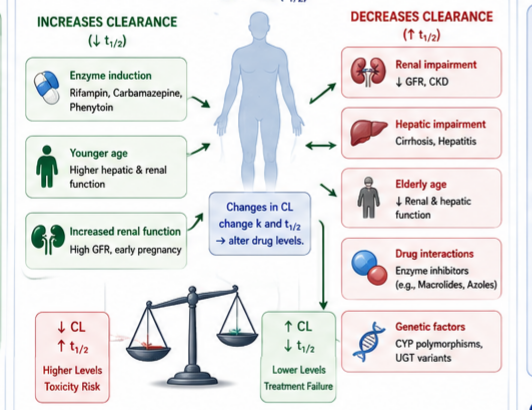 The elimination rate constant, k, and therefore the half-life, are not fixed properties of a drug. They vary from patient to patient and within the same patient over time, depending on physiological state, organ function, concomitant medications, and other factors. Understanding these sources of variability is essential for individualizing drug therapy.
Renal Function
Renal drug clearance occurs through three mechanisms: glomerular filtration, tubular secretion, and tubular reabsorption. Glomerular filtration rate, or GFR, declines with age, with certain diseases such as chronic kidney disease and diabetes, and with acute kidney injury. Drugs that are primarily eliminated by glomerular filtration, such as digoxin, aminoglycosides, vancomycin, and many beta-lactam antibiotics, will have reduced clearance and prolonged half-life when GFR falls.
Tubular secretion is an active process mediated by transporters such as organic anion transporters and organic cation transporters. These transporters can be inhibited by competing drugs, reducing clearance. For example, probenecid inhibits the tubular secretion of penicillins, a interaction that was historically exploited to prolong penicillin half-life when the drug was scarce and expensive.
Tubular reabsorption is influenced by urine pH and flow rate. Weak bases are reabsorbed more extensively in alkaline urine, while weak acids are reabsorbed more in acidic urine. Manipulating urine pH is sometimes used therapeutically to enhance elimination of drugs in overdose. Urinary alkalinization with intravenous sodium bicarbonate enhances the elimination of salicylates and phenobarbital by ion trapping, reducing reabsorption.
Clinicians estimate renal function using serum creatinine and equations such as the Cockcroft-Gault formula or the Modification of Diet in Renal Disease equation to calculate estimated creatinine clearance or estimated GFR. These estimates are then used to adjust doses of renally eliminated drugs. Many drug references provide specific dosing recommendations for different ranges of renal function.
Hepatic Function
Hepatic drug clearance depends on liver blood flow, the intrinsic ability of hepatocytes to metabolize the drug, and the extent of protein binding. The relationship among these factors is described by the well-stirred model of hepatic clearance, which states that hepatic clearance equals liver blood flow times the intrinsic clearance divided by the sum of liver blood flow and intrinsic clearance, with a correction for the fraction of drug unbound in plasma.
For drugs with high intrinsic clearance, such as lidocaine, propranolol, and morphine, hepatic clearance is limited primarily by liver blood flow. These are called flow-limited drugs. Changes in liver blood flow, as occur in heart failure, cirrhosis with portosystemic shunting, or shock, will significantly alter their clearance. Their half-lives will change correspondingly.
For drugs with low intrinsic clearance, such as warfarin, phenytoin, and theophylline, hepatic clearance is limited by the metabolic capacity of the liver. These are called capacity-limited drugs. Their clearance is sensitive to changes in enzyme activity due to liver disease, genetic polymorphisms, or drug interactions, but is relatively insensitive to changes in liver blood flow.
Liver disease can reduce hepatic clearance through several mechanisms. Hepatocyte loss reduces the total amount of enzyme available. Portosystemic shunting reduces the delivery of drug to functional hepatocytes. Reduced synthesis of albumin increases the free fraction of highly protein-bound drugs, making more drug available for metabolism and offsetting some of the reduction in intrinsic clearance. The net effect on half-life varies depending on whether volume of distribution also changes, as it often does in patients with cirrhosis and ascites.
Unfortunately, there is no single laboratory test that accurately predicts hepatic drug clearance in the way that creatinine clearance predicts renal drug clearance. Liver function tests such as transaminases reflect hepatocellular injury rather than metabolic capacity. The Child-Pugh score and the Model for End-Stage Liver Disease score provide some guidance, but dose adjustment in liver disease remains challenging and often relies on therapeutic drug monitoring.
Age
Age affects both volume of distribution and clearance, with predictable consequences for half-life. Neonates have immature hepatic enzyme systems and reduced renal function, resulting in lower clearance and longer half-lives for many drugs compared with older children and adults. The half-life of caffeine, for example, is approximately 80 hours in neonates compared with 3 to 5 hours in adults. The half-life of gentamicin is prolonged in neonates, necessitating longer dosing intervals.
At the other extreme of life, elderly patients experience a progressive decline in renal function, even in the absence of overt renal disease. GFR declines by approximately 1 milliliter per minute per 1.73 square meters per year after age 40 on average, although there is substantial individual variability. Hepatic mass and blood flow also decline with age, though metabolic capacity is more variable. Changes in body composition, including reduced lean body mass and increased adipose tissue, alter volumes of distribution.
The practical consequence is that elderly patients often require lower doses and longer dosing intervals than younger adults. Drugs that are renally eliminated, have narrow therapeutic indices, or have active metabolites that accumulate in renal impairment require particular attention.
Drug Interactions
Drug interactions that alter elimination kinetics are among the most clinically significant. Enzyme inhibition reduces clearance, increasing half-life and steady-state concentrations. Enzyme induction increases clearance, decreasing half-life and steady-state concentrations. Transporter inhibition can similarly reduce clearance by blocking renal or biliary secretion.
Cytochrome P450 enzymes are the most common sites of metabolic drug interactions. CYP3A4 inhibitors such as ketoconazole, clarithromycin, and ritonavir can substantially increase exposure to CYP3A4 substrates such as midazolam, simvastatin, and many kinase inhibitors. CYP2D6 inhibitors such as fluoxetine and paroxetine can convert extensive metabolizers into phenotypic poor metabolizers, increasing concentrations of CYP2D6 substrates such as tamoxifen, which requires CYP2D6 for conversion to its active metabolite endoxifen.
Enzyme induction occurs over days to weeks as new enzyme protein is synthesized. Rifampicin is a potent inducer of CYP3A4, CYP2C9, CYP2C19, and other enzymes and transporters. It can reduce the half-lives and steady-state concentrations of oral contraceptives, warfarin, antiretrovirals, and immunosuppressants to the point of therapeutic failure. St John’s wort, a widely used herbal supplement, induces CYP3A4 and P-glycoprotein and has been implicated in transplant rejection due to reduced cyclosporine concentrations and unintended pregnancies due to reduced oral contraceptive efficacy.
Drug interactions are predictable from pharmacokinetic principles. If an interaction alters clearance, the effect on half-life and steady-state concentration follows first-order kinetics. The new steady state will be reached after four to five half-lives of the inhibited or induced drug, which may be days or weeks.
Genetic Polymorphisms
Pharmacogenetics has revealed that genetic variation in drug-metabolizing enzymes and transporters contributes to interindividual variability in drug elimination. The most studied polymorphisms are in the cytochrome P450 enzymes, N-acetyltransferase, thiopurine methyltransferase, and UDP-glucuronosyltransferase.
CYP2D6 is highly polymorphic, with alleles that result in absent, reduced, normal, or increased enzyme activity. Approximately 7 to 10 percent of Caucasians are poor metabolizers with two nonfunctional alleles, while a smaller percentage are ultrarapid metabolizers with gene duplications. Codeine is a prodrug that requires CYP2D6 for conversion to morphine. Poor metabolizers derive little analgesic benefit from codeine, while ultrarapid metabolizers may develop opioid toxicity from standard doses.
CYP2C19 polymorphisms affect the metabolism of proton pump inhibitors, clopidogrel, and voriconazole. Clopidogrel is a prodrug that requires CYP2C19 for activation. Patients with loss-of-function CYP2C19 alleles have reduced active metabolite formation, less platelet inhibition, and a higher risk of cardiovascular events after percutaneous coronary intervention.
Thiopurine methyltransferase metabolizes azathioprine and mercaptopurine. Patients with low or absent TPMT activity are at high risk of severe myelosuppression from standard doses because more of the drug is shunted toward the formation of cytotoxic thioguanine nucleotides. TPMT testing before initiating thiopurine therapy is recommended to guide dose selection.
These genetic polymorphisms alter the elimination rate constant and half-life of the affected drugs or their active metabolites. Knowing a patient’s genotype can help predict the appropriate dose, but therapeutic drug monitoring remains important when available.
Disease States
Beyond liver and kidney disease, other conditions can alter drug elimination. Heart failure reduces cardiac output and hepatic blood flow, decreasing clearance of flow-limited drugs. It can also reduce renal perfusion, adding a renal component to altered elimination. The volume of distribution may increase due to edema and ascites, further prolonging half-life.
Critical illness produces complex changes in pharmacokinetics. The systemic inflammatory response can alter drug-metabolizing enzyme expression, protein binding, and organ blood flow. Augmented renal clearance, defined as a creatinine clearance greater than 130 milliliters per minute per 1.73 square meters, occurs in some critically ill patients, particularly younger trauma patients, and can result in subtherapeutic concentrations of renally eliminated antibiotics when standard doses are used.
Thyroid disease affects metabolic rate and can alter drug elimination. Hyperthyroidism increases the clearance of some drugs, while hypothyroidism decreases it. The mechanism involves changes in hepatic enzyme activity and renal function secondary to altered cardiac output and blood flow.
Therapeutic Drug Monitoring and First-Order Kinetics
Therapeutic drug monitoring, or TDM, is the clinical practice of measuring drug concentrations in plasma to guide dosing. TDM is indicated for drugs with a narrow therapeutic index, a well-defined relationship between concentration and effect, significant interindividual pharmacokinetic variability, and for which the clinical effect is not easily measured directly.
Commonly monitored drugs include digoxin, aminoglycosides, vancomycin, phenytoin, lithium, cyclosporine, tacrolimus, and certain antiepileptics. For each of these drugs, first-order kinetics provides the framework for interpreting concentrations and adjusting doses.
When a drug follows first-order kinetics, the relationship between dose and steady-state concentration is linear. If a patient has a trough vancomycin concentration of 10 milligrams per liter on a dose of 1000 milligrams every 12 hours, and the target trough is 15 milligrams per liter, the dose can be increased proportionally to 1500 milligrams every 12 hours. This proportionality holds because clearance, and therefore the relationship between dosing rate and concentration, is constant.
The timing of sample collection is critical for accurate TDM. Trough concentrations are drawn just before the next dose, when the concentration is at its lowest. Peak concentrations are drawn after the distribution phase is complete, typically 30 to 60 minutes after an intravenous infusion ends. Interpreting a drug level requires knowing the sampling time relative to the dose, the dosing history, and the half-life.
For drugs with nonlinear kinetics such as phenytoin, TDM is even more important because the dose-concentration relationship is not proportional. Small dose changes can produce large concentration changes, and TDM allows empiric dose adjustment based on measured concentrations.
Bayesian pharmacokinetic software uses population pharmacokinetic models combined with individual patient data, including measured drug concentrations, to estimate that patient’s pharmacokinetic parameters and predict the concentration-time profile for any dosing regimen. This approach is increasingly used for vancomycin and aminoglycoside dosing in hospitals and represents a practical application of first-order pharmacokinetic principles.
Special Populations and First-Order Kinetics
Pregnancy
Pregnancy produces substantial changes in maternal physiology that alter drug disposition. Plasma volume expands, increasing the volume of distribution for hydrophilic drugs. Cardiac output and renal blood flow increase, raising GFR and enhancing renal drug clearance. Hepatic enzyme activity changes, with CYP3A4, CYP2D6, and CYP2C9 activity generally increasing, while CYP1A2 activity decreases. Serum albumin concentration falls, increasing the free fraction of highly protein-bound drugs.
The net effect is that clearance of many drugs is increased during pregnancy, shortening half-life and reducing steady-state concentrations at a given dose. This has been documented for lamotrigine, where clearance increases progressively during pregnancy, and doses often need to be increased to maintain seizure control. After delivery, clearance returns to baseline over several weeks, and doses must be reduced to avoid toxicity.
Obesity
Obesity alters both volume of distribution and clearance. For lipophilic drugs, volume of distribution may increase substantially, leading to a longer half-life even if clearance is unchanged. For hydrophilic drugs, volume of distribution may be relatively unchanged in proportion to total body weight but increased relative to ideal body weight. Clearance may increase due to larger organ mass and higher GFR, partially offsetting the effect of increased volume of distribution.
Selecting the appropriate weight metric for dosing in obesity is a common clinical challenge. For some drugs, such as aminoglycosides, adjusted body weight is used. For others, ideal body weight or total body weight is preferred. The choice depends on the drug’s physicochemical properties and the available evidence.
Renal Replacement Therapy
Patients receiving hemodialysis, peritoneal dialysis, or continuous renal replacement therapy present unique pharmacokinetic challenges. These modalities remove drug from the body, supplementing or replacing endogenous clearance. The extent of drug removal depends on the drug’s molecular weight, protein binding, volume of distribution, and the characteristics of the dialysis procedure.
During hemodialysis, small, water-soluble, minimally protein-bound drugs are efficiently removed. The half-life of such drugs is shortened during dialysis, and concentrations can fall below the therapeutic range if supplemental doses are not given. Drugs with large volumes of distribution are poorly removed because only a small fraction of the total body drug burden is in the plasma at any time.
Understanding first-order kinetics is essential for managing drug therapy in dialysis patients. The elimination rate constant during dialysis is the sum of the endogenous elimination rate constant, which is typically low in patients with end-stage renal disease, and the dialytic elimination rate constant, which depends on the dialyzer and blood flow rate. Post-dialysis supplementation doses are calculated to replace the drug removed during the procedure.
Common Drugs That Follow First-Order Kinetics: Clinical Examples
To consolidate these concepts, it is useful to examine a range of commonly prescribed drugs and consider how first-order kinetics applies to their clinical use.
Acetaminophen
Acetaminophen is metabolized primarily by glucuronidation and sulfation, with a minor fraction oxidized by CYP2E1 to the toxic metabolite N-acetyl-p-benzoquinone imine, which is then conjugated with glutathione. At therapeutic doses, acetaminophen elimination follows first-order kinetics with a half-life of approximately two to four hours. In overdose, the sulfation and glucuronidation pathways become saturated, and a larger fraction is shunted to CYP2E1, depleting glutathione and causing hepatotoxicity. The half-life prolongs in overdose, and a prolonged half-life beyond four hours is a marker of hepatic injury.
Warfarin
Warfarin is a racemic mixture of R-warfarin and S-warfarin, with S-warfarin being approximately three to five times more potent. S-warfarin is metabolized primarily by CYP2C9, while R-warfarin is metabolized by multiple CYP enzymes. Both enantiomers follow first-order elimination, but their half-lives differ significantly. S-warfarin has a half-life of approximately 24 to 33 hours, while R-warfarin has a half-life of approximately 37 to 89 hours. CYP2C9 genetic polymorphisms and drug interactions that inhibit CYP2C9 reduce S-warfarin clearance and prolong its half-life, increasing the anticoagulant effect and bleeding risk.
Metformin
Metformin is eliminated unchanged by the kidneys through glomerular filtration and tubular secretion via organic cation transporters. It follows first-order kinetics, and its half-life is approximately 6 hours in patients with normal renal function. Because metformin accumulates in renal impairment, it is contraindicated when the estimated GFR falls below 30 milliliters per minute per 1.73 square meters, and the dose should be reduced when GFR falls below 45, due to the risk of lactic acidosis.
Amoxicillin
Amoxicillin is a beta-lactam antibiotic that is primarily eliminated by renal tubular secretion and glomerular filtration. Its half-life is approximately 60 to 90 minutes in adults with normal renal function, which is why it is typically dosed every 8 to 12 hours. In severe renal impairment, the half-life can extend to 7 to 20 hours, and the dosing interval must be prolonged. The short half-life in normal renal function illustrates why time-dependent antibiotics benefit from frequent dosing or extended infusions.
Morphine
Morphine is metabolized primarily by glucuronidation to morphine-3-glucuronide and morphine-6-glucuronide, the latter of which is pharmacologically active and more potent than the parent drug. Morphine itself has a half-life of approximately two to four hours and follows first-order elimination. However, the active metabolite morphine-6-glucuronide accumulates in renal impairment, and its prolonged half-life can lead to opioid toxicity even after morphine administration has stopped. This is a critical example of why drug metabolites must be considered alongside the parent drug.
Caffeine
Caffeine is metabolized primarily by CYP1A2 to paraxanthine, theobromine, and theophylline. In adults, caffeine elimination follows first-order kinetics with a half-life of approximately three to five hours. However, the half-life is dramatically prolonged in neonates, who have immature CYP1A2 activity, to approximately 80 hours. This prolonged half-life means that caffeine administered to preterm infants for apnea of prematurity can be given as a single daily dose, and a loading dose is used to achieve therapeutic concentrations quickly.
Question . What is first-order kinetics in simple terms?
Question . Why is half-life constant in first-order kinetics?
Question . How is first-order kinetics different from zero-order kinetics?
Question . Do all drugs follow first-order kinetics?
Question . Why does it take four to five half-lives to reach steady state?
Question . How does renal impairment affect first-order elimination?
Question . What is the difference between clearance and half-life?
Question . Can protein binding affect first-order elimination?
Historical Context and Development of Pharmacokinetics
The understanding of first-order kinetics in pharmacology did not emerge fully formed. It developed over decades through the convergence of clinical observation, mathematical modeling, and advances in analytical chemistry that allowed drug concentrations to be measured in biological fluids.
The term pharmacokinetics was coined in the 1950s, but the mathematical foundations were laid earlier. In 1913, Michaelis and Menten published their classic paper on enzyme kinetics, introducing the equation that now bears their names. In 1924, Widmark described the kinetics of ethanol elimination, recognizing that ethanol did not follow the expected exponential decline. This was an early recognition that some drugs, or at least ethanol, which was one of the first substances studied kinetically, could exhibit saturation.
The development of compartmental models in the 1930s and 1940s provided a mathematical framework for describing drug distribution and elimination. Teorell, a Swedish physiologist, published a series of papers in 1937 that outlined many of the concepts still used today, including volume of distribution and clearance.
The real explosion in pharmacokinetics came in the 1960s and 1970s, driven by several forces. Analytical techniques such as gas chromatography and high-performance liquid chromatography allowed sensitive and specific measurement of drug concentrations. The recognition that therapeutic failures and toxicities could often be explained by pharmacokinetic variability spurred interest in therapeutic drug monitoring. The thalidomide disaster and subsequent drug regulation increased the demand for rigorous pharmacokinetic and toxicological studies before drug approval.
Gerhard Levy, often called the father of clinical pharmacokinetics, made seminal contributions to the understanding of drug absorption, distribution, and elimination. His work on the pharmacokinetics of salicylates elucidated the saturation of elimination pathways and the clinical consequences of nonlinear kinetics. The development of digoxin radioimmunoassay by Smith, Butler, and Haber in 1969 enabled routine measurement of digoxin concentrations and transformed the management of heart failure and atrial fibrillation.
Today, pharmacokinetics is an integral part of drug development, regulatory science, and clinical practice. Population pharmacokinetic modeling, physiologically based pharmacokinetic modeling, and pharmacogenetics have added new layers of sophistication. Yet the fundamental principles, including first-order elimination kinetics, remain as relevant as ever.
Common Misconceptions About First-Order Kinetics
Medical students and trainees often develop misconceptions about first-order kinetics that can lead to clinical errors if not corrected. Addressing these explicitly can strengthen understanding.
Misconception 1: A constant fraction means the same amount is eliminated each half-life.
This is incorrect. A constant fraction of the remaining drug is eliminated, but because the remaining amount decreases, the absolute amount eliminated also decreases. During the first half-life, 500 milligrams of a 1000-milligram dose might be eliminated. During the second half-life, 250 milligrams are eliminated. During the third, 125 milligrams. The fraction, 50 percent, is constant. The absolute amount is not.
Misconception 2: Half-life determines how long a drug works.
Half-life is one factor determining duration of action, but it is not the only one. Some drugs have effects that persist long after the drug is eliminated from plasma, either because of irreversible receptor binding, such as aspirin’s effect on platelets, or because of downstream physiological changes, such as proton pump inhibitors suppressing acid secretion for days despite a half-life of about one hour. Conversely, some drugs with long half-lives may have effects that wear off before the drug is eliminated if tolerance develops.
Misconception 3: Steady state means the concentration is constant throughout the dosing interval.
Steady state means that the average concentration over the dosing interval is constant and that the peak and trough concentrations repeat identically from one interval to the next. The concentration still fluctuates within each interval, rising during absorption and falling during elimination, unless the drug is given as a continuous infusion.
Misconception 4: If a drug follows first-order kinetics, doubling the dose doubles the concentration at all times.
This is true for the steady-state average concentration but may not hold at specific time points if the drug exhibits multi-compartment distribution or if absorption is saturable. The linearity of first-order kinetics applies to elimination, but distribution and absorption can introduce nonlinearities.
Misconception 5: Drugs with long half-lives are always dosed less frequently.
Dosing frequency is determined by both half-life and the width of the therapeutic window. A drug with a long half-life may still be dosed frequently if the therapeutic window is narrow and fluctuations must be minimized. Conversely, a drug with a short half-life can be dosed infrequently if it is formulated as an extended-release product or if the pharmacodynamic effect persists.
Clinical Case Studies Illustrating First-Order Kinetics
Case Study 1: Vancomycin Dosing in a Patient with Fluctuating Renal Function
A 65-year-old man is admitted to the intensive care unit with septic shock secondary to methicillin-resistant Staphylococcus aureus bacteremia. He is started on vancomycin with a loading dose of 25 milligrams per kilogram, followed by a maintenance dose of 15 milligrams per kilogram every 12 hours, based on his estimated creatinine clearance of 90 milliliters per minute. On day three, his creatinine clearance has fallen to 40 milliliters per minute due to acute kidney injury from sepsis. His vancomycin trough concentration, which was 14 milligrams per liter on day two, is now 22 milligrams per liter.
What happened? The decline in renal function reduced vancomycin clearance, decreasing the elimination rate constant and prolonging the half-life. The patient continued to receive the same doses, but his body was eliminating a smaller fraction per hour. The drug accumulated, and the trough concentration rose. The time to reach the new, higher steady state will be determined by the new, longer half-life. The dose interval must be extended or the dose reduced to bring the trough back into the target range. The clinician uses Bayesian software to estimate the patient’s current pharmacokinetic parameters and recommends a new dose of 15 milligrams per kilogram every 24 hours. A trough level in two days will confirm whether the new regimen is appropriate.
This case illustrates how first-order elimination constants change with renal function and how therapeutic drug monitoring guides dose adjustment.
Case Study 2: Phenytoin Toxicity After a Small Dose Increase
A 34-year-old woman with focal epilepsy has been stable on phenytoin 300 milligrams daily, with a steady-state concentration of 14 milligrams per liter. She has a breakthrough seizure, and her neurologist increases the dose to 400 milligrams daily. Three weeks later, she complains of nystagmus, ataxia, and drowsiness. Her phenytoin concentration is now 28 milligrams per liter.
Why did a 33 percent increase in dose produce a 100 percent increase in concentration? The answer lies in the saturation kinetics of phenytoin. At 14 milligrams per liter, her enzymes were already partially saturated. The incremental 100-milligram dose could not be metabolized as efficiently as the first 300 milligrams, and the steady-state concentration climbed disproportionately. The clinician reduces the dose to 350 milligrams daily and checks a level in two weeks, which returns at 18 milligrams per liter, within the therapeutic range.
This case demonstrates the danger of treating drugs with nonlinear kinetics as though they were linear. First-order principles do not apply, and dose adjustments must be made cautiously, ideally with pharmacokinetic consultation.
Case Study 3: Digoxin Toxicity in Renal Impairment
This case returns to the scenario that opened the article. A 72-year-old woman with heart failure and atrial fibrillation has been taking digoxin 0.125 milligrams daily for two years, with concentrations consistently in the therapeutic range. Over the past four months, her renal function has declined, and her serum creatinine has risen from 0.9 to 1.8 milligrams per deciliter. Her estimated creatinine clearance is now approximately 35 milliliters per minute, compared with 70 milliliters per minute previously. She presents with nausea, confusion, and bradycardia. Her digoxin concentration is 3.8 nanograms per milliliter.
Digoxin clearance is proportional to creatinine clearance. When her creatinine clearance halved, so did her digoxin clearance. The elimination rate constant was reduced by half, and the half-life doubled. On the same daily dose, her steady-state concentration approximately doubled, from a presumed therapeutic level around 1.5 nanograms per milliliter to the toxic level measured. The clinician holds digoxin, monitors her electrocardiogram, and calculates that her half-life in the current state is approximately 80 to 100 hours. It will take several days for her concentration to fall into the therapeutic range. When it does, the clinician will restart digoxin at a reduced dose of 0.125 milligrams every other day, adjusted for her current renal function.
Integration of First-Order Kinetics with Other Pharmacokinetic Concepts
First-order kinetics does not exist in isolation. It is intimately connected with other pharmacokinetic principles, including absorption, distribution, metabolism, excretion, bioavailability, and pharmacodynamics.
Absorption and First-Order Kinetics
Drug absorption is also often a first-order process. When a drug is administered orally, the rate of absorption is proportional to the amount of drug remaining at the absorption site. The absorption half-life describes how quickly the drug enters the systemic circulation. In most cases, absorption is faster than elimination, so the elimination half-life is the primary determinant of dosing frequency. However, when absorption is slower than elimination, as with extended-release formulations or subcutaneous depot injections, absorption becomes the rate-limiting step, and the apparent half-life reflects absorption rather than elimination. This phenomenon, known as flip-flop kinetics, allows drugs with short elimination half-lives to be administered less frequently.
Distribution and Multi-Compartment Models
The simple one-compartment model with first-order elimination is a useful approximation, but many drugs are better described by multi-compartment models. After intravenous administration, there is often a rapid initial decline in plasma concentration, called the distribution phase, followed by a slower terminal elimination phase. The distribution phase reflects equilibration of the drug between the central compartment, which includes plasma and highly perfused tissues, and peripheral compartments, such as muscle and fat.
During the terminal elimination phase, the drug concentration declines with first-order kinetics, and the terminal half-life is the parameter used for clinical decision-making. However, if a drug level is drawn during the distribution phase, it will not reflect the terminal half-life accurately, and extrapolating from it will lead to errors in dose adjustment.
Metabolism and Clearance Concepts
First-order elimination kinetics is the macroscopic manifestation of the underlying enzymatic processes. Clearance, which determines the elimination rate constant, is the sum of metabolic clearance and renal clearance. Metabolic clearance depends on the intrinsic activity of drug-metabolizing enzymes and the delivery of the drug to those enzymes. Renal clearance depends on glomerular filtration, tubular secretion, and tubular reabsorption.
The concept of extraction ratio is useful here. Drugs with a high hepatic extraction ratio, greater than 0.7, are efficiently removed from the blood as it passes through the liver. Their clearance is limited by liver blood flow. Drugs with a low extraction ratio, less than 0.3, are poorly extracted, and their clearance is limited by the metabolic capacity of the liver and the extent of protein binding.
These concepts help predict which drugs will be most affected by changes in liver blood flow, such as in heart failure or cirrhosis, and which will be most affected by changes in enzyme activity, such as with drug interactions or genetic polymorphisms.
Pharmacodynamics and the Concentration-Effect Relationship
First-order kinetics explains how drug concentrations change over time, but the clinical importance of those changes depends on pharmacodynamics, the relationship between concentration and effect. For many drugs, effect is related to concentration by a sigmoidal Emax model. At low concentrations, effect increases steeply with concentration. At high concentrations, effect approaches a maximum, and further increases in concentration produce little additional benefit but may cause toxicity.
The therapeutic window is the range of concentrations within which the probability of efficacy is high and the probability of toxicity is low. For drugs with first-order kinetics, maintaining concentrations within this window requires a dosing regimen that matches the rate of drug input to the rate of drug elimination. When clearance changes, the dosing regimen must change correspondingly to keep the steady-state concentration within the therapeutic window.
Teaching First-Order Kinetics: Approaches for Students and Educators
Learning first-order kinetics can be challenging because it requires integrating mathematical concepts with clinical reasoning. Several teaching strategies can facilitate understanding.
Analogies, such as the draining bucket of water or the exponential decay of a radioactive isotope, help students grasp the concept of a constant fraction eliminated per unit time. Graphing exercises, in which students plot concentration-time data on both linear and semilogarithmic axes, reinforce the visual patterns of first-order elimination.
Case-based learning, using real clinical scenarios like those presented in this article, connects the abstract mathematics to patient care. When students calculate the time to reach a new steady state after a dose change, or predict the effect of renal impairment on drug accumulation, they see the practical utility of the concepts.
Pharmacokinetic simulations, using software that allows students to manipulate parameters and observe the effects on concentration-time curves, provide an interactive learning experience. Many free and commercial programs are available for this purpose.
For educators, emphasizing the clinical relevance of first-order kinetics, rather than the mathematical derivations, can engage students who might otherwise be intimidated by the equations. Starting with the clinical question, such as why some drugs are dosed once daily and others multiple times daily, and working backward to the pharmacokinetic principles, makes the material more accessible.
Future Directions and Advanced Topics
Pharmacokinetics continues to evolve as a science. Several advanced topics build on the foundation of first-order kinetics and are relevant to current and future clinical practice.
Physiologically based pharmacokinetic modeling uses physiological parameters such as organ blood flows, tissue volumes, and enzyme expression levels to predict drug concentrations in different tissues and populations. These models are increasingly used in drug development to predict drug interactions, pediatric dosing, and pharmacokinetics in special populations.
Pharmacogenomics is moving from single-gene testing to whole-genome sequencing, with the potential to predict an individual’s drug-metabolizing capacity comprehensively. The challenge is integrating this genetic information with other sources of pharmacokinetic variability, including age, organ function, and drug interactions, to provide truly individualized dosing recommendations.
Model-informed precision dosing uses population pharmacokinetic models, Bayesian estimation, and electronic health record data to provide real-time dosing recommendations. This approach is already used for vancomycin and aminoglycosides in some hospitals and is expanding to other drugs, including immunosuppressants, antiepileptics, and anticoagulants.
The application of machine learning and artificial intelligence to pharmacokinetic data holds promise for identifying patterns and predicting drug concentrations in complex patients. These approaches may eventually supplement or replace traditional compartmental modeling.
Despite these advances, the core principles of first-order kinetics will remain relevant. The relationship between clearance, volume of distribution, and half-life will continue to guide dosing. The recognition that most drugs follow first-order elimination under normal conditions, and that saturation leads to nonlinear kinetics, will remain essential knowledge for clinicians.
Conclusion
First-order kinetics is not simply a topic to memorize for an examination and then forget. It is a living principle that operates in every patient receiving drug therapy. Every time a clinician adjusts a dose for renal impairment, orders a drug level, or explains to a patient why a medication must be taken at specific intervals, first-order kinetics is at work.
The key takeaways are deceptively simple but profound in their implications. Most drugs are eliminated at a rate proportional to their plasma concentration, so a constant fraction is removed per unit of time. This results in a constant half-life, which allows prediction of the time to steady state and the time to drug elimination after discontinuation. The elimination rate constant is determined by clearance and volume of distribution, and changes in either parameter alter the half-life and the steady-state concentration.
Clinically, first-order kinetics underpins the design of dosing regimens, the interpretation of drug levels, and the anticipation of drug accumulation or subtherapeutic dosing. It explains why drugs with short half-lives require frequent dosing, why loading doses are needed for drugs with long half-lives, and why steady state takes four to five half-lives regardless of dose.
The contrast with zero-order kinetics highlights what can go wrong when elimination pathways become saturated. Drugs like phenytoin, ethanol, and salicylates in high doses depart from first-order behavior and require more cautious management.
Pharmacokinetic variability, arising from differences in renal function, hepatic function, age, genetics, drug interactions, and disease states, makes drug therapy an exercise in applied first-order kinetics. The clinician who understands these principles can individualize therapy, anticipate problems, and respond appropriately when drug concentrations stray outside the therapeutic range.
For medical students, mastering first-order kinetics provides a solid foundation for clinical pharmacology and therapeutics. For practicing clinicians, revisiting these principles sharpens the ability to manage complex patients with multiple medications and changing organ function. For educators, conveying the clinical relevance of first-order kinetics engages learners and prepares them for the realities of patient care.
In the end, first-order kinetics is about predictability. In a field as complex and uncertain as medicine, having a reliable framework for understanding how drugs behave in the body is invaluable. The equations may seem abstract, but their consequences are concrete: therapeutic success or failure, the avoidance of toxicity, and the safe and effective use of the medications that are among our most powerful tools for relieving suffering and treating disease.
References
The following authoritative sources were consulted in the preparation of this article. Readers are encouraged to refer to the most current editions for the latest evidence and recommendations.
Atkinson AJ, et al. Principles of Clinical Pharmacology. 4th ed. Academic Press; 2022.
Bauer LA. Applied Clinical Pharmacokinetics. 3rd ed. McGraw-Hill; 2014.
Benet LZ, Zia-Amirhosseini P. Basic principles of pharmacokinetics. Toxicol Pathol. 1995;23(2):115-123.
British National Formulary. Latest edition. BMJ Group and Pharmaceutical Press.
Brunton LL, et al. Goodman & Gilman’s The Pharmacological Basis of Therapeutics. 14th ed. McGraw-Hill; 2023.
Gibaldi M, Perrier D. Pharmacokinetics. 2nd ed. Marcel Dekker; 1982.
Katzung BG, et al. Basic & Clinical Pharmacology. 16th ed. McGraw-Hill; 2024.
Lexicomp Online. Wolters Kluwer Clinical Drug Information.
Micromedex Solutions. Truven Health Analytics.
Peck CC, et al. Opportunities for integration of pharmacokinetics, pharmacodynamics, and toxicokinetics in rational drug development. Clin Pharmacol Ther. 1992;51(4):465-473.
Rang HP, et al. Rang & Dale’s Pharmacology. 10th ed. Elsevier; 2024.
Rowland M, Tozer TN. Clinical Pharmacokinetics and Pharmacodynamics: Concepts and Applications. 5th ed. Wolters Kluwer; 2019.
U.S. Food and Drug Administration. Guidance for Industry: Population Pharmacokinetics. 2022.
U.S. National Library of Medicine. PubMed Database.
UpToDate. Wolters Kluwer Clinical Drug Information.
World Health Organization. The International Pharmacopoeia. Latest edition.
Disclaimer: This article is intended for educational purposes only and does not constitute medical advice. Drug dosing should always be individualized based on the patient’s clinical condition, organ function, concomitant medications, and therapeutic drug monitoring when available. Clinicians should consult current prescribing information and institutional guidelines before making therapeutic decisions.