Gentamicin Injection 9 Powerful Uses and Serious Side Effects You Must Know
Gentamicin Injection: 7 Powerful Uses, Dosage & Serious Side Effects Explained
What if one of the most powerful antibiotics in modern medicine — capable of rescuing patients from life-threatening Gram-negative sepsis — could also destroy their kidneys and hearing in a matter of days?
That antibiotic is gentamicin, and it has been on the World Health Organization’s Model List of Essential Medicines for decades. Isolated in 1963 from Micromonospora purpurea, a soil bacterium, gentamicin revolutionized the treatment of serious infections caused by Pseudomonas aeruginosa, Escherichia coli, Klebsiella, and other Gram-negative pathogens that had previously been death sentences. But here is the paradox that every clinician must confront: the same drug that can save a patient’s life can also cause irreversible ototoxicity and acute kidney injury.
Different antibiotics work against different bacteria, reach different tissues, have different pharmacological properties, and carry different risks. The appropriate choice depends on the suspected or confirmed organism, site and severity of infection, local resistance patterns, allergies, kidney and liver function, drug interactions, and patient-specific considerations. But gentamicin occupies a particularly critical niche: it is a concentration-dependent bactericidal aminoglycoside that remains indispensable for serious Gram-negative infections and synergistic therapy in enterococcal endocarditis.
What you are about to read will challenge the way you think about this drug. We will explore 7 powerful uses of gentamicin injection — from FDA-approved indications and dosage strategies to its mechanism of action, resistance challenges, and the latest evidence from clinical studies. Whether you are a medical student preparing for ward rounds, a practicing clinician refining your antimicrobial stewardship, or a pharmacist ensuring safe dispensing, the clinically important details in this article will strengthen your understanding of this remarkable but demanding antibiotic. Stay with us — because the details that make gentamicin truly powerful are revealed progressively.
A sobering clinical reality first: adverse drug reactions account for a significant proportion of hospital admissions, and aminoglycosides like gentamicin are among the most commonly implicated drug classes. Understanding the full safety profile is not optional — it is essential. For a suspenseful, evidence-based look at this hidden crisis, explore Shocking Adverse Drug Reaction Facts before you prescribe another aminoglycoside.
Key Facts Table: Gentamicin at a Glance
The following table summarizes the most clinically important facts about gentamicin injection. This is not a substitute for full prescribing information, but it provides a rapid reference for healthcare professionals and students.
| Parameter | Details |
|---|---|
| Generic Name | Gentamicin sulfate |
| Common Brand Names | Garamycin (historical), Gentak (ophthalmic), generic formulations |
| Drug Class | Aminoglycoside antibiotic |
| Therapeutic Class | Antibacterial (bactericidal) |
| Pharmacologic Class | 30S ribosomal subunit inhibitor |
| ATC Code | J01GB03 |
| Available Strengths | 10 mg/mL, 40 mg/mL (80 mg/2 mL), 100 mg/2 mL; also ophthalmic and topical formulations |
| Dosage Forms | Injection (vial, ampoule, prefilled syringe); ophthalmic solution; topical cream/ointment |
| Route(s) of Administration | Intramuscular (IM), intravenous (IV) infusion, intrathecal/intraventricular (specialized use) |
| FDA Status | FDA-approved for serious infections caused by susceptible Gram-negative organisms |
| Primary Clinical Uses | Septicemia, neonatal sepsis, meningitis, UTI, respiratory infections, skin/soft tissue infections, GI infections, endocarditis (synergy), tularemia, plague |
| Bioavailability | ~100% (IM); complete (IV) |
| Protein Binding | Low (<30%) |
| Volume of Distribution | 0.2–0.25 L/kg (adults); higher in neonates, obese patients, and those with ascites |
| Half-Life | 2–3 hours (normal renal function); prolonged in renal impairment |
| Metabolism | Not metabolized; excreted unchanged |
| Major Route of Elimination | Renal (glomerular filtration) — >90% unchanged in urine |
| Renal/Hepatic Considerations | Dose adjustment required in renal impairment; hepatic impairment has minimal effect |
| Major Contraindications | Hypersensitivity to aminoglycosides; myasthenia gravis; previous aminoglycoside-induced ototoxicity |
| Important Adverse Effects | Nephrotoxicity, ototoxicity (vestibular and cochlear), neuromuscular blockade, neurotoxicity |
This table is a snapshot. Every parameter in it will be expanded in the dedicated sections below, but we will not repeat the full explanations unnecessarily.
Join Your Favourite WhatsApp Groups from thousands of Groups at ssthem.xyz
FDA-Approved Uses
The U.S. Food and Drug Administration (FDA) has granted gentamicin sulfate injection approval for a well-defined set of clinical indications, each supported by adequate and well-controlled trials. Understanding these approved uses is essential for appropriate prescribing and antimicrobial stewardship. This section details what is gentamicin injection used for from an FDA standpoint, along with pathogen and dosing details.
Gentamicin sulfate injection is indicated for the treatment of serious infections caused by susceptible strains of the following microorganisms: Pseudomonas aeruginosa, Proteus species (indole-positive and indole-negative), Escherichia coli, Klebsiella-Enterobacter-Serratia species, Citrobacter species, and Staphylococcus species (coagulase-positive and coagulase-negative). Clinical studies have shown gentamicin injection to be effective in bacterial neonatal sepsis; bacterial septicemia; and serious bacterial infections of the central nervous system (meningitis), urinary tract, respiratory tract, gastrointestinal tract (including peritonitis), skin, bone, and soft tissue (including burns).[reference:0]
Important distinction: Aminoglycosides, including gentamicin, are not indicated in uncomplicated initial episodes of urinary tract infections unless the causative organisms are susceptible to gentamicin and are not susceptible to less toxic antibiotics. This is a critical prescribing principle: gentamicin should be reserved for serious infections where safer alternatives are unavailable or ineffective.
Gentamicin is FDA-approved for bacterial septicemia and neonatal sepsis  caused by susceptible organisms. In neonates with suspected bacterial sepsis, gentamicin is typically combined with a penicillin-type drug (such as ampicillin) to provide coverage for both Gram-negative and Gram-positive organisms, including Group B Streptococcus. Pathogens: E. coli, Klebsiella species, Enterobacter species, Pseudomonas aeruginosa, and other susceptible Gram-negative bacilli. Dosage considerations: Neonatal dosing is based on gestational age and postnatal age. For neonates less than 7 days old, 5 mg/kg every 36 hours is commonly recommended; for those older than 7 days, 5 mg/kg every 24 hours may be appropriate. Therapeutic drug monitoring is essential in this population.
Gentamicin is approved for serious bacterial infections of the CNS.  However, because aminoglycosides penetrate the blood-brain barrier poorly, intravenous gentamicin alone is insufficient for meningitis. Intrathecal or intraventricular administration may be considered for Gram-negative meningitis, particularly when caused by multidrug-resistant organisms. Pathogens: E. coli, Klebsiella, Pseudomonas aeruginosa, and other Gram-negative bacilli. Intrathecal/intraventricular dosing: The 2017 IDSA guidelines recommend a conventional adult intraventricular/intrathecal gentamicin dose of 4–8 mg once daily, with pediatric dosing of 1–2 mg once daily, combined with intravenous therapy. Drainage tubes should be clamped for 0.5–2 hours after local administration to allow drug distribution.
Gentamicin is FDA-approved for serious urinary tract infections caused by susceptible organisms.  However, it is not recommended for uncomplicated UTIs because of its toxicity profile and the availability of safer oral alternatives. Pathogens: E. coli, Proteus species, Klebsiella species, Enterobacter species, and Pseudomonas aeruginosa. Dosage considerations: For adults with normal renal function, 3–5 mg/kg/day divided into three doses (every 8 hours) is the standard regimen. Some guidelines permit 160 mg once daily for uncomplicated UTIs when renal function is normal.
Gentamicin is approved for respiratory tract infections  caused by susceptible Gram-negative organisms, including hospital-acquired pneumonia and ventilator-associated pneumonia. Pathogens: Pseudomonas aeruginosa, Acinetobacter species, Klebsiella pneumoniae, and Enterobacter species. Clinical note: Gentamicin is typically used in combination with a beta-lactam for empirical coverage of hospital-acquired pneumonia. Monotherapy is generally avoided because of the risk of resistance emergence and incomplete coverage of Gram-positive pathogens.
Gentamicin is FDA-approved for skin, bone, and soft tissue infections, including burns complicated by sepsis. Pathogens: Staphylococcus species (coagulase-positive and coagulase-negative), Pseudomonas aeruginosa, Proteus species, and other susceptible Gram-negative organisms. Dosage considerations: For serious infections, 3 mg/kg/day divided every 8 hours is standard. Life-threatening infections may require up to 5 mg/kg/day initially, with reduction to 3 mg/kg/day as clinically indicated.
Gentamicin is approved for gastrointestinal tract infections,  including peritonitis. It is often used in combination with anaerobic coverage (e.g., metronidazole) for intra-abdominal infections. Pathogens: E. coli, Klebsiella species, Enterobacter species, and other Gram-negative bacilli.
Gentamicin is FDA-approved for use in combination with a penicillin-type drug for the treatment of endocarditis  caused by group D streptococci (enterococci). This is a synergistic indication — gentamicin is not used alone but rather to enhance the bactericidal activity of the beta-lactam. Current guidelines from the European Society of Cardiology (ESC) and American Heart Association (AHA) recommend penicillin, amoxicillin, or ampicillin plus adjunctive gentamicin or ceftriaxone for enterococcal endocarditis. Dosage (AHA/IDSA recommendations): 3 mg/kg/day IM or IV, given in 2–3 equally divided doses, plus penicillin G or ampicillin. Duration: 4–6 weeks. Important nuance: For enterococcal endocarditis, gentamicin should be given in evenly divided doses every 8 hours to maintain synergistic concentrations. Once-daily dosing is not appropriate for this indication because sustained concentrations are required for synergy.
Guideline-Supported Uses (Not FDA-Approved): Beyond FDA-approved indications, gentamicin is recommended by CDC guidelines as a first-line treatment for tularemia and as a first-line alternative for plague. Clinicians must always consider local resistance patterns, culture results, and current guidelines when considering these uses, and must never label a guideline-supported use as FDA-approved.
Guideline Evolution: Recent AHA/IDSA guidelines have moved away from routine gentamicin use in staphylococcal endocarditis due to the high risk of acute kidney injury and ototoxicity. The addition of gentamicin to vancomycin is not recommended for bacteremia or native valve infective endocarditis caused by MRSA.
Dosage Table
The table below provides a concise summary of typical dosing for common indications. Doses may vary based on renal and hepatic function, severity, and susceptibility data. This gentamicin injection dosage for adults table should be used as a clinical reference, not as a substitute for individualized patient assessment.
| Patient/Condition | Recommended Dose | Frequency | Duration | Important Considerations |
|---|---|---|---|---|
| Serious systemic infections (normal renal function) | 3 mg/kg/day | Every 8 hours (three divided doses) | 7–10 days | Standard regimen; monitor peak and trough levels. |
| Life-threatening infections (normal renal function) | Up to 5 mg/kg/day initially | Every 6–8 hours (three to four divided doses) | 7–10 days | Reduce to 3 mg/kg/day as soon as clinically indicated. |
| Once-daily dosing (extended-interval) | 5–7 mg/kg | Once every 24 hours | 7–10 days | Preferred for most Gram-negative infections; requires therapeutic drug monitoring. |
| Enterococcal endocarditis (synergy) | 3 mg/kg/day | Every 8 hours (three divided doses) | 4–6 weeks | Divided dosing required for synergistic activity; once-daily dosing is NOT appropriate. |
| Uncomplicated UTI (normal renal function) | 160 mg | Once daily | 7–10 days | May be used when organism is susceptible and less toxic alternatives are unsuitable. |
| Neonates <7 days | 5 mg/kg | Every 36 hours | 10 days | Adjust based on gestational age and renal function. |
| Neonates >7 days | 5 mg/kg | Every 24 hours | 10 days | Monitor trough levels; target <1 mg/L. |
| Intrathecal/intraventricular (adults) | 4–8 mg | Once daily | Variable | Combine with IV therapy; clamp drain for 0.5–2 hours. |
| Intrathecal/intraventricular (children) | 1–2 mg | Once daily | Variable | Combine with IV therapy; clamp drain for 0.5–2 hours. |
Critical dosing principles: Obese patients: Use adjusted body weight (ABW) — estimated lean body weight plus 40% of excess weight — for dose calculation. Renal impairment: The initial dose is the same as for patients with normal renal function, but subsequent doses must be adjusted based on creatinine clearance and serum levels. Hemodialysis: The recommended dosage at the end of each dialysis period is 1–1.7 mg/kg, depending on the severity of infection. Duration: Prolonged therapy (beyond 7–10 days) increases the risk of nephrotoxicity and ototoxicity. Monitor closely.
Mechanism of Action
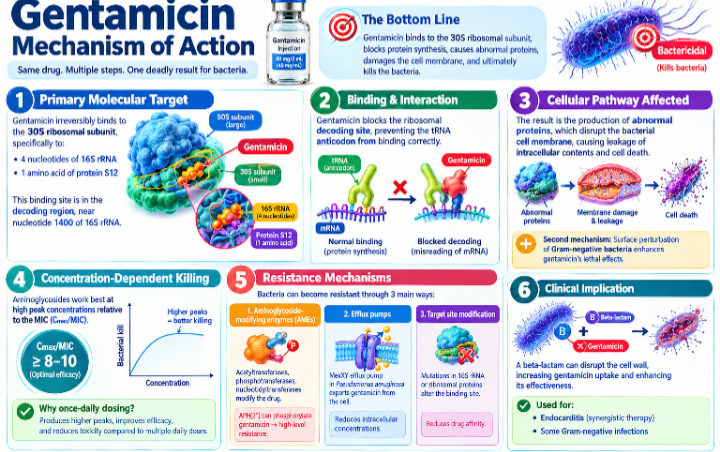
Gentamicin exerts its bactericidal effect through a well-characterized molecular mechanism that distinguishes it from many other antibiotic classes. Understanding this mechanism is fundamental to appreciating both its clinical utility and its limitations.
Primary Molecular Target: Gentamicin irreversibly binds to specific proteins and RNA within the bacterial 30S ribosomal subunit. Specifically, it binds to four nucleotides of 16S ribosomal RNA (rRNA) and a single amino acid of protein S12. This binding site is located in the decoding region of the ribosome, near nucleotide 1400 of 16S rRNA.
Binding and Interaction: The binding of gentamicin interferes with the ribosomal decoding site, which normally interacts with the wobble base of the tRNA anticodon. This interference causes misreading of mRNA, premature termination of protein synthesis, and polysome breakup — active polysomes are converted into nonfunctional monosomes.
Cellular Pathway Affected: The production of abnormal proteins disrupts bacterial cell membrane integrity, leading to leakage of intracellular contents and cell death. Gentamicin also has a second mechanism of action involving surface perturbation of Gram-negative bacteria, which enhances its lethal effects.
Concentration-Dependent Killing: Aminoglycosides exhibit concentration-dependent bactericidal activity. The ratio of peak concentration to MIC (Cmax/MIC) is the pharmacodynamic parameter most closely correlated with clinical efficacy. This is why once-daily dosing — which produces higher peaks — is preferred over multiple daily dosing for most indications.
Resistance Mechanisms: Bacterial resistance to gentamicin occurs through three major mechanisms. First, aminoglycoside-modifying enzymes (AMEs): The most common mechanism. Enzymes such as acetyltransferases, phosphotransferases, and nucleotidyltransferases modify the drug, preventing it from binding to the ribosome. The enzyme APH(2”) can phosphorylate gentamicin, leading to high-level gentamicin resistance. Second, efflux pumps: The MexXY efflux pump in Pseudomonas aeruginosa can actively export gentamicin from the bacterial cell, reducing intracellular concentrations. Third, target site modification: Mutations in the 16S rRNA or ribosomal proteins can alter the binding site, reducing drug affinity.
Clinical Implication: Combination therapy with a beta-lactam may enhance gentamicin uptake by disrupting the cell wall, which is why synergistic combinations are used for endocarditis and some Gram-negative infections.
What Is Gentamicin?
Gentamicin is a broad-spectrum aminoglycoside antibiotic derived from Micromonospora purpurea. Unlike beta-lactams or macrolides, aminoglycosides are concentration-dependent bactericidal agents — their killing power increases with higher peak concentrations relative to the minimum inhibitory concentration (MIC) of the target organism.
Generic Name and Drug Class: The generic name is gentamicin sulfate. It is commercially available as gentamicin C complex, a mixture of gentamicin C1, C1a, and C2, which together account for approximately 80% of the preparation and possess the highest antibacterial activity. It belongs to the aminoglycoside class of antibiotics.
Pharmacologic Classification: Gentamicin is classified as a protein synthesis inhibitor that targets the 30S ribosomal subunit. It is bactericidal — it kills bacteria rather than merely inhibiting their growth.
Therapeutic Role: Clinically, gentamicin serves as a critical antibiotic for serious Gram-negative infections, including sepsis, meningitis, and complicated urinary tract infections. It is also used synergistically with beta-lactams for enterococcal endocarditis and is a first-line agent for tularemia and plague according to CDC guidelines.
Formulations, Strengths, and Routes: Gentamicin injection is supplied as a sterile solution for IM or IV administration. The 80 mg/2 mL (40 mg/mL) strength is one of the most commonly stocked formulations in hospital pharmacies worldwide. It must be diluted before IV use and should never be administered as an undiluted bolus. Other strengths include 10 mg/mL and 100 mg/2 mL. Ophthalmic and topical formulations are also available for localized infections.
Differences from Closely Related Medicines: Compared to tobramycin, gentamicin has slightly greater activity against Serratia and Enterobacter species but less activity against Pseudomonas aeruginosa. Amikacin, another aminoglycoside, is more resistant to aminoglycoside-modifying enzymes and is often reserved for gentamicin-resistant organisms. Streptomycin, the oldest aminoglycoside, is now primarily used for plague, tularemia, and brucellosis rather than routine Gram-negative coverage. For a suspenseful, detailed comparison of another workhorse antibiotic, explore Facts About Ceftriaxone Sodium Uses — and see why the two are not interchangeable.
Pharmacokinetics & Pharmacodynamics Key Table
The following table summarizes the key pharmacokinetic (PK) and pharmacodynamic (PD) properties that inform the clinical use of gentamicin.
| Parameter | Clinically Relevant Details |
|---|---|
| Absorption | Rapid and complete after IM injection; 100% bioavailability. |
| Peak Serum Concentration | 30–90 minutes after IM; 30 minutes after completion of IV infusion. |
| Distribution | Primarily extracellular fluid; Vd 0.2–0.25 L/kg in adults. |
| Protein Binding | Low (<30%). |
| Metabolism | Not metabolized; no active metabolites. |
| Elimination | Renal glomerular filtration; >90% excreted unchanged in urine. |
| Half-Life (Normal Renal Function) | 2–3 hours. |
| Half-Life (Renal Impairment) | Prolonged proportionally to creatinine clearance reduction. |
| Clearance | ~1.0–1.2 mL/min/kg (normal renal function). |
| Therapeutic Peak (Traditional Dosing) | 5–10 mg/L. |
| Therapeutic Trough (Traditional Dosing) | <2 mg/L; <1 mg/L preferred for extended therapy. |
| Therapeutic Peak (Once-Daily Dosing) | 15–20 mg/L or higher (depending on MIC). |
| Trough (Once-Daily Dosing) | <1 mg/L (ideally undetectable). |
| Post-Antibiotic Effect | Prolonged (concentration-dependent; 1–4 hours). |
| Volume of Distribution (Special Populations) | Increased in neonates, obese patients, ascites, burns, cystic fibrosis. |
| Pharmacodynamic Target | 30S ribosomal subunit; Cmax/MIC ratio of ≥8–10 associated with optimal bactericidal activity. |
| PK/PD Index | Cmax/MIC. |
This table is a quick reference. The following sections explain the most important details without unnecessary repetition.
Half-Life
The elimination half-life of gentamicin is a fundamental pharmacokinetic parameter that directly influences dosing frequency and helps clinicians anticipate drug accumulation in specific populations. Under normal renal function, the mean serum half-life of gentamicin is approximately 2–3 hours.
This relatively short half-life explains why gentamicin is dosed every 8 hours for most indications — the dosing interval is designed to maintain serum concentrations above the MIC for the infecting organism throughout the treatment period while allowing drug-free intervals to reduce toxicity. Renal impairment has the most clinically significant impact on gentamicin half-life. Since gentamicin is eliminated primarily by the kidneys, any condition that reduces glomerular filtration rate will prolong the half-life and necessitate dosage interval adjustments.
The clinical significance of half-life extends beyond dosing convenience. A prolonged half-life increases the risk of drug accumulation and toxicity, particularly in patients with renal impairment who may develop nephrotoxicity or ototoxicity if the dosage is not appropriately adjusted. Conversely, an understanding of half-life allows clinicians to predict how quickly a drug will be cleared from the body after discontinuation.
Metabolism
Gentamicin is characterized by remarkable metabolic stability, a property that simplifies its clinical use and minimizes concerns about hepatic drug interactions.
Primary Metabolic Pathway: Gentamicin is not metabolized. It is excreted unchanged in the urine. This means there are no active metabolites, no cytochrome P450-mediated interactions, and no need for dosage adjustment in hepatic impairment alone.
Clinical Relevance: The lack of hepatic metabolism has several important clinical implications. First, hepatic impairment does not significantly alter the pharmacokinetics of gentamicin, and dosage adjustment is generally not required for hepatic dysfunction alone. Second, it reduces the risk of drug-drug interactions mediated through metabolic pathways. Third, it ensures that the active drug is available for antibacterial activity without requiring metabolic activation.
Enzyme Interactions: While gentamicin itself does not meaningfully inhibit or induce cytochrome P450 enzymes, the co-administration of other nephrotoxic drugs — such as amphotericin B, vancomycin, NSAIDs, or contrast media — can increase the risk of renal toxicity. This interaction occurs at the level of renal excretion rather than hepatic metabolism.
Bioavailability & Protein Binding
Bioavailability: Gentamicin has ~100% bioavailability after intramuscular administration and complete bioavailability after intravenous administration. Unlike oral antibiotics, gentamicin is not absorbed from the gastrointestinal tract, which is why it must be given parenterally for systemic infections.
Protein Binding: Gentamicin is less than 30% bound to plasma proteins, primarily albumin. This low degree of protein binding has several clinical implications. First, it means that a substantial fraction of the drug circulates in the free, pharmacologically active form capable of diffusing into tissues and binding to bacterial ribosomes. Second, it means that gentamicin is not subject to the same degree of drug displacement interactions as highly protein-bound drugs. Third, in conditions that alter plasma protein concentrations — such as hypoalbuminemia in hepatic disease, nephrotic syndrome, or malnutrition — the free fraction of gentamicin may increase, potentially enhancing both therapeutic and toxic effects. For a deeper dive into this concept, refer to our detailed guide on plasma protein binding.
Spectrum of Activity
Understanding the antimicrobial spectrum of gentamicin is essential for appropriate prescribing and antimicrobial stewardship. Gentamicin is active against a wide range of Gram-negative organisms and some Gram-positive organisms, but has important limitations that clinicians must recognize.
Gram-Negative Activity: Gentamicin demonstrates reliable activity against Escherichia coli, Klebsiella pneumoniae, Enterobacter species, Serratia species, Citrobacter species, Proteus species (both indole-positive and indole-negative), Pseudomonas aeruginosa, and Acinetobacter species. This broad Gram-negative spectrum is one of gentamicin’s defining features.
Gram-Positive Activity: Gentamicin has activity against Staphylococcus species (coagulase-positive and coagulase-negative), including methicillin-susceptible Staphylococcus aureus (MSSA). It also has synergistic activity against enterococci when combined with beta-lactams. However, gentamicin is not active against methicillin-resistant Staphylococcus aureus (MRSA) and should not be used for infections suspected or confirmed to be caused by this organism.
Anaerobes and Atypicals: Gentamicin has no activity against anaerobes because aminoglycosides require oxygen-dependent uptake mechanisms to enter bacterial cells. It also lacks activity against Mycoplasma pneumoniae, Chlamydia pneumoniae, and Legionella species.
Acquired and Intrinsic Resistance: Intrinsic resistance refers to resistance mechanisms that are inherent to a bacterial species. Streptococcus pneumoniae and other streptococci are intrinsically resistant to aminoglycosides (though synergy with beta-lactams may still occur). Stenotrophomonas maltophilia is also intrinsically resistant. Acquired resistance occurs most commonly through the acquisition of aminoglycoside-modifying enzymes, including acetyltransferases, phosphotransferases, and nucleotidyltransferases. Efflux pumps and target site mutations are additional mechanisms.
Susceptibility Testing: The clinical utility of gentamicin for any given infection ultimately depends on the susceptibility of the infecting organism. Clinicians should always consult local susceptibility data when available, as resistance patterns vary geographically and temporally. Importantly, in vitro activity does not automatically translate to clinical effectiveness.
Pharmacodynamics
The pharmacodynamics of gentamicin — how the drug exerts its effects on bacteria — provides the scientific rationale for dosing strategies and explains why certain dosage regimens are more effective than others.
Concentration-Dependent Killing: Gentamicin exhibits concentration-dependent bactericidal activity. This means that the extent of bacterial killing is primarily determined by the peak concentration of the drug relative to the minimum inhibitory concentration (MIC) for the infecting organism. The PK/PD index that best correlates with efficacy for aminoglycosides is the Cmax/MIC ratio. A Cmax/MIC ratio of ≥8–10 is associated with optimal bactericidal activity. This pharmacodynamic principle explains why once-daily dosing — which produces higher peaks — is preferred over multiple daily dosing for most indications.
The use of once-daily (OD) regimens versus multiple dosage (MD) for the administration of aminoglycosides is based on the unique characteristics of these drugs, including concentration-dependent bactericidal activity and the fact that the tubular mechanism for cortical uptake of these antibiotics is saturable. Therefore, the administration of a single large dose of the antibiotic would allow higher serum peak levels and less exposure of the tubular cells to the drug.[reference:3]
Post-Antibiotic Effect: Gentamicin demonstrates a prolonged post-antibiotic effect (PAE), meaning that bacterial growth remains suppressed even after drug concentrations fall below the MIC. The PAE for gentamicin is concentration-dependent and ranges from 1–4 hours. This contributes to the efficacy of intermittent dosing regimens.
Therapeutic Window: The therapeutic window for gentamicin — the range between effective and toxic concentrations — is narrow. This is why therapeutic drug monitoring is essential. Trough concentrations should be maintained below 2 mg/L (preferably below 1 mg/L for extended therapy) to minimize the risk of nephrotoxicity and ototoxicity.
Contraindications
Absolute Contraindications: Gentamicin is contraindicated in patients with known hypersensitivity to gentamicin or other aminoglycosides. This is an absolute contraindication because hypersensitivity reactions can range from mild rash to life-threatening anaphylaxis.
Disease-Specific Contraindications: Gentamicin should be used with extreme caution, and is generally contraindicated, in patients with myasthenia gravis because aminoglycosides can exacerbate neuromuscular blockade and precipitate respiratory depression. It is also contraindicated in patients with a history of previous aminoglycoside-induced ototoxicity, as re-exposure may result in further and potentially irreversible hearing loss.
Relative Contraindications: Gentamicin should be used with caution in patients with pre-existing renal impairment, elderly patients with reduced creatinine clearance, and patients receiving other nephrotoxic or ototoxic drugs. In these populations, the benefits of therapy must be carefully weighed against the risks, and alternative agents should be considered when possible.
Warnings & Precautions
Side Effects
Understanding the side effect profile of gentamicin is essential for patient counseling and clinical monitoring. Adverse effects are broadly categorized by frequency, and distinguishing between common, bothersome side effects and serious adverse reactions is clinically important.
Common Side Effects:
Less Common Side Effects:
Distinguishing Side Effects from Adverse Reactions: It is important for clinicians to distinguish between side effects (predictable, often dose-related, and generally manageable) and adverse reactions (unexpected, potentially serious, and requiring medical intervention). A mild rise in serum creatinine may be a manageable side effect that resolves with dose adjustment. However, a significant decline in renal function or new-onset hearing loss represents a serious adverse reaction requiring immediate medical evaluation.
Adverse Effects
While the common side effects of gentamicin are generally manageable, the drug carries a risk of serious adverse effects that all prescribers must recognize and monitor for.
Drug Interactions
The following table summarizes clinically meaningful drug interactions with gentamicin. Theoretical interactions of little clinical relevance have been omitted.
| Interacting Medicine/Class | Potential Interaction | Clinical Significance | Management Consideration |
|---|---|---|---|
| Other aminoglycosides | Additive nephrotoxicity and ototoxicity. | Increased risk of serious adverse effects. | Avoid concurrent use. |
| Loop diuretics (furosemide, ethacrynic acid) | Additive ototoxicity; may increase aminoglycoside concentrations. | Increased risk of hearing loss and renal impairment. | Monitor renal function and hearing; avoid where possible. |
| Vancomycin | Additive nephrotoxicity. | Increased risk of acute kidney injury. | Monitor renal function closely; consider alternative agents. |
| Amphotericin B | Additive nephrotoxicity. | Increased risk of renal impairment. | Avoid concurrent use if possible; monitor renal function. |
| NSAIDs | Reduced renal perfusion; increased nephrotoxicity risk. | Increased risk of acute kidney injury. | Monitor renal function; avoid prolonged concurrent use. |
| Neuromuscular blockers | Additive neuromuscular blockade; risk of respiratory depression. | Potentially life-threatening respiratory compromise. | Monitor neuromuscular function; have calcium chloride available. |
| Beta-lactams (penicillins, cephalosporins) | In vitro inactivation when mixed in same infusion; synergy when administered separately. | Loss of efficacy if mixed; enhanced killing if given separately. | Administer via separate lines; flush thoroughly between doses. |
| Indomethacin | Increased gentamicin serum concentrations. | Increased risk of toxicity. | Monitor levels; adjust dose. |
| Cisplatin | Additive nephrotoxicity and ototoxicity. | Increased risk of renal and hearing damage. | Avoid concurrent use. |
Administration Table
Practical administration instructions are essential for patient education and nursing practice. The table below summarizes key administration factors.
| Administration Factor | Guidance |
|---|---|
| Route | Intramuscular (IM); intravenous (IV) infusion; intrathecal/intraventricular (specialized use). |
| IV Administration | Must be diluted before IV use. Administer over 30–60 minutes; never give as undiluted bolus. |
| IM Administration | Administer deep into a large muscle mass; rotate injection sites. |
| Intrathecal/Intraventricular | Use preservative-free preparation. Clamp drainage tubes for 0.5–2 hours after administration. |
| Timing | Every 8 hours for traditional dosing; once daily for extended-interval dosing (except endocarditis synergy, which requires divided dosing). |
| Missed Dose | Take as soon as remembered unless close to next scheduled dose; do not double doses. |
| Storage | Store vials at controlled room temperature (20–25°C). Do not freeze. Protect from light. |
| Special Administration Instructions | Complete the full prescribed course even if symptoms improve. Do not share medication. |
Pharmacokinetics
This section consolidates the clinically relevant pharmacokinetic properties of gentamicin in a professional overview. Detailed explanations of half-life, metabolism, bioavailability, and protein binding are provided in their respective dedicated sections above and are not repeated here.
Absorption and Bioavailability: Gentamicin is rapidly and completely absorbed after intramuscular administration, with 100% bioavailability. After intravenous administration, bioavailability is complete.
Distribution: Gentamicin has a volume of distribution of 0.2–0.25 L/kg, indicating distribution primarily into extracellular fluid. The drug achieves therapeutic concentrations in serum, urine, and some tissues, but penetration into cerebrospinal fluid is poor unless the meninges are inflamed.
Metabolism and Elimination: Gentamicin is not metabolized. It is eliminated primarily unchanged by the kidneys through glomerular filtration. More than 90% of a dose is recovered in the urine as unchanged drug.
Special Populations: In neonates, the volume of distribution is higher and renal clearance is lower, requiring dose adjustment based on gestational and postnatal age. In elderly patients with reduced creatinine clearance, the elimination half-life is prolonged. In patients with renal impairment, the dosage interval must be extended.
Special Populations
Pregnancy: Gentamicin crosses the placenta. There are no adequate data from the use of gentamicin in pregnant women, but because of the potential risk of inner ear and renal damage to the fetus, gentamicin should not be used in pregnancy unless in case of a life-threatening indication and if the expected benefit outweighs the risk. CDC recommends gentamicin as a first-line option for tularemia in pregnant women, with shared decision-making regarding risks and benefits.
Lactation: Small amounts of gentamicin have been detected in breast milk. Because of the potential risk to the newborn, breastfeeding should be discontinued during therapy unless the expected benefits outweigh any potential risk.
Pediatrics: Gentamicin is FDA-approved for neonatal sepsis and is widely used in this population. Dosing must be carefully adjusted based on gestational age, postnatal age, and renal function. For neonates less than 7 days old, 5 mg/kg every 36 hours is commonly recommended; for those older than 7 days, 5 mg/kg every 24 hours may be appropriate. Therapeutic drug monitoring is essential.
Older Adults: Advanced age is associated with decreased renal function, even when serum creatinine appears normal. Therefore, creatinine clearance should be estimated in all elderly patients before initiating gentamicin. Dose reduction and extended dosing intervals are often required.
Obese Patients: Gentamicin distributes primarily into lean body mass. In obese patients, dosing should be based on adjusted body weight (ABW), calculated as estimated lean body weight plus 40% of the excess weight. Dosing on total body weight may lead to supratherapeutic levels and toxicity.
Renal Impairment: Dose adjustment is mandatory in patients with impaired renal function. The initial dose is the same as for patients with normal renal function, but subsequent doses must be adjusted based on creatinine clearance and serum levels. Hemodialysis removes gentamicin; the recommended dosage at the end of each dialysis period is 1–1.7 mg/kg, depending on the severity of infection.
Monitoring
Clinical Perspective
From a clinical standpoint, gentamicin remains an indispensable antibiotic for serious Gram-negative infections. Its rapid bactericidal activity, concentration-dependent killing, and synergy with beta-lactams make it uniquely valuable for conditions such as enterococcal endocarditis, neonatal sepsis, and multidrug-resistant Gram-negative infections.
However, gentamicin is not a drug to be used casually. Every dose carries the risk of nephrotoxicity and ototoxicity. Every patient requires individualized assessment of renal function, weight, and risk factors. Every course of therapy requires therapeutic drug monitoring, clinical vigilance, and a willingness to discontinue the drug at the first sign of toxicity.
Clinicians may prefer gentamicin when treating serious infections caused by susceptible Gram-negative organisms, particularly when culture data support its use and when the patient has normal renal function. It is also a first-line agent for tularemia and plague according to CDC guidelines, and remains a key component of synergistic therapy for enterococcal endocarditis.
Situations where clinicians may prefer alternatives include infections suspected to be caused by MRSA, Streptococcus pneumoniae, or anaerobes — all of which are resistant to gentamicin. In patients with significant renal impairment or those at high risk of ototoxicity, safer alternatives should be considered whenever possible.
Antimicrobial stewardship considerations are paramount. Gentamicin should be used judiciously to preserve its effectiveness. Clinicians should obtain cultures whenever possible, narrow therapy based on susceptibility results, and avoid using gentamicin for conditions where narrower-spectrum or less toxic agents would be equally effective.
Patient-specific considerations include renal function, allergy history, age, weight, and the presence of conditions that increase the risk of toxicity. Interpretation of treatment response should occur within 48–72 hours; if the patient is not improving, reassessment of the diagnosis, culture data, and therapeutic choice is warranted.
Question. What is gentamicin injection used for?
Answer : Gentamicin injection is used to treat serious bacterial infections caused by susceptible Gram-negative organisms, including septicemia, neonatal sepsis, meningitis, urinary tract infections, respiratory tract infections, skin and soft tissue infections, and gastrointestinal infections. It is also used in combination with penicillin-type drugs for enterococcal endocarditis.
Question. What are the most common side effects of gentamicin injection?
Answer : The most serious side effects are nephrotoxicity (kidney damage) and ototoxicity (hearing and balance damage). Other side effects include neuromuscular blockade, neurotoxicity, injection site reactions, nausea, and rash. A systematic review found that acute kidney injury occurred in approximately 10% of patients receiving a single dose, though most cases were reversible.
Question. How is gentamicin injection dosage determined for adults?
Answer : Gentamicin injection dosage for adults depends on the indication, severity of infection, renal function, and body weight. Standard dosing for serious infections is 3 mg/kg/day divided every 8 hours. Once-daily dosing (5–7 mg/kg every 24 hours) is increasingly preferred for most Gram-negative infections. Dose adjustment is mandatory in renal impairment.
Question. What is gentamicin 80 mg injection used for?
Answer : The 80 mg/2 mL formulation is one of the most commonly used strengths. It may be used for systemic infections, urinary tract infections, and other susceptible infections. The dose is calculated based on body weight (3–5 mg/kg/day) and is administered intramuscularly or intravenously after dilution.
Question. What are gentamicin injection kidney side effects?
Answer : Gentamicin can cause acute kidney injury (nephrotoxicity), typically presenting as a rising serum creatinine after 5–7 days of therapy. Risk factors include pre-existing renal impairment, concurrent nephrotoxic drugs, prolonged therapy, and high trough levels. Most cases are reversible with early detection and dose adjustment. Hemodialysis may be required in severe cases.
Question. What are gentamicin injection side effects in adults?
Answer : In adults, gentamicin side effects include nephrotoxicity (approximately 10% incidence with single dose), ototoxicity (vestibular and cochlear, usually irreversible), neuromuscular blockade, neurotoxicity (numbness, tingling, convulsions), hypersensitivity reactions, and injection site reactions.
Question. Can gentamicin be used in pregnancy?
Answer : Gentamicin should not be used in pregnancy unless in case of a life-threatening indication and if the expected benefit outweighs the risk. It crosses the placenta and may cause fetal ototoxicity and nephrotoxicity. CDC recommends gentamicin as a first-line option for tularemia in pregnant women, with shared decision-making regarding risks and benefits.
Question. How long can gentamicin be given?
Answer : The duration of gentamicin therapy depends on the indication. For most serious infections, 7–10 days is standard. Prolonged therapy (beyond 7–10 days) increases the risk of nephrotoxicity and ototoxicity and should be avoided unless absolutely necessary. For endocarditis, gentamicin may be given for 4–6 weeks as part of combination therapy.
Question. Is gentamicin safe for neonates?
Answer : Gentamicin is FDA-approved for neonatal sepsis and is widely used in this population. However, dosing must be carefully adjusted based on gestational age, postnatal age, and renal function. Therapeutic drug monitoring is essential to prevent toxicity.
Question. What happens if gentamicin overdose occurs?
Answer : In the event of overdosage or toxic reactions, hemodialysis may aid in the removal of gentamicin from the blood, especially if renal function is or becomes compromised. The rate of removal is considerably lower by peritoneal dialysis than by hemodialysis. In newborns, exchange transfusions may also be considered.
Question. What is gentamicin injection used for in adults?
Answer : In adults, gentamicin injection is used for serious systemic infections caused by susceptible Gram-negative organisms, including septicemia, urinary tract infections, respiratory tract infections, skin and soft tissue infections, intra-abdominal infections, and enterococcal endocarditis (synergy). It is also a first-line agent for tularemia and plague according to CDC guidelines.
Question. Does gentamicin interact with other medicines?
Answer : Yes. Gentamicin interacts with other nephrotoxic and ototoxic drugs, including other aminoglycosides, loop diuretics, vancomycin, amphotericin B, NSAIDs, and cisplatin. It also interacts with neuromuscular blockers, potentially causing respiratory depression. Beta-lactams may inactivate gentamicin in vitro when mixed in the same infusion.
Question. What monitoring is required during gentamicin therapy?
Answer : Therapeutic drug monitoring (trough levels) is essential, along with monitoring of renal function (serum creatinine, creatinine clearance), audiometric testing in high-risk patients, and clinical assessment for signs of nephrotoxicity, ototoxicity, and neuromuscular blockade.
5 Authentic Studies
Study 1
Citation: Barza M, Ioannidis JP, Cappelleri JC, Lau J. Single or multiple daily doses of aminoglycosides: a meta-analysis. BMJ. 1996;312(7027):338-345. PMID: 8722531.
Study Type: Meta-analysis of randomized clinical trials.
Population: 2,881 patients from 19 publications of 20 study comparisons.
Intervention/Exposure: Once-daily versus multiple divided daily dosing of aminoglycosides (netilmicin in 11 studies, amikacin in 7 studies, gentamicin in 2 studies).
Main Outcome: Clinical efficacy, bacteriological efficacy, nephrotoxicity, and ototoxicity.
Key Findings: The meta-analysis showed a small, statistically significant difference in clinical efficacy of 3.5% (95% confidence intervals 0.5% to 6.5%, P = 0.027) in favour of once-daily administration, but no significant differences in bacteriological efficacy or nephrotoxicity were detected. Auditory and vestibular toxicity rates were low for all agents and no differences in these toxicities were identified between once-daily or multiple-dose administration regimens.[reference:7]
Clinical Significance: This landmark meta-analysis provided strong evidence that aminoglycosides can be given once-daily without loss of efficacy or increased toxicity, offering greater simplicity and potentially improved cost-effectiveness compared to divided-dose regimens.
Important Limitation: Only two of the included studies specifically evaluated gentamicin; most data came from netilmicin and amikacin studies.
Study 2
Citation: Hayward RS, Harding J, Molloy R, et al. Adverse effects of a single dose of gentamicin in adults: a systematic review. Br J Clin Pharmacol. 2018;84(2):223-238. PMID: 29064590.
Study Type: Systematic review.
Population: 24,107 participants receiving a single one-off dose of gentamicin (doses ranged from 1 mg/kg to 480 mg per dose) across 36 included studies.
Intervention/Exposure: Single dose of intravenous or intramuscular gentamicin for any indication, compared to another medication or placebo.
Main Outcome: Frequency and type of adverse events, including acute kidney injury and ototoxicity.
Key Findings: Acute kidney injury was described in 2,520 participants (approximately 10%) receiving gentamicin. The large majority of cases were reversible. There were no cases of ototoxicity reported in patients receiving gentamicin. A significant number of patients saw a transient rise in creatinine after a single dose of gentamicin at doses up to 480 mg. Persistent renal impairment and other adverse events were relatively rare.[reference:8]
Clinical Significance: This comprehensive systematic review quantified the risk of nephrotoxicity associated with single-dose gentamicin and demonstrated that most cases of AKI are reversible. It provides essential data for risk-benefit discussions with patients and for clinical decision-making regarding gentamicin use.
Important Limitation: A meta-analysis was not performed due to study heterogeneity.
Study 3
Citation: Demczar DJ, Nafziger AN, Bertino JS Jr. Pharmacokinetics of gentamicin at traditional versus high doses: implications for once-daily aminoglycoside dosing. Antimicrob Agents Chemother. 1997;41(5):1115-1119. PMID: 9145878.
Study Type: Randomized, crossover single-dose pharmacokinetic study.
Population: 11 healthy volunteers.
Intervention/Exposure: Two doses of gentamicin (2 and 7 mg/kg of body weight) administered as 1-hour infusions.
Main Outcome: Volume of distribution at steady state (Vss), half-life, clearance (CL), and maximum concentration in serum (Cmax).
Key Findings: Significant differences in distribution half-life (average, 21.8 and 41.6 min [P ≤ 0.05]) and gentamicin CL (76.6 ± 6.6 and 67.2 ± 4.2 mL/min/1.73 m² [P ≤ 0.001]) were found between traditional-dose and high-dose groups, respectively. The pharmacokinetics of gentamicin at a large dose differ significantly from those at the traditional dose.[reference:9]
Clinical Significance: This study has direct implications for once-daily aminoglycoside dosing. It demonstrated that when Cmax values reported in the literature are distributional, they show falsely high Cmax/MIC ratio estimates, and once-daily aminoglycoside nomogram dosing tools developed with distributional Cmax values are probably inaccurate.
Important Limitation: The study was conducted in healthy volunteers only; findings may differ in critically ill patients with altered pharmacokinetics.
Study 4
Citation: Laskin OL, Longstreth JA, Smith CR, Lietman PS. Netilmicin and gentamicin multidose kinetics in normal subjects. Clin Pharmacol Ther. 1983;34(5):644-650. PMID: 6627825.
Study Type: Randomized, double-blind comparative clinical trial.
Population: 20 healthy subjects (10 received gentamicin, 10 received netilmicin).
Intervention/Exposure: 1.7 mg/kg gentamicin or netilmicin as a 20-minute infusion every 8 hours for 10 days (28 doses).
Main Outcome: Multidose pharmacokinetics, including terminal plasma half-life, volume of distribution at steady state, and urinary recovery.
Key Findings: Multidose kinetics were of the same order for gentamicin and netilmicin with the exception of the terminal plasma t 1/2 (94 and 156 hours) and the volume of distribution at steady state (450 and 1072 mL/kg). Aminoglycoside was detectable in plasma and continued to be eliminated in urine for at least 6 days after the final dose. None of the subjects had any auditory, vestibular, or renal toxicity.[reference:10]
Clinical Significance: This study confirmed the existence of a deep tissue compartment for gentamicin and demonstrated that the drug continues to be eliminated from the body for days after the final dose. This has important implications for understanding the duration of drug exposure and the potential for delayed toxicity.
Important Limitation: The study was conducted in healthy volunteers with normal renal function; findings may differ in patients with renal impairment.
Study 5
Citation: Tunkel AR, Hasbun R, Bhimraj A, et al. 2017 Infectious Diseases Society of America’s Clinical Practice Guidelines for Healthcare-Associated Ventriculitis and Meningitis. Clin Infect Dis. 2017;64(6):e34-e65. PMID: 28203777.
Study Type: Clinical practice guideline.
Population: Patients with healthcare-associated ventriculitis and meningitis, including those with Gram-negative infections caused by multidrug-resistant organisms.
Intervention/Exposure: Intraventricular/intrathecal (IVT/ITH) gentamicin administration.
Main Outcome: Recommendations for antimicrobial dosing and administration in healthcare-associated CNS infections.
Key Findings: The 2017 IDSA guidelines recommend that the conventional adult IVT/ITH dosage of gentamicin is 4–8 mg, the pediatric dosage is 1–2 mg, combined with IV therapy. Drainage tubes should be clamped for 0.5–2 hours after local administration. Aminoglycosides are concentration-dependent bactericidal agents with low blood-brain barrier penetration, and IVT/ITH administration achieves CSF concentrations significantly above the susceptibility breakpoint.[reference:11]
Clinical Significance: These guidelines provide the standard of care for intrathecal/intraventricular gentamicin administration in CNS infections and are essential for clinicians managing multidrug-resistant Gram-negative meningitis.
Important Limitation: The evidence grade for these recommendations is “very low” due to the limited number of high-quality clinical trials.
Medical Information Disclaimer
This article is provided for educational and informational purposes only and is intended for healthcare professionals. It does not constitute medical advice and should not be used as a substitute for professional diagnosis, treatment, or clinical judgment. The information presented is based on current, authoritative medical evidence, including FDA prescribing information, CDC guidelines, IDSA recommendations, and peer-reviewed literature. However, medical knowledge evolves, and readers should consult the most current prescribing information and clinical guidelines before making treatment decisions.
Gentamicin is a prescription-only medication. It should never be used without a physician’s supervision. Treatment decisions — including dose selection, duration, and adjustments — depend on the patient’s diagnosis, age, renal and hepatic function, interacting medications, susceptibility data, and clinical judgment. Do not self-medicate with gentamicin. If you have questions about your treatment, consult your healthcare provider.
For healthcare professionals: Always refer to the FDA-approved prescribing information for the most current and complete information regarding gentamicin sulfate injection, including boxed warnings, contraindications, dosing, and monitoring recommendations.