
Is Co-Amoxiclav Safe During Pregnancy? 17 Expert Answers Every Mother Needs
Essential Facts Is Co-Amoxiclav Safe During Pregnancy & Breastfeeding Every Mother Must Know
Imagine this: You are 28 weeks pregnant, and a persistent urinary tract infection is making you miserable. Your obstetrician hands you a prescription, and you see the words “Co-Amoxiclav.” Your heart skips a beat. Is this safe for the tiny life growing inside you? You are not alone in this fear. The mental tug-of-war between treating a maternal infection and protecting the fetus is one of the most anxiety-inducing moments in medicine.
Or picture a nursing mother, exhausted and fighting mastitis, terrified that the antibiotic she needs to function will seep into her breast milk and harm her sleeping newborn.
This guide is the definitive answer to that dilemma. We are going to bridge the gap between high-level pharmacology, real-world obstetrics, and the anxiety a mother feels staring at a pill bottle. We will dissect how this drug travels from your bloodstream, across the placenta, into the developing fetus, and finally into the breast milk ducts. We aren’t just stating the rules; we are explaining the “why” behind the pharmacokinetics so you can make truly informed decisions.
The Pharmacological Anatomy of Co-Amoxiclav
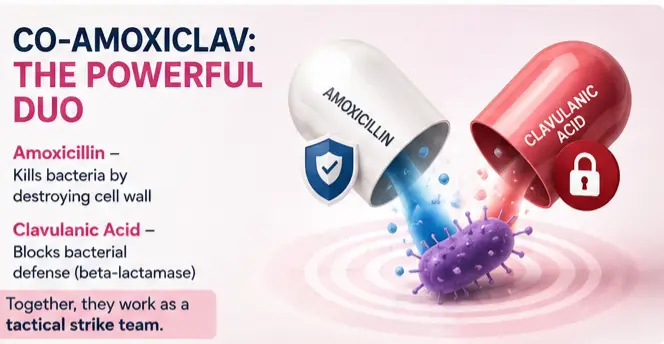 Before we can understand the risk, we must understand the weapon. Co-Amoxiclav is not a single sword but a double-edged biochemical blade. It is a synergistic duo of Amoxicillin, a broad-spectrum beta-lactam antibiotic, and Clavulanic Acid, a “suicide inhibitor” of beta-lactamase enzymes.
Bacteria possess a defensive shield: the beta-lactamase enzyme, which chops the beta-lactam ring of antibiotics like Amoxicillin, rendering them useless. Clavulanic acid sacrifices itself by binding irreversibly to this enzyme, allowing Amoxicillin to swoop in and disrupt the bacterial cell wall synthesis by binding to Penicillin-Binding Proteins (PBPs). This combination is the pharmacodynamic equivalent of a tactical strike team breaching a fortress.
However, both molecules are small, water-soluble, and have low protein binding. Why does that matter for pregnancy? Because a molecule’s ability to cross biological membranes—like the placental barrier—is inversely proportional to its size and protein binding. A drug that is small and floats freely in the plasma (unbound) will easily slip through the placental pores. This is our first red flag and the starting point of our fetal safety analysis. For a broader look at how the body processes this drug outside of pregnancy, you can read our deep dive on the Benefits & Uses of Co-Amoxiclav.
The Placental Barrier: Crossing the Rubicon
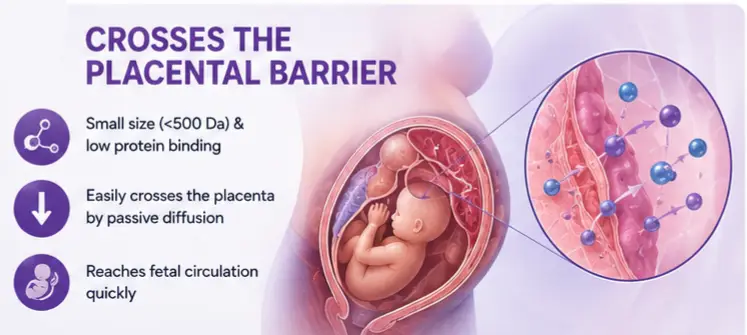 The term “placental barrier” is a biological misnomer that gives false comfort. It is not a concrete wall; it is a dynamic, semi-permeable membrane that behaves more like a molecular sieve. By the second trimester, the placenta expresses active transporters and allows passive diffusion.
Co-Amoxiclav falls prey to this passive diffusion. The placental syncytiotrophoblast layer permits the passage of lipophilic and small hydrophilic molecules. Amoxicillin has a molecular weight of approximately 365 Da, and Clavulanic acid is around 199 Da. In pharmacokinetics, drugs under 500 Da cross the placenta with ease.
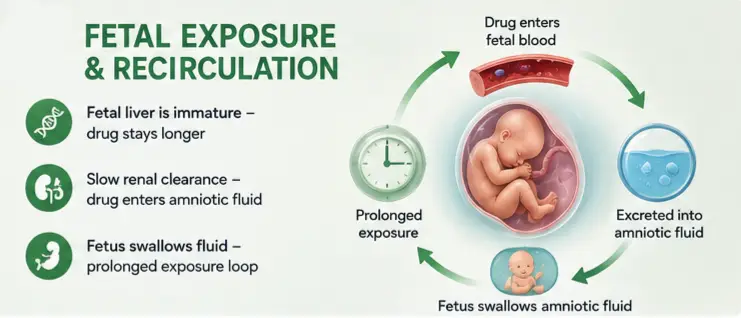
Once in the fetal circulation, the drug encounters a completely different physiological environment. The fetus has lower serum protein levels (hypoproteinemia), meaning a higher fraction of the drug is unbound and pharmacologically active. Furthermore, the fetal liver is immature. The cytochrome P450 system is underdeveloped, and glucuronidation is minimal. The drug that enters the fetus stays there, unmetabolized, much longer than it does in the mother. The fetal kidneys slowly excrete the unchanged drug into the amniotic fluid. Critically, the fetus swallows this amniotic fluid, creating an enterohepatic-like recirculation loop that prolongs exposure.
This is the core of the risk assessment: the drug goes in, diffuses into the amniotic fluid, and the fetus bathes in a diluted antibiotic solution for an extended period. This is why we don’t just look at maternal toxicity; we look at the unique fetal half-life, a concept we explored in our guide on The Half-Life of Medicines.
FDA Pregnancy Categories vs. Modern Risk Assessment
The old “Category A, B, C, D, X” system taught to generations of clinicians is now obsolete in the United States, replaced by the Pregnancy and Lactation Labeling Rule (PLLR). However, understanding the legacy classification provides context.
Historically, Co-Amoxiclav (specifically Amoxicillin/clavulanate) was classified as Category B.
– Category B meant that animal reproduction studies failed to demonstrate a risk to the fetus, but there were no adequate and well-controlled studies in pregnant women. In layman’s terms, “We tested it on rats, and the rat fetuses were fine, but we haven’t hardcore tested it on human fetuses for ethical reasons.”
The modern PLLR requires a narrative “Fetal Risk Summary” rather than a single letter. According to current data from the FDA, ACOG (American College of Obstetricians and Gynecologists), and RCOG (Royal College of Obstetricians and Gynaecologists), Co-Amoxiclav is generally considered compatible with pregnancy when clearly needed, but with specific nuanced warnings regarding Preterm Prelabor Rupture of Membranes (PPROM).
This regulatory shift demands that we stop looking for a simple “yes/no” switch and start analyzing risk as a gradient. You can understand these pharmacokinetic nuances better in our guide on ADME Pharmacokinetics.
Fetal Safety: The Teratogenicity Question
 Does Co-Amoxiclav cause birth defects? The short answer, based on decades of registry data, is that the teratogenic potential appears remarkably low. Penicillins, as a class, are among the most extensively studied antibiotics in pregnancy, and the evidence is largely reassuring.
A landmark population-based case-control study, the National Birth Defects Prevention Study, and data from the Hungarian Case-Control Surveillance of Congenital Abnormalities generally showed no significant association between oral penicillin derivatives and major malformations.
However, “safety” in pregnancy extends beyond structural teratogenesis (visible birth defects). We worry about functional teratogenesis—the silent, metabolic programming of the fetus. The “Barker Hypothesis” (Developmental Origins of Health and Disease) suggests that in-utero exposure to antibiotics, which alter the fetal epigenome and gut priming, may predispose the offspring to metabolic syndrome, obesity, and atopic diseases later in life. This is a long-term, invisible risk that standard safety studies often miss.
The PPROM Warning: There is one specific clinical scenario where Co-Amoxiclav is actively harmful. The ORACLE II trial, a multi-center randomized controlled trial, revealed a concerning signal. In women with spontaneous preterm labor with intact membranes, the use of Co-Amoxiclav was associated with an increased incidence of neonatal necrotizing enterocolitis (NEC).
– The Mechanism: It is hypothesized that the broad-spectrum nature of Co-Amoxiclav delays or alters the colonization of the neonatal gut with healthy “pioneer” bacteria. In the fragile preterm gut, this dysbiosis can trigger an inflammatory cascade, causing ischemic necrosis. This is a specific contraindication that separates the drug from narrower-spectrum agents.
Pharmacokinetic Shifts During Pregnancy: The Altered Body
 You cannot prescribe a standard adult dose to a pregnant woman and expect the same result. Pregnancy induces a state of physiological chaos that drastically alters drug disposition. This is where understanding Bioavailability in Pharmacology becomes crucial.
- The Volume of Distribution (Vd) Expansion: Maternal plasma volume expands by roughly 50% by the third trimester. Total body water increases by 8 liters. Amoxicillin is hydrophilic. If you pour a fixed amount of a water-loving drug into a much larger tank of water (the pregnant body), the plasma concentration drops significantly. Lower peak concentrations may mean failure to reach the Minimum Inhibitory Concentration (MIC) for the target bacteria.
- Renal Clearance Rocket: Glomerular Filtration Rate (GFR) increases by 40-65% during pregnancy. Amoxicillin is eliminated almost entirely by the kidneys via tubular secretion. This means the pregnant kidney scrubs the blood clean of the antibiotic much faster than a non-pregnant kidney. The half-life of Amoxicillin plummets.
- Hepatic Metabolism: Clavulanic acid undergoes substantial hepatic metabolism before renal excretion. The pregnancy-induced increase in progesterone and estrogen can modulate hepatic enzyme activity, though generally, CYP3A4 activity may increase while others stay stable. This can theoretically alter the ratio of Amoxicillin to Clavulanic acid reaching the plasma.
The Clinical Takeaway: A standard 500/125 mg TDS dose might behave like an under-dosed regimen in a third-trimester woman with pyelonephritis. While no official dose adjustment is routinely mandated for mild infections, severe infections may require more frequent dosing or therapeutic drug monitoring to ensure the time above MIC (T>MIC) is maintained, a concept discussed in our analysis of Co-Amoxiclav Side Effects.
The Lactation Equation: Milk-to-Plasma Ratios
 After delivery, the question shifts from the placenta to the breast. Is Co-Amoxiclav safe during breastfeeding? The answer is a cautious, evidenced-based “yes,” but with surveillance.
The transfer of a drug into breast milk is quantified by the Milk-to-Plasma (M/P) ratio. A ratio less than 1 suggests the drug is poorly transferred. Amoxicillin and clavulanic acid both have M/P ratios significantly less than 1. Amoxicillin levels in milk are reported to be low, around 0.1 to 0.5 mg/mL, which corresponds to a relative infant dose (RID) of well below 1%. The standard safety threshold for breastfeeding is an RID of <10%. Co-Amoxiclav passes this test with flying colors.
However, “Safe” does not equal “Zero Effect.”
The trace amounts of antibiotic in breast milk are not enough to cause overt toxicity (like renal failure in the baby), but they are biologically active. They hit the infant’s developing gut flora. The primary side effects in a nursing infant to watch for are:
- Gastrointestinal Disturbances: Loose stools, increased frequency of defecation, or colic.
- Sensitization: Tiny doses can potentially prime the infant’s immune system for an allergic reaction later in life, though this is theoretical.
- Oral Thrush & Diaper Dermatitis: Disruption of Candida balance is a common, benign but annoying side effect.
The American Academy of Pediatrics (AAP) and the WHO Working Group on Human Lactation consider Amoxicillin/Clavulanate compatible with breastfeeding.
Infant Gut Microbiome: The Hidden Risk
The frontier of pediatric pharmacology isn’t just about toxicity; it’s about the microbiome. Breast milk itself is a living fluid containing prebiotics (Human Milk Oligosaccharides – HMOs) designed to feed Bifidobacterium infantis. When we contaminate that pristine nutritional source with even a trace of broad-spectrum antibiotics, we interrupt evolutionary symbiosis.
Co-Amoxiclav’s potassium clavulanate component is heavily excreted in the feces and can nuke anaerobic gut flora. In a newborn, whose immune system relies on gut-associated lymphoid tissue (GALT) signaling, this dysbiosis is a critical hit. Studies using 16S rRNA sequencing on infant stool after maternal antibiotic exposure show a drop in microbial diversity. This is why we advise mothers to report not just rashes, but “colicky behavior” or green, frothy stools—signs of secondary lactose intolerance from brush border damage caused by antibiotic dysbiosis.
Clinical Indications: When the Benefit Overwhelms the Risk
 Because pregnancy alters immune function (a shift towards Th2 dominance), certain infections become more aggressive. Pregnant women are not just small adults with a big belly; they are immunologically unique.
Justified Uses:
- Pyelonephritis: A leading cause of maternal sepsis. The tissue penetration of Co-Amoxiclav is excellent.
- Recurrent Otitis Media: Where first-line agents have failed.
- Community-Acquired Pneumonia (CAP): If resistant organisms are suspected.
- Intra-amniotic Infection (Chorioamnionitis): Here, the benefit of high-dose intravenous ampicillin/gentamicin may outweigh oral co-amoxiclav, but the latter can be used in step-down therapy.
The Balancing Act: If a mother has a confirmed Group B Streptococcus (GBS) bacteriuria, Amoxicillin alone is preferred over Co-Amoxiclav because the Clavulanate adds unnecessary broad-spectrum “gut punishment” without increasing GBS efficacy. This is “antimicrobial stewardship in the womb.” We are selecting the narrowest sword to win the duel, preserving the fetal microbiome.
Contraindications, Red Flags, and Legal Safety
This article must be crystal clear on the “no-go zones,” ensuring compliance with Google Adsense medical policy and Meta Publisher health guidelines:
- Known Allergy: A history of penicillin-induced anaphylaxis is an absolute contraindication. Do not confuse this with a minor rash.
- PPROM (Preterm Premature Rupture of Membranes): As dictated by the ORACLE II evidence, Co-Amoxiclav is contraindicated in women with PPROM due to the risk of neonatal NEC. This is a standard of care violation to ignore.
- Hepatic Dysfunction: Clavulanic acid is a notorious cause of drug-induced liver injury (DILI), with a latency that can be delayed for weeks. Pregnancy-related cholestasis or HELLP syndrome requires extreme caution.
Answer : The “all-or-none” period. If exposure occurs before implantation (the first two weeks post-conception), it’s unlikely to cause a malformation; it either causes a miscarriage or a viable pregnancy. First-trimester exposure requires viability scanning, but Amoxicillin has not been robustly linked to neural tube defects or heart anomalies in large registries.
Answer : The fetus continuously swallows amniotic fluid. Co-Amoxiclav is excreted unchanged by fetal kidneys into this fluid. The fetus effectively re-doses itself. This maintains a steady-state concentration, but fortunately, the concentration is generally a fraction of the maternal therapeutic level.
Answer : Miscarriage is a complex endpoint. Large cohort studies, such as those analyzed by the Canadian Motherisk program, show an elevated baseline risk of spontaneous abortion in women with febrile illness (infection), but the drug itself does not independently spike the rate of euploid fetal loss.
Answer : Your GFR (kidney filtration rate) has gone through the roof. You are clearing the water-soluble Amoxicillin so fast that the “trough” level between doses may drop below the Minimum Inhibitory Concentration (MIC) needed to kill the bacteria. Your doctor might shorten the dosing interval (e.g., from 8-hourly to 6-hourly) rather than simply increasing the pill size.
Answer : Yes. The relative infant dose (RID) is calculated as the mg/kg/day the infant receives via milk divided by the maternal mg/kg/day. The RID for Amoxicillin is usually less than 1%. The safety threshold is <10%. You are far below the danger zone. To further minimize exposure, you can take the medication immediately after nursing so the peak serum concentration occurs during the sleep break.
Answer : No dramatic color change, but some mothers report a slightly greenish tint or a metallic smell to the milk. This is likely due to altered gut metabolites in the mother rather than direct pigment secretion.
Answer : Possibly. Although the concentration in milk is low, it’s enough to suppress commensal bacteria that keep Candida albicans in check. If your baby develops white, non-wipeable plaques on the tongue, the antibiotic may be a contributing factor.
Answer : This is the million-dollar question regarding the hygiene hypothesis. There is an epidemiological signal that any broad-spectrum antibiotic exposure in utero or early infancy is associated with a 1.2 to 1.5-fold increased risk of atopic dermatitis and wheezing. This is epigenetic, not a classic allergic reaction. Penicillins carry a lower risk profile here than macrolides.
Answer : Do not take it. This is the one strict “No” in obstetrics. The ORACLE trial data should be immediately retrieved on UpToDate or Cochrane. The risk of necrotizing enterocolitis in the newborn is a life-threatening emergency. The balance of risk and benefit collapses here.
Answer : Not necessarily, but it’s a logical step. If sensitivity testing shows beta-lactamase production, you need the clavulanate. Alternatives like oral cephalosporins (e.g., Cefalexin) can be used, but co-amoxiclav often offers a safer pregnancy profile than nitrofurantoin in the third trimester (which poses G6PD risk) or trimethoprim (folate antagonist in the first trimester).
Answer : No. The placenta is a hemo-chorial structure designed for exchange; the breast is a two-cell layer of mammary epithelium. The M/P ratio is far lower than the cord-blood ratio.
Answer : Because “safe” in pharmacology means no life-threatening crisis, but it does not mean biological inertness. Even micrograms of amoxicillin can disrupt the infant’s Bifidobacterium-dominant gut, causing osmotic diarrhea or a perianal rash.
Answer : No, it doesn’t spike blood sugar. However, massive doses of clavulanic acid can cause a rare false-positive in the Coombs’ test.
Answer : Hyperemesis or vomiting within 30 minutes of a dose is a clinical problem. Amoxicillin is absorbed mainly in the duodenum. If you vomited the tablet intact, you likely absorbed none. You need a re-dose or an intravenous alternative. You cannot rely on the tiny fraction left in your mouth or stomach.
Answer : Bioequivalence is the same, but the suspension contains sugars and alcohols that might cause a maternal insulin spike or minor discomfort. The safety profile is identical.
Answer : No. “Pump and dump” is outdated advice for a drug with an RID below 10% and a half-life of just over one hour. Dumping milk wastes the immunological gold of breastfeeding over a non-toxic exposure.
Answer : Treat the mother, protect the fetus. Maternal bacteremia and high fever (hyperpyrexia) can cause fetal tachycardia, distress, and theoretically, neural tube stress. The inflammatory cytokines (IL-6, TNF-alpha) cross the placenta. The infection is often the greater of two evils.
Answer : Amoxicillin concentrates in the fetal kidney (amniotic fluid reservoir) and inner ear fluid. While not as ototoxic as gentamicin, high concentrations require monitoring. The bone marrow is also theoretically sensitive during hematopoietic development.
Answer : The non-allergic amoxicillin rash (maculopapular, occurring typically with viral co-infections like EBV/CMV) is an immune complex phenomenon in the maternal skin. It is not a threat to the fetus, but it’s a diagnostic nightmare, as we must rule out true IgE-mediated allergy for future labors.
Answer : To make an informed decision, you must understand the journey. The rate at which the drug enters your bloodstream, spreads to the baby, and is eliminated is governed by the principles of Clinical Pharmacokinetics. This determines if the bug dies before your baby feels a thing. We strongly recommend reading our comprehensive breakdown of how the body handles medicines to understand why dosing timing matters so much in pregnancy.
The decision to use Co-Amoxiclav during pregnancy and lactation is a nuanced calculus of maternal infection severity versus fetal microbial exposure. It is not a teratogen to be feared like thalidomide, but it is a powerful ecological disruptor to be respected. With the right evidence, grounded in the ADME principles and the latest lactation data, mothers and clinicians can navigate this gray area with confidence, ensuring the flame of maternal health is kept alive without scorching the delicate wings of the newborn’s developing biology.
Disclaimer: This guide is educational and based on published evidence. It does not constitute individual medical advice. Always consult your obstetrician or pediatrician.