Dosage Calculator
Dosage Calculator
Dosage Guide
2. The Core Dosage Calculation Formulas
There are several methods to calculate medication doses. Depending on the clinical setting and the type of medication (oral, injectable, etc.), one method may be preferred over another.
A. The Standard Formula (D/H x Q)
This is the most universally taught and utilized formula in nursing and pharmacy. It is particularly useful when calculating the volume of a liquid medication required to deliver a specific dose.
- D = Desired Dose (What the doctor ordered)
- H = Have (What is available on the label/vial)
- Q = Quantity (The volume the “Have” dose is in)
Example 1: A physician orders 500 mg of Amoxicillin. The pharmacy stocks a liquid suspension of 250 mg per 5 mL. How many mL will you administer?
- Desired (D) = 500 mg
- Have (H) = 250 mg
- Quantity (Q) = 5 mL
Calculation: (500 mg / 250 mg) x 5 mL = 2 x 5 mL = 10 mL
B. The Ratio and Proportion Method
This method uses basic algebra to solve for an unknown variable (X) by setting up two equivalent ratios.
Example 2: Order: 300 mg. Available: 100 mg tablets. How many tablets are needed?
- 100 mg : 1 tab = 300 mg : X tab
- Cross multiply: 100X = 300
- X = 300 / 100
- X = 3 tablets
C. Dimensional Analysis (The Factor-Label Method)
Dimensional analysis is a powerful, fail-safe method that uses fractions to cancel out unwanted units until you are left with the desired unit. It is highly recommended for complex calculations involving multiple conversions.
Example 3: Order: 0.5 g of a medication. Available: 250 mg per 5 mL. How many mL?
Step 1: Set up the equation starting with what you need to find (mL).
X mL = (5 mL / 250 mg) x (1000 mg / 1 g) x (0.5 g / 1)
Step 2: Cancel units.
The “g” cancels out. The “mg” cancels out. You are left with mL.
Step 3: Multiply across.
(5 x 1000 x 0.5) / (250 x 1) = 2500 / 250 = 10 mL
3. Weight-Based Pediatric Dosage Calculations
Pediatric dosing is rarely a “one-size-fits-all” standard dose. Children metabolize drugs differently based on their age, organ function, and most importantly, their body weight. Pediatric dosages are almost always calculated in mg/kg/day or mg/kg/dose.
Example 4: A 20 kg child requires Amoxicillin. The standard pediatric dose is 40 mg/kg/day, divided into two doses.
- Weight = 20 kg
- Dose = 40 mg/kg/day
- Total Daily Dose = 20 x 40 = 800 mg/day
Since it is divided into two doses (Twice a day), the individual dose is:
800 mg / 2 = 400 mg per dose.
If the suspension available is 250 mg / 5 mL:
(400 mg / 250 mg) x 5 mL = 8 mL per dose.
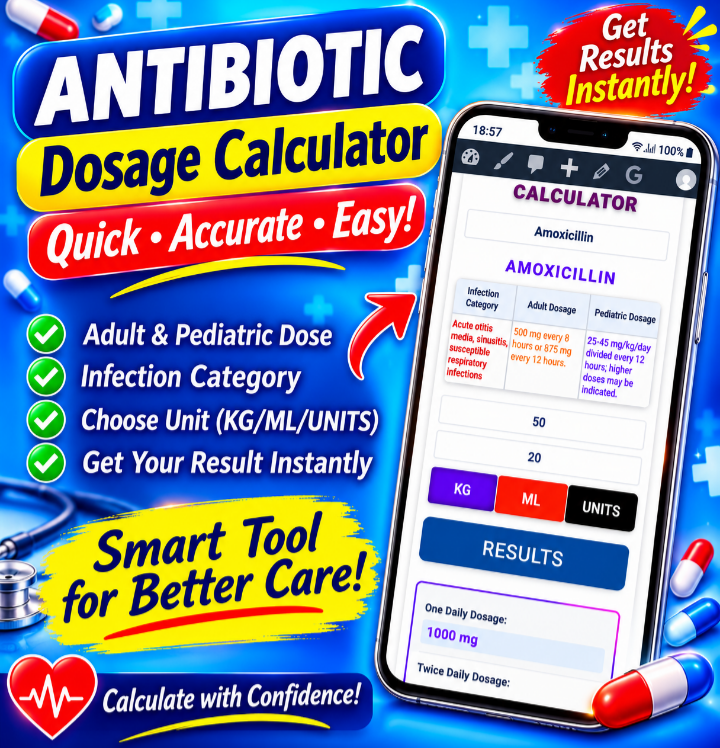
(Note: This is exactly the logic your digital Dosage Calculator uses when you enter the weight and the recommended mg/kg dosage!)
Body Surface Area (BSA) Calculations
For certain medications, particularly chemotherapy agents and specific pediatric drugs, dosing is based on Body Surface Area (BSA) rather than weight. BSA is measured in square meters (m²).
Once BSA is determined, the dose is calculated as:
BSA (m²) x Dose (mg/m²) = Total Dose
4. Intravenous (IV) Infusion Calculations
Calculating IV drip rates requires an understanding of flow rate (mL/hour) and drop factor (drops/mL). This ensures the patient receives the correct amount of fluid and medication over time.
Gravity Drip Rate (Drops per Minute – gtt/min)
- Drop factors: Macro-drip is usually 10, 15, or 20 gtt/mL. Micro-drip is always 60 gtt/mL.
Example 5: Infuse 1000 mL of Normal Saline over 8 hours using a macro-drip set with a drop factor of 15 gtt/mL.
- Time in minutes = 8 hours x 60 = 480 minutes.
- (1000 mL x 15 gtt/mL) / 480 min = 15,000 / 480 = 31.25 gtt/min (rounded to 31).
Electronic Infusion Pumps (mL/hr)
Most modern facilities use IV pumps. Calculating the rate is simpler:
Volume / Time in Hours = mL/hr
Using the example above: 1000 mL / 8 hours = 125 mL/hr.
5. Unit Conversions for Specific Medications (Insulin & Heparin)
Some drugs have unique units of measurement.
- Insulin: Prescribed in “Units”. Calculated using the standard formula: (Desired Units / Have Units) x Quantity. (e.g., Order: 15 Units. Have: U-100 syringe. Draw up to the 15-unit mark).
- Heparin: Prescribed in “Units/kg” for boluses or “Units/kg/hr” for infusions. Heavily reliant on weight-based formulas and requires constant aPTT monitoring.
6. The “Five Rights” of Medication Administration
Calculations are only half the battle. Even a mathematically perfect calculation is dangerous if administered to the wrong patient or at the wrong time. Always adhere to the Five Rights:
- Right Patient: Verify identity using two identifiers (e.g., name and date of birth).
- Right Drug: Check the label three times.
- Right Dose: Double-check your calculations, especially with high-alert medications (insulin, heparin, opioids, and chemotherapy).
- Right Route: Ensure the ordered route (oral, IV, IM, SubQ) matches the prepared medication.
- Right Time: Administer at the correct interval as prescribed.
7. Common Pitfalls and How to Avoid Them
- Misplaced Decimals: A dose of 1.0 mg is vastly different from 10 mg. Always lead with a zero for decimals less than one (e.g., 0.5 mL, not .5 mL) to prevent it from being misread as 5 mL.
- Trailing Zeros: Never write “5.0 mg.” It is too easy for a rushed professional to misread it as 50 mg. Write “5 mg.”
- Mixing Units: Weighing a patient in pounds but using a formula that requires kilograms is a classic error. Always convert pounds to kg by dividing by 2.2.
- Rounding Errors: Do not round numbers until the very end of the calculation. If you round the intermediate steps, the final dose can be significantly off.
- Illegible Handwriting: If you cannot read the prescription, or if a calculation is ambiguous, stop and verify with the prescribing physician.
8. The Role of Technology in Dosage Calculations
While nurses and pharmacists must know the math, technology is increasingly used to prevent errors. Electronic Health Records (EHRs) with Computerized Provider Order Entry (CPOE) automatically calculate doses based on patient weight and flag drug allergies.
However, technology is not infallible. “Automation bias”—trusting the computer blindly—can be dangerous if incorrect data is entered into the system. Therefore, the healthcare professional must always verify the digital calculation.
This is where tools like the Amoxicillin Dosage Calculator come into play. Digital calculators are excellent resources for quick, reliable estimations based on standard clinical guidelines (like the data sourced from ssthem.org). However, a digital calculator should only be used as a supplementary tool to cross-check your own manual calculations, not as a replacement for clinical judgment.
9. Frequently Asked Questions (FAQ)
Q: How do I calculate a dose if the medication is in a tablet form?
A: Use the formula D/H. If the doctor orders 1 gram and you have 500 mg tablets: (1000 mg / 500 mg) = 2 tablets.
Q: What is the difference between mg/kg/day and mg/kg/dose?
A: “mg/kg/day” is the total amount the patient should receive in a 24-hour period (which must be divided by the number of doses). “mg/kg/dose” is the amount to be given at one specific time.
Q: Can I use a standard adult dose for a child?
A: Never. Pediatric patients have immature liver and kidney functions and require weight-based or BSA-based calculations. Always use pediatric-specific guidelines.
10. Conclusion
Dosage calculation is a fundamental skill that blends mathematical precision with clinical discernment. Whether you are utilizing the standard formula, dimensional analysis, or a digital dosage calculator tool, the ultimate goal is patient safety.
By mastering unit conversions, understanding weight-based formulas, and adhering strictly to the “Five Rights,” healthcare professionals can ensure accurate medication administration. For patients and caregivers, using reliable, guideline-backed calculators—while always confirming with a healthcare professional—empowers them to participate safely in their own care.
Disclaimer: This article is for educational and informational purposes only. The formulas and examples provided are standard clinical concepts, but medication dosing is highly individualized. Always consult a qualified healthcare professional or pharmacist before administering any medication.





Good