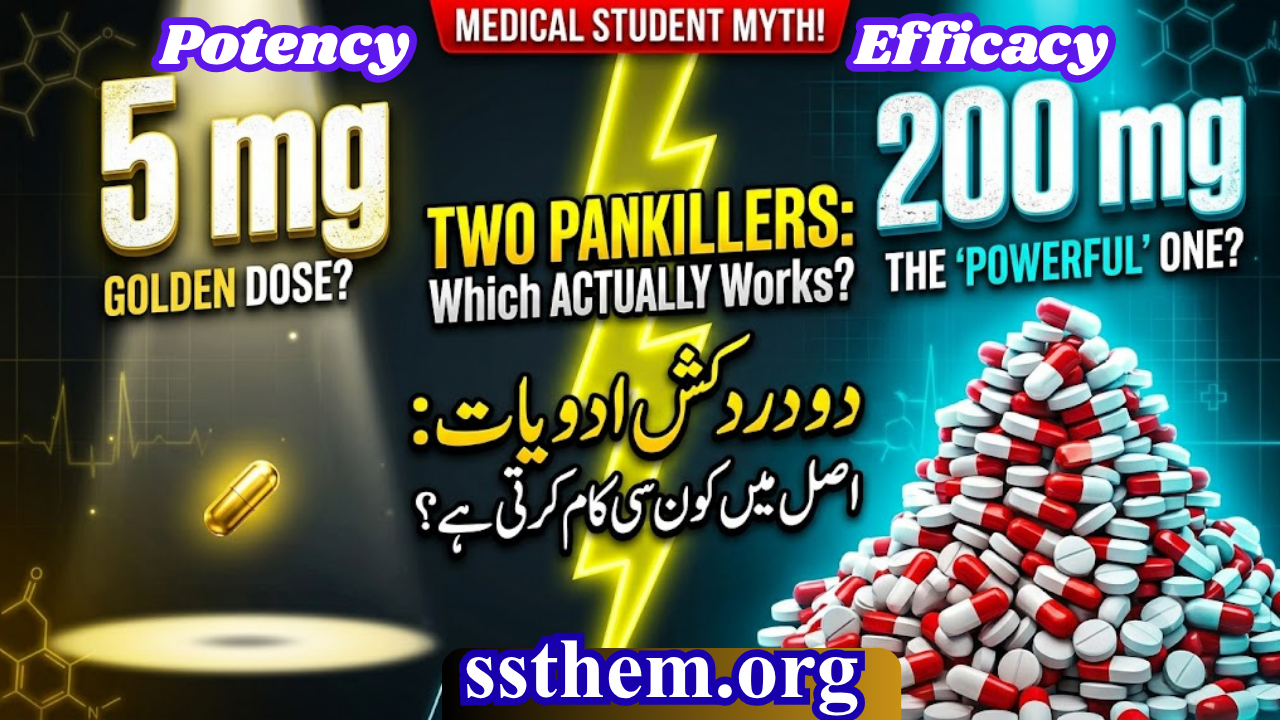
Potency vs Efficacy Explained 15 Powerful Differences with Clinical Examples
Potency vs Efficacy A Tale of Two Painkillers
Imagine a patient in your clinic describing severe, debilitating pain. You have two different pain medications available. Drug A relieves pain completely at a very small dose—just 5 mg. Drug B requires 200 mg to achieve the same complete pain relief. Which drug would you prescribe?
Many medical students and even some clinicians might instinctively choose Drug A. It seems more “powerful.” However, this choice reflects a common misconception in pharmacology—confusing potency with efficacy.
In reality, both drugs in our scenario have equal efficacy because they both achieve complete pain relief. The difference lies in their potency—the dose required to produce that effect. But what if Drug A relieved only 50% of pain even at the highest safe doses, while Drug B could eliminate pain entirely with careful titration? In that case, Drug B would be more clinically valuable despite requiring higher doses.
This distinction between potency and efficacy is fundamental to rational prescribing. Understanding these concepts allows healthcare professionals to select the right drug for the right patient, optimize dosing regimens, and avoid potentially dangerous therapeutic errors. Let us explore these concepts in depth, beginning with a clear understanding of each term before examining how they work together in clinical practice.
Understanding Drug-Receptor Interactions
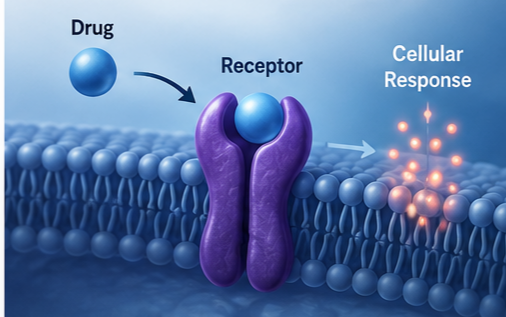
Before defining potency and efficacy, we must first appreciate the fundamental framework of pharmacodynamics—the study of what a drug does to the body . Most drugs exert their effects by interacting with specific cellular targets called receptors, which are typically proteins located on cell membranes or within cells.
When a drug molecule (ligand) binds to its receptor, it forms a drug-receptor complex. This binding initiates a conformational change in the receptor protein that triggers a cascade of intracellular events, ultimately producing a measurable biological response. The relationship between drug concentration and the resulting effect is described mathematically by the dose-response curve.
The key parameters describing this relationship are affinity and intrinsic activity:
- Affinity refers to how strongly a drug binds to its receptor. Drugs with high affinity bind more readily and require lower concentrations to occupy receptor sites.
- Intrinsic activity refers to the ability of a drug-receptor complex to produce a biological response. This property determines whether a drug acts as an agonist, partial agonist, or antagonist.
Potency and efficacy emerge from these fundamental properties. Potency depends partly on affinity, while efficacy reflects the intrinsic activity of the drug-receptor complex . Understanding this distinction helps explain why some drugs can be highly potent yet relatively ineffective, while others require larger doses to achieve their full therapeutic effect.
What Is Potency in Pharmacology?
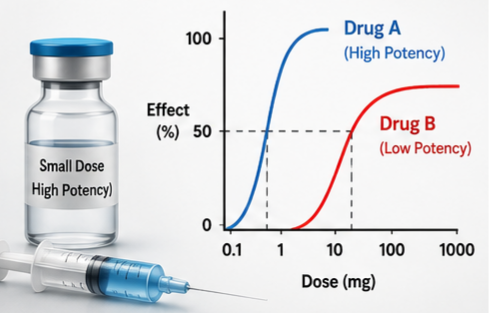
Potency refers to the amount of drug required to produce a specified effect . In quantitative terms, potency is expressed as the EC₅₀ (half-maximal effective concentration)—the concentration of drug needed to produce 50% of its maximal effect. Alternatively, when using dose rather than concentration, it is expressed as the ED₅₀ (half-maximal effective dose).
A drug with higher potency requires a lower dose to achieve a given effect compared to a less potent drug. Potency depends on two factors: the drug’s affinity for its receptor and the efficiency of coupling between receptor occupancy and biological response.
Think of potency as “the economy” of a drug—how efficiently it achieves its effect per unit of dose. However, potency does not tell us anything about the maximum effect the drug can produce.
Clinical Implications of Potency
In practice, potency influences dosing decisions primarily through economic and practical considerations. For example, an antihypertensive drug with higher potency might be formulated in smaller tablets, making it easier for patients to swallow. Highly potent drugs may also be preferred when administering medications through routes with limited volume capacity, such as intrathecal or epidural injections.
However, potency alone should never determine drug selection in clinical practice. Many clinicians mistakenly equate higher potency with greater clinical effectiveness or believe that more potent drugs are inherently more dangerous. Neither assumption is correct.
What Is Efficacy in Pharmacology?
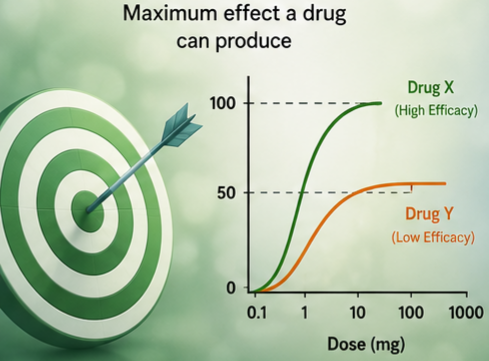
Efficacy (also called maximal efficacy) is the maximum biological effect a drug can produce, regardless of the dose administered . In dose-response curve terms, efficacy is represented by Eₘₐₓ—the plateau of the curve where further dose increases produce no additional response.
Efficacy reflects the drug’s intrinsic activity or its ability to activate the receptor once bound. Full agonists have high efficacy because they activate receptors completely, triggering a full biological response. Partial agonists have lower efficacy—they activate receptors to a lesser extent, producing a submaximal response even at full receptor occupancy. Antagonists, by contrast, have zero efficacy; they occupy receptors without activating them, simply blocking agonist binding.
Why Efficacy Is More Important Clinically
Efficacy is the single most important pharmacodynamic parameter in clinical decision-making . A drug that lacks sufficient efficacy cannot achieve the therapeutic goal regardless of dose escalation—you cannot “dose your way” to a greater effect than the drug’s intrinsic activity permits.
Consider the management of severe hypertension. A diuretic that acts on the loop of Henle has greater efficacy for producing diuresis than a thiazide diuretic that acts on the distal convoluted tubule. In patients with severe heart failure, the loop diuretic may be necessary because thiazides simply cannot produce enough fluid elimination regardless of dose. This distinction illustrates why drugs with different mechanisms often have different maximum efficacies—a concept tied to the physiology of their target systems.
قرآن، حدیث، سیرتِ انبیاء اور اسلامی تاریخ کی ایسی مستند معلومات پڑھیں جو دل کو بھی چھوئیں اور علم بھی بڑھائیں۔
Read authentic Islamic content on the Qur’an, Hadith, the Prophets, and Islamic history that inspires the heart and expands knowledge.
The Dose-Response Curve: Visualizing Potency and Efficacy
To truly understand the relationship between potency and efficacy, we must explore their graphical representation—the graded dose-response curve.
When drug dose (plotted on a logarithmic scale on the x-axis) is plotted against drug effect (plotted on a linear scale on the y-axis), the resulting curve typically has a sigmoidal shape. This curve provides three critical pieces of information:
- The baseline effect (before drug administration)
- The potency (EC₅₀ or ED₅₀)
- The maximal efficacy (Eₘₐₓ)
Interpreting the Curve
The curve’s position along the dose axis indicates potency. A curve shifted to the left—requiring lower drug concentrations to achieve effect—represents a more potent drug. A shift to the right indicates lower potency.
The height of the curve’s plateau indicates efficacy. A drug that achieves a higher maximum effect has greater efficacy. Drugs that cannot achieve the same maximum effect have lower efficacy—they are partial agonists.
Types of Dose-Response Curves
Different drugs acting on the same receptor system may display:
- Parallel curves with different positions on the dose axis (equal efficacy, different potency)
- Different maxima (different efficacy, variable potency)
- Different slopes (different responsiveness to dose changes)
The steepness of a dose-response curve also matters clinically. Steep curves mean small dose increases produce large effects, which can be beneficial for achieving rapid responses but dangerous when the curve represents undesirable effects (e.g., respiratory depression with opioids).
Full Agonists, Partial Agonists, and Antagonists
Understanding potency and efficacy requires familiarity with the drug classes defined by their intrinsic activity:
Full Agonists
Full agonists are drugs that produce a maximal biological response when they occupy their receptors. They have high intrinsic activity and achieve the same maximum effect as the endogenous ligand that naturally activates the receptor. For example, morphine is a full agonist at the mu-opioid receptor—at sufficient doses, it can produce the same maximum analgesia as endogenous endorphins.
Partial Agonists
Partial agonists bind to receptors but activate them less effectively than full agonists . No matter how high the dose, a partial agonist cannot produce the same maximum response as a full agonist. For example, buprenorphine is a partial agonist at the mu-opioid receptor. At higher doses, it provides analgesia that is “good enough” for many patients but cannot match the maximum effect of morphine.
Clinically, partial agonists offer important advantages. Because they cannot produce a full effect, they are less likely to cause certain adverse effects. Buprenorphine produces less respiratory depression than full opioid agonists, making it safer in overdose situations.
Antagonists
Antagonists bind to receptors but have no intrinsic activity—they produce no biological response . Instead, they block receptor sites, preventing agonists from binding and producing effects. Antagonists can be:
- Competitive antagonists (bind reversibly to the same site as the agonist; their effect can be overcome by increasing agonist concentration)
- Noncompetitive antagonists (bind irreversibly or to a different site; their effect cannot be overcome by increasing agonist concentration)
Clinical Case Examples
Case 1: Opioid Analgesics
Consider three patients with chronic pain:
- Patient A receives morphine 10 mg, a full mu-opioid agonist with moderate potency but high efficacy.
- Patient B receives fentanyl 0.1 mg, a full mu-opioid agonist with very high potency (approximately 100 times more potent than morphine) and equal efficacy.
- Patient C receives buprenorphine 2 mg, a partial mu-opioid agonist with high potency but lower efficacy.
All three patients may achieve satisfactory pain relief, but the partial agonist (buprenorphine) cannot provide the same maximum analgesia as the full agonists, regardless of dose escalation. However, buprenorphine has a “ceiling effect” that limits respiratory depression, making it safer in certain patient populations.
Case 2: Inhaled Bronchodilators
The clinical importance of distinguishing potency from efficacy was demonstrated in studies comparing bronchodilator effects of fenoterol and salbutamol in asthma patients . On a microgram-equivalent basis:
- Both drugs had similar bronchodilator potency—their ability to dilate airways was comparable.
- However, fenoterol had significantly greater potency for systemic effects, including tremor and heart rate changes, which could translate to more adverse effects at equivalent bronchodilator doses.
The clinical takeaway: while drugs may appear equipotent for desired effects, they may have different potency for adverse effects—a distinction critical for patient safety.
Discover real online earning methods that work in today’s digital world from the comfort of your home.
Potency vs. Efficacy: Practical Clinical Distinctions
Potency: The “Economy” of the Drug
- Definition: The dose required to produce a specified effect
- Clinical relevance: Influences dose selection, route, and formulation
- Comparison: Drug A (5 mg) is more potent than Drug B (200 mg) if both achieve the same effect at those doses
- Clinical myth: Higher potency ≠ better drug
Efficacy: The “Capability” of the Drug
- Definition: The maximum effect the drug can achieve
- Clinical relevance: Determines whether a drug can achieve therapeutic goals
- Comparison: Drug A (100% pain relief at adequate dose) has greater efficacy than Drug B (50% pain relief maximum)
- Clinical reality: Efficacy is what ultimately matters for treatment success
Common Misconceptions in Clinical Practice
Misconception 1: “A More Potent Drug Is More Effective”
This is perhaps the most common clinical error. Potency does not determine effectiveness—efficacy does. A low-potency but high-efficacy drug can be titrated to achieve the desired effect (possibly requiring larger doses), while a high-potency but low-efficacy drug cannot achieve therapeutic goals regardless of dose escalation.
Misconception 2: “Potency Is the Same as Affinity”
While related, these are distinct concepts. Affinity describes binding strength to the receptor; potency describes the dose needed to produce an effect. A drug may have high affinity but low potency if receptor coupling is inefficient.
Misconception 3: “More Potent Drugs Are More Dangerous”
Potency alone does not predict safety. Drug safety is determined by the therapeutic index (the ratio of toxic dose to effective dose), not potency. A highly potent drug can have a wide therapeutic index (safe) or a narrow one (dangerous).
Research and Evidence-Based Practice : Key Studies
- Opioid Analgesics and Potency (2014): This review emphasized that clinicians must not mistake opioid potency for effectiveness. Published conversion tables often fail to accurately guide dose rotation because they are based on limited data that may not apply to chronic pain populations.
- Pharmacodynamic Models: The concentration-effect relationship can be complex, involving delays, saturation, tolerance, and feedback mechanisms. Pharmacodynamic modeling helps characterize these relationships quantitatively, optimizing drug development and clinical dosing.
- Beta-2 Agonist Studies: The fenoterol versus salbutamol study demonstrated that clinically, both drugs appear equipotent as bronchodilators but differ in systemic potency—a distinction with safety implications.
Get clear, trusted information about medicines, diseases, symptoms, and treatments in a simple way.
Therapeutic Index and Clinical Safety
Understanding the relationship between potency and efficacy is essential for calculating the therapeutic index (TI), which represents drug safety:
Therapeutic Index (TI) = TD₅₀ / ED₅₀
Where TD₅₀ is the dose producing toxicity in 50% of patients, and ED₅₀ is the dose producing the desired effect in 50% of patients. A drug with a high therapeutic index has a wide margin of safety.
The Therapeutic Window
The therapeutic window is the dose range between the minimum effective dose and the minimum toxic dose—the “safe zone” for drug administration. This concept is more practical in clinical settings than the therapeutic index and depends on the severity of the disease being treated.
For life-threatening conditions like cancer, a narrow therapeutic window may be acceptable. For conditions like mild hypertension, a wide window is essential to avoid toxicity in the significant number of patients who would receive the drug.
Get practical daily tips to improve your health, skin, hair, and fitness.
Pharmacogenetics: Individualizing Therapy
Genetic Factors Influencing Response
Individual patient responses to drugs vary dramatically due to genetic polymorphisms affecting both pharmacokinetics and pharmacodynamics. Genetic variations can alter:
- Receptor structure (affecting agonist binding and intrinsic activity)
- Signal transduction pathways (affecting efficacy)
- Drug metabolism (affecting effective concentrations and thus apparent potency)
Clinical Implications
The same drug at the same dose may be highly effective in one patient and ineffective in another. Understanding the distinction between potency and efficacy helps clinicians interpret such variability and adjust therapy accordingly.
Clinical Pearls for Prescribing
- Always prioritize efficacy over potency when selecting drugs for severe disease. You can increase the dose to compensate for lower potency (up to the maximum safe dose), but you cannot achieve an effect beyond the drug’s maximum efficacy.
- Understand the ceiling effect for partial agonists. Drugs with a ceiling effect are often safer because they cannot produce unlimited biological effects, but they also cannot achieve maximum therapeutic goals.
- Consider side effects at different potencies. A drug may be equally efficacious for the desired effect but have different potency for adverse effects—a distinction with safety implications.
- Don’t confuse potency with clinical utility. The most potent drug is not always the best choice. Factors like cost, formulation, side effect profile, and patient characteristics all matter.
Question . What is the difference between potency and efficacy?
Question . Which is more important clinically: potency or efficacy?
Question . Does higher potency mean a drug is better?
Question . What is the difference between a full agonist and a partial agonist?
Question . Can a partial agonist block a full agonist?
Question . Why do some drugs have steep dose-response curves?
Question . What is the therapeutic window?
Question . How does receptor occupancy relate to drug effect?
Question . What are spare receptors?
Question . Does a drug’s potency depend on its affinity?
Question . What is EC₅₀?
Question . What is ED₅₀?
Question . What is Emax?
Question . Can two drugs have the same efficacy but different potency?
Question . Can a drug with lower potency be more clinically useful?
Question . What is a competitive antagonist?
Question . What is a noncompetitive antagonist?
Question . Do all drugs act through receptors?
Question . What is a dose-response relationship?
Question . What is the difference between graded and quantal dose-response curves?
Question . What is a dose-ratio?
Question . Can a drug have high efficacy but low potency?
Question . What is pharmacodynamics?
Question . What is pharmacokinetics?
Question . How does disease affect dose-response relationships?
Question . What is the ceiling effect?
Question . What is intrinsic activity?
Question . Can partial agonists be clinically useful?
Question . What is the therapeutic index?
Question . How do clinicians determine which drug to prescribe?
Key Takeaways
Understanding the Core Concepts
- Potency and efficacy are distinct, complementary pharmacodynamic parameters. Potency describes the dose needed to produce an effect; efficacy describes the maximum effect achievable.
- Efficacy is clinically more important than potency . A drug’s ability to achieve therapeutic goals matters more than the dose required to do so.
- Full agonists have high efficacy; partial agonists have lower efficacy; antagonists have zero efficacy.
- Dose-response curves visually represent both potency (position on the dose axis) and efficacy (height of the plateau).
- Potency depends on affinity and coupling efficiency; efficacy reflects intrinsic activity.
- The therapeutic window and therapeutic index help clinicians assess drug safety in relation to dose.
- Patient variability in pharmacodynamic response can affect both apparent potency and efficacy.
The distinction between potency and efficacy lies at the heart of rational pharmacotherapy. Potency—the dose required to produce an effect—influences practical aspects of prescribing such as tablet size, route of administration, and cost. Efficacy—the maximum effect a drug can achieve—determines whether a drug can meet therapeutic goals.
As clinicians, we must be vigilant against the misconception that more potent drugs are more effective . This error can lead to inappropriate drug selection, with patients receiving treatments that cannot achieve desired outcomes despite seemingly adequate dosing.
The dose-response curve remains one of our most powerful tools for understanding drug action. It reveals not just the economy of a drug (its potency) but its capability (its efficacy). When we prescribe, we should ask not just “how much drug do I need to give?” but “what can this drug ultimately achieve?”
In the end, it is efficacy—the therapeutic ceiling—that determines whether our patients receive meaningful benefit. We can always adjust dose to address potency; we cannot adjust dose to create efficacy that does not exist. This understanding is fundamental to evidence-based, patient-centered prescribing and represents a cornerstone of clinical pharmacology education.
References
- Brunton LL, Hilal-Dandan R, Knollmann BC. Goodman & Gilman’s The Pharmacological Basis of Therapeutics. 13th ed. McGraw-Hill Education; 2018.
- Katzung BG, Vanderah TW. Basic & Clinical Pharmacology. 15th ed. McGraw-Hill Education; 2021.
- Rang HP, Dale MM, Ritter JM, Flower RJ, Henderson G. Rang & Dale’s Pharmacology. 8th ed. Elsevier; 2016.
- von Zastrow M, Bourne HR. Drug receptors and pharmacodynamics. In: Katzung BG, Vanderah TW, eds. Basic & Clinical Pharmacology. 15th ed. McGraw-Hill Education; 2021.
- Lipworth BJ, Clark DJ, McFarlane LC. Comparison of the relative airways and systemic potencies of inhaled fenoterol and salbutamol in asthmatic patients. Thorax. 1995;50(1):54-61.
- Gabrielsson J, Hjorth S. Dose-Response-Time Data Analysis: An Underexploited Trinity. Pharmacol Rev. 2019;71(1):1-22.
- Saeki S, Yamamoto H, Saito Y, et al. Suppression of nociceptive responses by spinal mu opioid agonists: effects of stimulus intensity and agonist efficacy. Anesth Analg. 1993;77(2):265-274.
- Clinical Laboratory Standards Institute (CLSI). Performance Standards for Antimicrobial Susceptibility Testing. 32nd ed. CLSI supplement M100. CLSI; 2022.
- European Medicines Agency (EMA). Guideline on the Pharmacokinetic and Pharmacodynamic Evaluation of Antimicrobial Medicines. EMA/CHMP/167068/2004. 2022.
- U.S. Food and Drug Administration (FDA). Guidance for Industry: Exposure-Response Relationships — Study Design, Data Analysis, and Regulatory Applications. FDA; 2003.
Further Reading
- StatPearls: “Pharmacodynamics” (comprehensive review)
- UpToDate: “Principles of pharmacology: Drug-receptor interactions”
- WHO Model Formulary: Standard drug information for evidence-based prescribing
- British National Formulary (BNF): Current prescribing guidance and drug information
2 Comments