12 Life-Saving Therapeutic Drug Monitoring Concepts Every Medical Student Should Master
Expert Therapeutic Drug Monitoring Strategies: A Clinical Scenario to Begin
Picture a 64-year-old man with atrial fibrillation and heart failure who has been taking digoxin 0.25 mg daily for several months. He arrives at the emergency department complaining of nausea, vomiting, and visual disturbances—he reports seeing halos around lights. His electrocardiogram shows characteristic downsloping ST-segment depression. A stat digoxin level returns at 3.2 ng/mL, well above the typical therapeutic range of 0.8–2.0 ng/mL. The diagnosis is digoxin toxicity, and it could have been prevented.
Now consider a 45-year-old woman who recently underwent a kidney transplant. She has been maintained on a standard dose of tacrolimus, an immunosuppressant crucial for preventing graft rejection. Her trough tacrolimus level is found to be 4 ng/mL—significantly below the target range of 5–15 ng/mL. She is at risk of acute rejection, a potentially devastating complication that could cost her the transplanted organ.
What connects these two patients? In both cases, the prescribed dose did not produce the intended drug concentration. Yet, with routine therapeutic drug monitoring (TDM), these scenarios could have been anticipated and managed before clinical deterioration occurred.
This is the essence of TDM: a clinical pharmacology tool that systematically measures drug concentrations in biological fluids—typically blood—to guide individualized dosing and maintain drug exposure within a safe and effective window. It is the bridge between population-based prescribing and patient-specific therapy.
1. Defining Therapeutic Drug Monitoring: More Than a Blood Test
1.1 The Core Definition
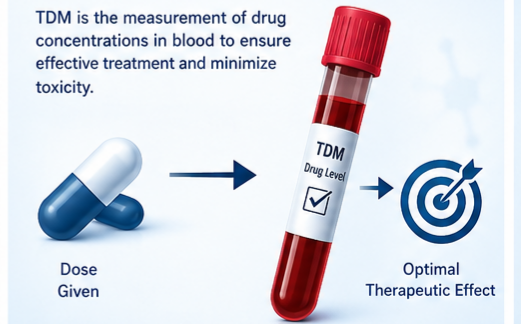
Therapeutic Drug Monitoring (TDM) is the clinical practice of measuring specific drug concentrations in a patient’s blood (or other biological samples) at designated time points, and then interpreting those results to individualize medication dosing regimens. The overarching goal is to maintain drug concentrations within a therapeutic range—a concentration window associated with optimal clinical efficacy and minimal toxicity.
TDM is not merely a laboratory test. It is an integrated, multidisciplinary process that combines:
- Pharmacokinetics: Understanding how the body absorbs, distributes, metabolizes, and eliminates the drug (ADME).
- Pharmacodynamics: Understanding the relationship between drug concentration at the site of action and the resulting clinical effect.
- Laboratory Medicine: Accurate and precise measurement of drug concentrations using validated analytical techniques.
- Clinical Decision-Making: Interpreting the measured concentration in light of the patient’s clinical status, organ function, co-medications, and genetics to recommend a personalized dose adjustment.
1.2 Why the “One-Size-Fits-All” Approach Fails
Standard drug dosing is typically derived from clinical trials that establish an effective dose for an “average” patient. However, interindividual variability—the substantial differences between patients in how they respond to and process drugs—makes this approach insufficient for many medications. Drug concentration in the body can vary dramatically due to:
- Age: Infants and elderly patients often have different drug clearance rates compared to young adults.
- Body Weight and Composition: Affects the volume of distribution for lipophilic drugs.
- Genetics: Polymorphisms in drug-metabolizing enzymes (e.g., cytochrome P450 family) can lead to ultrarapid, extensive, poor, or intermediate metabolism of a drug.
- Kidney Function: Reduced glomerular filtration leads to accumulation of renally cleared drugs.
- Liver Function: Impaired hepatic metabolism or biliary excretion can increase drug exposure.
- Drug-Drug Interactions: Concomitant medications can inhibit or induce drug metabolism.
- Disease States: Critical illness, infection, and inflammation can alter drug pharmacokinetics.
- Adherence: Inconsistent medication intake can lead to subtherapeutic trough levels.
- Pregnancy: Physiological changes can significantly accelerate drug clearance.
When a drug has a narrow therapeutic index (NTI)—meaning the difference between the minimum effective concentration (MEC) and the minimum toxic concentration (MTC) is small—these pharmacokinetic differences can have dire consequences. A small dose change may result in either treatment failure or severe toxicity.
2. The Pharmacokinetic and Pharmacodynamic Foundation of TDM
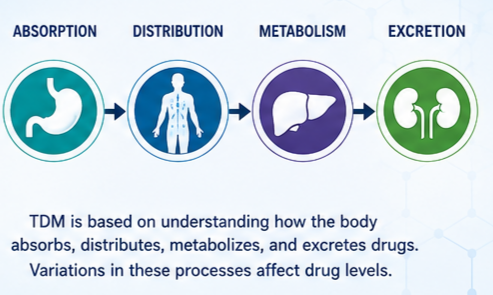 A complete understanding of TDM requires a firm grasp of fundamental pharmacokinetic and pharmacodynamic principles. The framework of TDM is that a drug’s clinical effect is more closely related to its concentration at the site of action than to the administered dose.
2.1 Key Pharmacokinetic Concepts
Pharmacokinetics describes the journey of a drug through the body: “what the body does to the drug.” It is governed by the four processes of ADME: Absorption, Distribution, Metabolism, and Excretion.
2.1.1 Absorption
Absorption refers to the movement of a drug from its site of administration into the systemic circulation.
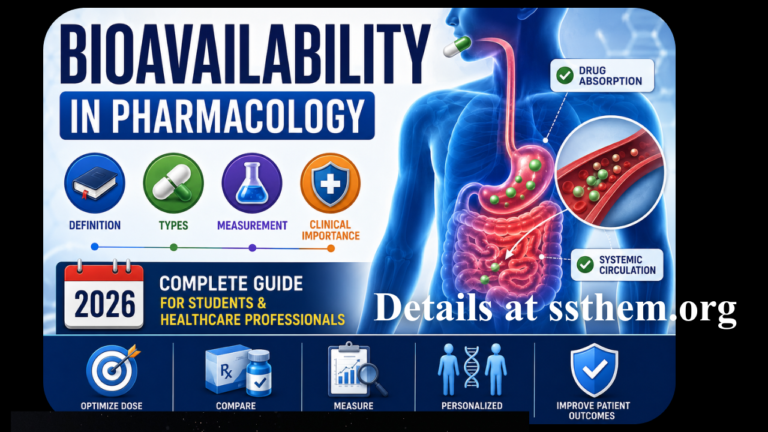
- Bioavailability (F): The fraction of an administered dose that reaches the systemic circulation unchanged. It is 100% for intravenous drugs but varies for oral drugs due to incomplete absorption and first-pass hepatic metabolism. Bioavailability is a critical factor in determining drug exposure.
- Cmax and Tmax: The maximum plasma concentration achieved and the time taken to reach it, respectively. These parameters influence the onset and peak effect of a drug.
- First-Pass Metabolism: Drugs absorbed from the gastrointestinal tract are transported via the portal vein to the liver, where they may be extensively metabolized before reaching the systemic circulation. This can significantly reduce the bioavailability of drugs like propranolol, nitroglycerin, and morphine.
2.1.2 Distribution
After absorption, a drug distributes from the circulation into tissues and organs, including the site of action.
- Volume of Distribution (Vd): A theoretical volume that describes the extent of drug distribution. It is calculated as Vd = Amount of Drug in Body / Plasma Concentration. A high Vd indicates extensive tissue binding (e.g., digoxin, amiodarone); a low Vd indicates the drug remains predominantly in the plasma (e.g., warfarin, aspirin).
- Protein Binding: Many drugs bind reversibly to plasma proteins, primarily albumin (for acidic drugs) and alpha-1-acid glycoprotein (for basic drugs). Only the free (unbound) fraction of a drug is pharmacologically active and capable of being metabolized or excreted. Changes in protein levels—such as hypoalbuminemia in liver disease or critical illness—can increase the free drug concentration, leading to increased effect or toxicity, even if the total drug concentration is within the therapeutic range. This is a critical consideration for highly protein-bound drugs like phenytoin.
2.1.3 Metabolism (Biotransformation)
Metabolism is the process by which the body chemically modifies a drug, primarily to make it more water-soluble and facilitate excretion. The liver is the primary site of drug metabolism, involving a family of enzymes known as the cytochrome P450 (CYP450) system.
- Phase I Reactions: Include oxidation, reduction, and hydrolysis, often mediated by CYP450 enzymes. These reactions can either activate or inactivate a drug, producing metabolites that may be active, inactive, or toxic.
- Phase II Reactions: Conjugation reactions (e.g., glucuronidation, sulfation) that link a drug or its Phase I metabolite to an endogenous substrate, making it highly polar and readily excretable.
Pharmacogenetics plays a significant role here. Polymorphisms in genes encoding CYP450 enzymes (e.g., CYP2D6, CYP2C19, CYP2C9, CYP3A5) create poor, intermediate, extensive, and ultrarapid metabolizer phenotypes. These genetic differences directly impact drug clearance and are increasingly used in TDM to select the right drug and dose. For instance, CYP2C9 and VKORC1 polymorphisms influence warfarin dosing, while CYP2D6 influences metabolism of many antidepressants and antipsychotics.
2.1.4 Excretion
Excretion is the irreversible elimination of a drug and its metabolites from the body. The kidneys are the principal organs of excretion for most drugs and their metabolites.
- Renal Clearance: Determined by glomerular filtration (for free, unbound drug), tubular secretion (active transport into urine), and tubular reabsorption (passive diffusion back into blood). In patients with impaired renal function, drugs cleared by the kidney (e.g., digoxin, gentamicin, vancomycin, lithium) will accumulate, and doses must be adjusted accordingly.
- Creatinine Clearance (CrCl): A bedside test used to estimate glomerular filtration rate (GFR). It is commonly calculated using the Cockcroft-Gault equation and is essential for adjusting doses of renally cleared drugs.
2.1.5 Half-Life and Steady State
- Elimination Half-Life (t½): The time required for the plasma concentration of a drug to fall by 50%. It is a function of both volume of distribution and clearance (t½ = 0.693 × Vd / Cl). The half-life determines the dosing frequency and the time required to reach steady state.
- Steady State (Css): The condition during which the rate of drug administration equals the rate of drug elimination, resulting in constant drug concentrations (with fluctuations). Steady state is typically reached after 4 to 5 half-lives of the drug. For a drug with a 24-hour half-life, it takes approximately 4-5 days to reach steady state. For TDM to be meaningful, samples must often be obtained at steady state, as concentrations before this point will continue to rise and may be falsely low.
2.2 Pharmacodynamics: Concentration at the Target Site
Pharmacodynamics describes the relationship between drug concentration and the resulting pharmacological effect—”what the drug does to the body.”
The goal of TDM is to maintain the free drug concentration at the site of action (e.g., receptors, enzymes, ion channels) within a therapeutic range that produces the desired effect while minimizing adverse reactions. For many drugs, plasma concentration is used as a surrogate marker for the concentration at the target site.
3. The Pillars of TDM: Therapeutic Range, Therapeutic Index, and the Clinical Picture
3.1 Therapeutic Range (Therapeutic Window)
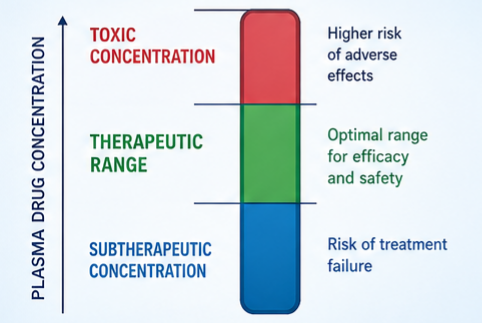
This is the defined concentration range within which a drug is expected to provide the desired therapeutic effect without unacceptable toxicity. It lies between the:
- Minimum Effective Concentration (MEC): The lowest concentration that produces a measurable therapeutic effect.
- Minimum Toxic Concentration (MTC): The concentration above which the risk of dose-related toxicity becomes clinically significant.
TDM aims to maintain drug levels within this narrow window.
3.2 Therapeutic Index (TI)
The therapeutic index is a measure of a drug’s safety margin. It is the ratio of the toxic dose to the therapeutic dose, often calculated in animal studies as LD50 (dose lethal to 50%) / ED50 (dose effective in 50%). In humans, it can be estimated as the ratio between MTC and MEC.
A narrow therapeutic index (NTI) means that the therapeutic range is very small. For drugs with an NTI, small changes in dose or pharmacokinetics can quickly lead to therapeutic failure or toxicity. Common examples include:
- Warfarin (INR): An anticoagulant whose effect (prolonged INR) is used as its own TDM marker, with a very narrow window between clots and bleeding.
- Lithium: A mood stabilizer with a narrow range (0.6–1.2 mmol/L) above which severe neurotoxicity, renal damage, and cardiac arrhythmias occur.
- Digoxin: Cardiac glycoside with a narrow range; toxicity results in arrhythmias and gastrointestinal symptoms.
- Phenytoin: Antiepileptic with non-linear pharmacokinetics; levels above 20 mcg/mL cause nystagmus, ataxia, and sedation.
- Vancomycin: Glycopeptide antibiotic with nephrotoxicity and ototoxicity risks.
- Tacrolimus and Cyclosporine: Immunosuppressants used in transplantation; subtherapeutic levels lead to rejection, while supratherapeutic levels cause nephrotoxicity and neurotoxicity.
- Aminoglycosides (Gentamicin, Tobramycin): Antibiotics causing nephrotoxicity and ototoxicity.
3.3 Clinical Interpretation: The Key Role of the Clinician
Knowing the drug concentration alone is insufficient. The TDM result must be interpreted by a clinician or clinical pharmacologist within the full clinical context:
- What is the clinical response? Is the patient improving? Are there signs of toxicity? Is treatment failing?
- What is the patient’s renal and hepatic function? Are there pharmacokinetic changes expected?
- When was the sample taken? Was it a trough, peak, or random sample? Was steady state achieved?
- What is the patient’s adherence? Does the level reflect non-compliance, or is it a true pharmacokinetic outlier?
- Are there potential drug-drug interactions? Are any new medications or OTC drugs being taken?
- What is the patient’s albumin and protein status? For highly protein-bound drugs like phenytoin, a free (unbound) drug level may be more informative than a total level.
4. When Is TDM Indicated? The Criteria for Monitoring
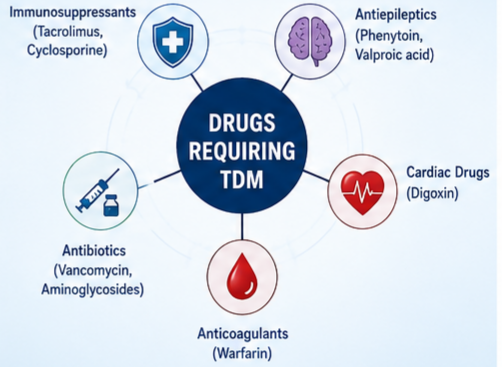
TDM is not indicated for every drug. It is a resource-intensive process that should be used strategically. The decision to employ TDM is guided by a set of clear clinical criteria:
4.1 The Core Criteria for TDM
- Narrow Therapeutic Index: The drug has a small difference between effective and toxic concentrations.
- Established Concentration-Response Relationship: There is a well-defined and validated relationship between drug concentration and both therapeutic and toxic effects.
- Large and Predictable Interindividual Variability: Pharmacokinetics vary significantly between patients, making it difficult to predict concentration from a standard dose. This variability can be due to genetics, age, organ function, or disease.
- Available and Reliable Analytical Method: A sensitive, specific, and accurate laboratory test for quantifying the drug is available (e.g., HPLC, LC-MS/MS, immunoassay).
- Dose Adjustment is Feasible: The results of TDM can be used to safely and effectively adjust the dose.
4.2 Clinical Scenarios Suggesting TDM
Even for drugs that meet the above criteria, TDM may not be required for every patient. It is often requested in specific clinical scenarios:
- Management of Suspected Toxicity: When symptoms suggestive of drug overdose appear (e.g., digoxin toxicity, lithium toxicity, phenytoin toxicity). TDM confirms the diagnosis and guides treatment.
- Treatment Failure: When a patient is not responding to a standard dose, TDM can determine if levels are subtherapeutic. This may be due to poor adherence, drug interactions, altered metabolism, or inadequate dosing.
- Drug Interactions: When a new drug is introduced that is known to significantly affect the metabolism or clearance of the monitored drug.
- Special Populations: In patients with renal or hepatic impairment, the elderly, children, critically ill patients, or pregnant women, where standard dosing may not apply.
- Long-Term Maintenance: To ensure drug levels remain in range during chronic therapy (e.g., lithium in bipolar disorder, anticonvulsants).
- Assessment of Adherence: In cases of non-adherence, TDM can reveal absent or very low drug concentrations.
5. Common Drug Classes and Specific Agents in TDM
Numerous drugs across various therapeutic classes are routinely monitored. The specific target ranges and sampling times are drug-specific and often governed by institutional protocols or established guidelines, such as those from the American Society of Health-System Pharmacists (ASHP) or the British National Formulary (BNF). Below are some key examples with reported therapeutic ranges based on clinical literature.
5.1 Anticonvulsants (Antiepileptics)
| Drug | Therapeutic Range (Total) | Key Notes |
|---|---|---|
| Phenytoin | 10–20 mcg/mL (40–80 µmol/L) | Non-linear (Michaelis-Menten) pharmacokinetics. Small dose changes cause large concentration changes. Free phenytoin monitoring is required in patients with hypoalbuminemia or uremia. Therapeutic range for free phenytoin is 1–2 mcg/mL. |
| Valproic Acid | 50–100 mcg/mL | High protein binding. Also used in bipolar disorder. Trough levels taken just before the next dose. |
| Carbamazepine | 4–12 mcg/mL | Autoinduction of metabolism occurs over 3-6 weeks, requiring dose increases. Often combined with other anticonvulsants. |
| Lamotrigine | 3–15 mcg/mL | Significant interindividual variability. Often used as adjunctive therapy for seizures. Valproic acid significantly increases its levels. |
| Phenobarbital | 15–40 mcg/mL | Long half-life, typically 50-120 hours. Can cause sedation. |
5.2 Immunosuppressants
| Drug | Therapeutic Range (Trough) | Key Notes |
|---|---|---|
| Tacrolimus | 5–15 ng/mL (varies by transplant type and time post-transplant) | Narrow therapeutic index. Metabolized by CYP3A4/5. Drug interactions common. Trough levels are the standard. |
| Cyclosporine | 100–400 ng/mL (varies) | Trough levels measured. Also available in a “C2” monitoring approach (2 hours post-dose) which may correlate better with AUC. |
| Sirolimus | 5–15 ng/mL (varies) | Often monitored alongside tacrolimus. |
5.3 Psychiatric Drugs
| Drug | Therapeutic Range | Key Notes |
|---|---|---|
| Lithium | 0.6–1.2 mmol/L | Narrow therapeutic index. Used for bipolar disorder and augmentation in depression. Toxic levels > 1.5 mmol/L cause severe neurotoxicity, renal impairment, and arrhythmias. Trough levels should be obtained 12 hours after the last dose. |
| Tricyclic Antidepressants (TCAs) | Varies by drug (e.g., nortriptyline: 50-150 ng/mL) | Due to wide interindividual variability in metabolism (CYP2D6), TDM can guide dosing to avoid cardiac toxicity. |
5.4 Antibiotics (Antimicrobials)
| Drug | Therapeutic Range | Key Notes |
|---|---|---|
| Vancomycin | Trough: 10-15 mcg/mL (for MRSA pneumonia, 15-20 mcg/mL) | Monitored for efficacy (especially in severe infections) and to prevent nephrotoxicity and ototoxicity. Trough levels are the standard. |
| Aminoglycosides | e.g., Gentamicin: Peak: 5-10 mcg/mL, Trough: <2 mcg/mL | Monitoring of both peak and trough levels may be used to optimize efficacy and prevent nephrotoxicity. |
| Voriconazole | Trough: 1–5.5 mcg/mL | Monitoring recommended to optimize antifungal effect and avoid hepatotoxicity and visual disturbances. |
5.5 Cardiovascular Drugs
| Drug | Therapeutic Range | Key Notes |
|---|---|---|
| Digoxin | 0.8–2.0 ng/mL (heart failure); 0.5–0.9 ng/mL (atrial fibrillation) | Narrow therapeutic index, especially in elderly or renal-impaired patients. Toxicity manifests as GI symptoms (nausea), visual disturbances (halos), and cardiac arrhythmias (like AV block). |
| Warfarin | INR: 2.0–3.0 (most indications); 2.5–3.5 (mechanical heart valves) | Effect monitoring (INR) is used instead of direct drug concentration, serving a similar purpose as TDM. Pharmacogenetics (CYP2C9, VKORC1) guide initial dosing. |
6. The TDM Workflow: From Collection to Clinical Action
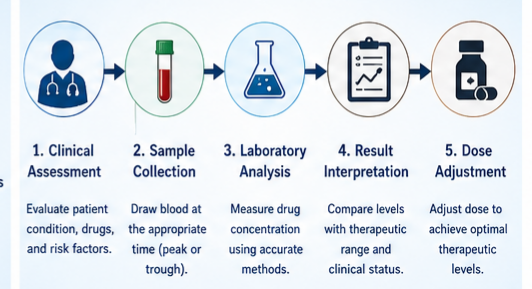
6.1 Step 1: Clinical Decision and Drug Selection
The process begins with the clinician deciding that TDM is indicated based on the criteria above. A specific drug is selected, and a monitoring protocol is chosen.
6.2 Step 2: Sample Collection and Timing
This is the most critical pre-analytical step. Inaccurate timing is a major source of misleading results.
- Trough Level (Cmin): The concentration just before administration of the next dose. This is the most common and reliable measure for most drugs, as it reflects the lowest concentration and is often best correlated with efficacy and toxicity. It is usually measured within 30 minutes of the next scheduled dose.
- Peak Level (Cmax): The maximum concentration after drug administration. Peak levels may be useful for assessing the risk of toxicity for some drugs (e.g., aminoglycosides).
- Steady State: As mentioned, sample collection should ideally occur at steady state, i.e., after 4-5 half-lives of the drug, unless a loading dose was given.
- Specimen: Venous blood is the most common specimen, but other fluids like saliva (e.g., for phenytoin or lithium) are sometimes used. The choice depends on the drug’s properties and the availability of a validated method.
Example: Trough vs. Peak Timings (Hypothetical): For a drug given every 8 hours, a trough sample is drawn immediately before the 8 am dose. A peak sample (if required, e.g., for gentamicin) is drawn approximately 30-60 minutes after the end of the IV infusion.
6.3 Step 3: Laboratory Measurement
The biological sample is analyzed using a validated laboratory method. Accuracy and precision are paramount.
- Immunoassays: These are widely used due to their convenience and automation. They use antibodies specific to the drug. However, cross-reactivity with structurally similar metabolites can lead to overestimation (as with tacrolimus).
- Chromatographic Methods (HPLC, LC-MS/MS): These are the gold standard for many drugs. They separate and quantify the drug and its metabolites, offering high specificity and sensitivity. LC-MS/MS is increasingly used due to its versatility and ability to measure multiple drugs simultaneously.
- Point-of-Care Testing (POCT): Emerging technologies aim to bring TDM closer to the patient, potentially at the bedside or in the clinic, providing rapid results. This is an active area of research.
6.4 Step 4: Clinical Interpretation and Dose Adjustment
This is the final and most crucial step. The laboratory result is interpreted by a clinician or clinical pharmacologist, who considers it alongside the patient’s clinical state, organ function, and other relevant factors to make a dosing decision.
- Linear Pharmacokinetics: If a drug follows linear PK (proportionality between dose and concentration), the new dose can be calculated using a simple proportion: (New Dose = (Target Concentration / Measured Concentration) × Current Dose). For example, if a measured trough is 4 mcg/mL and the target is 10 mcg/mL, and the current dose is 100 mg/day, the new dose would be 250 mg/day.
- Non-Linear Pharmacokinetics (Michaelis-Menten): For drugs like phenytoin, this simple proportion is dangerous. Here, small changes in dose can lead to large, unpredictable changes in concentration due to enzyme saturation. A more complex adjustment based on individual pharmacokinetic parameters is required (often using the Michaelis-Menten equation or Bayesian forecasting).
7. Advanced Concepts in Modern TDM
7.1 Pharmacogenomics (PGx) and TDM
TDM and pharmacogenomics are complementary and increasingly integrated approaches to precision medicine.
- TDM is a “Phenotypic” assessment. It measures the actual drug concentration, which represents the net effect of all genetic, physiological, and environmental factors influencing the drug’s ADME.
- Pharmacogenomics (PGx) is a “Genotypic” prediction. It identifies specific genetic variants (e.g., CYP2C19, CYP2D6, CYP3A5) that can predict a patient’s metabolic phenotype.
The synergy lies in using PGx pre-emptively to select the initial drug and starting dose, and then using TDM to monitor the actual outcome and fine-tune that dose in response to real-world patient data. For instance, a patient who is a CYP2C19 poor metabolizer of clopidogrel may not respond to that drug and should be given an alternative. A patient with a CYP2D6 ultrarapid metabolizer phenotype may require higher-than-normal doses of certain antidepressants and can be guided by TDM to ensure they reach the therapeutic range.
7.2 The Promise of Model-Informed Precision Dosing (MIPD)
MIPD is an advanced pharmacometric approach that combines TDM data with sophisticated pharmacokinetic/pharmacodynamic models and Bayesian statistics. It uses the patient’s individual characteristics (age, weight, renal function, genetic data) to predict a personalized dose. Once the first TDM concentration is obtained, it is entered into the model (through a process called Bayesian updating) to refine the dose recommendation. This is especially valuable for drugs with complex PK (like voriconazole) or in special populations.
7.3 Artificial Intelligence (AI) and TDM
AI and machine learning are being developed to assist in TDM. AI-driven algorithms can analyze large datasets to:
- Predict drug concentrations based on patient characteristics and dosing history.
- Identify patients at high risk of toxicity or therapeutic failure.
- Generate personalized dosing recommendations, acting as a clinical decision support tool for clinicians.
8. Pitfalls and Limitations of TDM
Despite its many benefits, TDM has limitations and pitfalls that clinicians must be aware of:
- Analytical Errors: The accuracy and precision of the laboratory method are critical. Interference from other drugs or metabolites can cause error.
- Sampling Errors: Incorrect timing, sample labeling, or collection method can yield misleading results.
- Interpretation Errors: A drug concentration cannot be interpreted in isolation. Clinical judgment is essential. A “normal” level might still be toxic in a patient with significant underlying disease or in an elderly patient who is more sensitive to the drug’s effects.
- Protein Binding Misinterpretation: In patients with low albumin (e.g., due to malnutrition, liver disease), total drug concentration might be misleading. Free drug concentration should be measured for highly protein-bound drugs like phenytoin.
- Not All Clinical Effects Are Concentration-Dependent: Some drugs’ effects are determined by receptor occupancy, receptor sensitivity, or the development of tolerance, not just concentration.
- TDM Is Retroactive: It detects a problem (subtherapeutic or toxic level) after it has occurred rather than preventing it proactively.
9. The Future of TDM: Towards Precision Medicine
The landscape of TDM is evolving rapidly, driven by advances in technology and a deeper understanding of pharmacology:
9.1 Point-of-Care (POC) TDM
The development of miniaturized biosensors and wearable devices promises to bring TDM to the patient’s bedside, allowing for real-time monitoring. A clinician could obtain a drug level within minutes, making immediate dose adjustments possible in critical care settings. This would be a revolution for managing life-threatening infections or immunosuppressive therapy.
9.2 Integration with Electronic Health Records (EHRs)
Seamless integration of TDM results with EHRs and clinical decision support systems will automatically alert clinicians to abnormal levels and suggest appropriate dose adjustments based on the latest guidelines and patient-specific data.
9.3 “Omics” Integration
Combining TDM with pharmacogenomics, metabolomics, and proteomics will create a comprehensive view of a patient’s drug response, allowing for even more precise dose tailoring.
9.4 Liquid Biopsies
Techniques to sample small amounts of blood for molecular analysis may provide novel tools to assess hepatic drug metabolism gene expression, augmenting standard TDM.
Summary of Key Points
| Concept | Definition/Description |
|---|---|
| Definition | Clinical practice of measuring drug concentrations to individualize dosing. |
| Pharmacokinetics (PK) | ADME: Absorption, Distribution, Metabolism, Excretion. “What the body does to the drug.” |
| Pharmacodynamics (PD) | Relationship between drug concentration and its effect. “What the drug does to the body.” |
| Therapeutic Range (Window) | Concentration range between MEC and MTC. |
| Therapeutic Index | Ratio between toxic and effective doses. Narrow TI = high risk. |
| Indications for TDM | Narrow TI; variable PK; suspected toxicity; treatment failure; drug interactions; special populations. |
| Key Drugs Monitored | Antiepileptics, immunosuppressants, aminoglycosides, vancomycin, lithium, digoxin. |
| Sample Types | Trough (most common), peak, random. Must be timed correctly. |
| Analytical Methods | Immunoassays, HPLC, LC-MS/MS (gold standard), emerging POCT. |
| Clinical Utility | Improves efficacy, reduces toxicity, enables personalized therapy, reduces hospitalizations. |
| Integration | With pharmacogenomics and MIPD for precision medicine. |
Question . What is the difference between TDM and routine drug testing?
Question . Is TDM needed for every drug?
Question . What are the most common drugs that require TDM in a hospital setting?
Question . Why is the timing of sample collection so important for TDM?
Question . Can pharmacogenomics replace TDM?
Question . What is the role of a clinical pharmacist in TDM?
Therapeutic Drug Monitoring is an essential pillar of modern clinical pharmacology and personalized medicine. It moves prescribing away from standardized, one-size-fits-all dosing towards a science-based, individualized approach. By systematically measuring drug concentrations and integrating this information with the patient’s clinical picture, TDM empowers clinicians to maximize drug efficacy, prevent serious adverse drug reactions, and dramatically improve patient outcomes.
The future of TDM lies in the integration of pharmacogenomics, model-informed precision dosing, artificial intelligence, and point-of-care technologies to make it an even more powerful, accessible, and proactive tool for healthcare. For the clinician, a thorough understanding of TDM principles is no longer a specialty skill but a core competency for rational, evidence-based pharmacotherapy.
Disclaimer: This article is for educational and informational purposes only and does not constitute medical advice. Always consult a qualified healthcare professional for diagnosis and treatment. Drug dosages and therapeutic ranges may vary; follow current clinical guidelines and local protocols.