25 Powerful Drug Clearance Facts Complete Pharmacology Guide with Formula, Types & Clinical Applications
Drug Clearance Explained: Definition, Formula, Types, Calculation & Clinical Applications
Drug clearance is one of the most fundamental concepts in clinical pharmacology and pharmacokinetics. It serves as the cornerstone for understanding how the body eliminates medications and, consequently, how to design safe and effective dosing regimens. For healthcare professionals, medical students, and researchers, a thorough grasp of drug clearance is essential for optimizing pharmacotherapy, preventing adverse drug reactions, and personalizing treatment for patients with organ dysfunction.
This comprehensive guide explores every facet of drug clearance—from its basic definition and mathematical formulas to its clinical applications in therapeutic drug monitoring and dose adjustment. Whether you are preparing for pharmacology examinations, managing complex patient cases, or developing new therapeutic agents, this resource provides the evidence-based foundation you need .
اسلامی معلومات | Islamic Knowledge قرآن، حدیث، انبیاء کرام، اسلامی تاریخ اور مذاہب کے بارے میں مستند اور تحقیقی معلومات ایک جگہ حاصل کریں۔ علم بڑھائیں، تحقیق کریں اور نئی معلومات دریافت کریں۔ Visit: ssthem.com
What Is Drug Clearance?
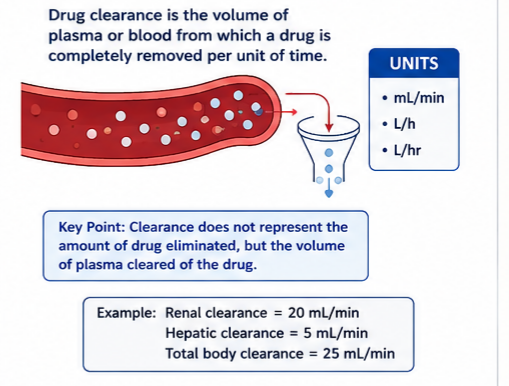
Drug clearance is defined as the volume of plasma or blood from which a drug is completely removed per unit of time . The standard units for clearance are volume per time, such as mL/min, L/h, or L/hr . This parameter reflects the efficiency of the body’s elimination processes without specifying the individual mechanisms involved .
A critical distinction must be made: clearance does not represent the amount of drug eliminated but rather the volume of biological fluid cleared of the drug. For example, if a drug has a renal clearance of 20 mL/min and hepatic clearance of 5 mL/min, the total body clearance would be 25 mL of plasma cleared of the drug per minute .
Historical Background
The concept of clearance originated in renal physiology before being adapted to pharmacology. Initially used to quantify kidney function through creatinine clearance, the principle was extended to describe drug elimination from the body . This evolution has made clearance the most clinically relevant parameter for determining dosing regimens of systemically administered drugs .
Learning Objectives
After reviewing this comprehensive guide, you will be able to:
- Define drug clearance and differentiate it from other pharmacokinetic parameters
- Apply the drug clearance formula to calculate total body clearance
- Distinguish between renal, hepatic, and other organ-specific clearance mechanisms
- Understand how the renal clearance model incorporates glomerular filtration, secretion, and reabsorption
- Explain hepatic clearance using the well-stirred model and extraction ratio concepts
- Differentiate between high-extraction and low-extraction drugs
- Recognize factors affecting drug clearance including age, disease states, and drug interactions
- Apply clearance principles to dose adjustment in renal and hepatic impairment
- Distinguish between clearance, elimination half-life, and volume of distribution
- Interpret clearance calculations in therapeutic drug monitoring
Why Drug Clearance Is Important
Drug clearance is the primary determinant for developing dosing regimens for long-term systemic therapy . Its clinical significance cannot be overstated:
- Dosing Rate Determination: At steady state, the dosing rate must equal the rate of drug elimination. The relationship is defined by the equation: Dosing rate = Clearance × Desired steady-state concentration
- Patient Safety: For patients with renal or hepatic disease, drug clearance can be severely affected, necessitating careful dose adjustment to prevent adverse drug effects .
- Therapeutic Drug Monitoring: Clearance values guide the monitoring of drugs with narrow therapeutic indices, such as aminoglycosides, vancomycin, and digoxin.
- Bioavailability Assessment: Clearance is central to calculating bioavailability and understanding systemic drug exposure (AUC) .
Basic Pharmacokinetic Principles
Units of Drug Clearance :- Drug clearance is expressed as volume per unit time:
- mL/min (common in clinical practice)
- L/h (frequently used in pharmacokinetic studies)
- L/hr (alternative notation)
For most adults, total body clearance ranges from less than 1 mL/min to several L/min, depending on the drug’s elimination characteristics. The maximum theoretical clearance is limited by cardiac output (approximately 5 L/min for blood) .
Drug Clearance Formula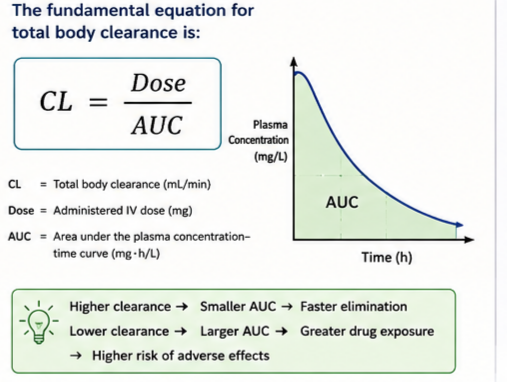 : The fundamental equation for total body clearance is:
CL = Dose / AUC
Where:
CL = Total body clearance
Dose = Administered intravenous dose (assuming complete bioavailability)
AUC = Area under the plasma concentration-time curve
This equation demonstrates that for a given dose, a higher clearance results in a smaller AUC, meaning the drug is eliminated more rapidly. Conversely, reduced clearance leads to greater drug exposure (larger AUC) and increased risk of adverse effects .
Total Body Clearance
Total body clearance (CLtotal) represents the sum of all organ-specific clearance mechanisms:
CLtotal = CLrenal + CLhepatic + CLpulmonary + CLother
This additive property is a fundamental principle in pharmacokinetics . For most drugs, the primary eliminating organs are the kidneys and liver, but other routes may contribute significantly for specific agents.
Organ Clearance
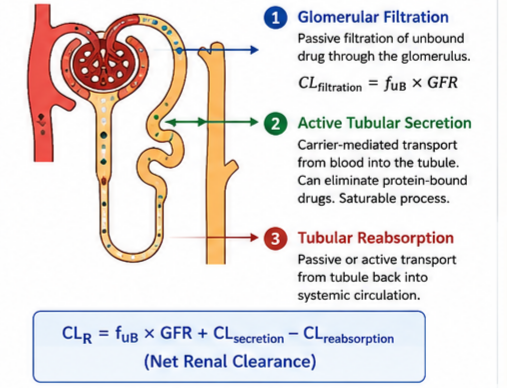
Renal Clearance : Renal clearance is the volume of plasma from which a drug is eliminated by the kidneys per unit time . This process involves three primary mechanisms :
- 1. Glomerular Filtration: Passive filtration of unbound drug through the glomerulus. The rate is calculated as: CLfiltration = fuB × GFR where fuB is the fraction of drug unbound in blood and GFR is glomerular filtration rate (approximately 120 mL/min in healthy young males) .
- 2. Active Tubular Secretion: Carrier-mediated transport of drugs from blood into the renal tubule. This process can eliminate protein-bound drugs and is saturable.
- 3. Tubular Reabsorption: Passive or active transport of drugs from the tubule back into the systemic circulation.
The operational renal clearance equation is:
CLR = fuB × GFR + CLsecretion – CLreabsorption
where CLsecretion is tubular secretion clearance and CLreabsorption is tubular reabsorption clearance .
Hepatic Clearance
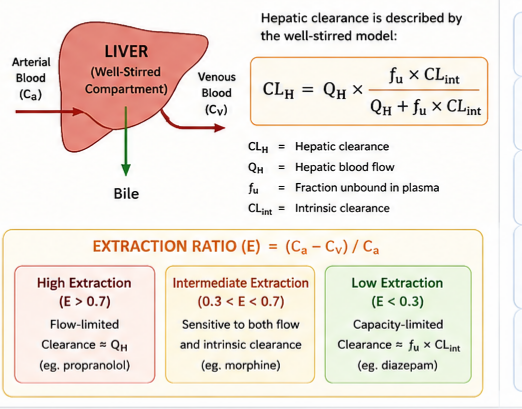
Hepatic clearance refers to the volume of blood perfusing the liver that is cleared of drug per unit time . Hepatic elimination occurs through:
- Metabolism (biotransformation to more polar, water-soluble metabolites)
- Biliary excretion (elimination of unchanged drug into bile)
The liver is the primary site of drug metabolism, transforming lipophilic drugs into more hydrophilic compounds that can be readily excreted in urine or bile . For many drugs, metabolic clearance and biliary clearance operate in parallel .
Pulmonary Clearance
For certain drugs, particularly volatile anesthetics, pulmonary clearance can be significant. These agents are eliminated through exhalation .
Biliary Clearance
Biliary excretion eliminates unchanged drugs and metabolites through the bile into the gastrointestinal tract. This represents a component of hepatic clearance .
Intestinal Clearance
Some drugs undergo intestinal metabolism and secretion, representing a less common but relevant pathway for certain compounds .
Mechanism of Drug Clearance
Renal Drug Clearance The kidney eliminates drugs through three distinct processes that occur in sequence along the nephron .
Glomerular Filtration
Glomerular filtration is a passive, nonsaturable process. Only unbound drug molecules (not bound to plasma proteins) that are small enough (< 20,000 Daltons) pass through the glomerular membrane. Factors affecting glomerular filtration:
- Protein binding: Only free drug is filtered; reduced protein binding increases filtration
- GFR: Decreased GFR (e.g., in renal disease, aging) reduces drug clearance
- Drug molecular weight: Larger molecules are filtered less efficiently
The glomerular filtration clearance is calculated as the product of the fraction unbound and GFR .
Active Tubular Secretion
Active tubular secretion occurs in the proximal tubule via transporter proteins. This process:
- Is energy-dependent and saturable (follows Michaelis-Menten kinetics at high concentrations)
- Can eliminate protein-bound drugs
- Is subject to drug-drug interactions (competition for transporters)
- Accounts for the rapid elimination of many organic acids and bases
Transporter systems involved include:
Organic anion transporters (OAT)
Organic cation transporters (OCT)
P-glycoprotein and other ABC transporters
Tubular Reabsorption
Tubular reabsorption moves drugs from the renal tubule back into the blood. This occurs primarily in the distal tubule and collecting duct. Reabsorption:
- Is influenced by urine pH (nonionized drugs are more lipid-soluble and reabsorbed)
- Depends on urine flow rate
- Is passive (for lipophilic drugs) or active (for specific compounds)
The net renal clearance is the sum of filtration and secretion minus reabsorption .
Hepatic Drug Clearance
The liver’s ability to clear drugs depends on three primary factors :
Liver Blood Flow:
Hepatic blood flow (QH) determines the rate of drug delivery to the liver. In a healthy adult, hepatic blood flow is approximately 1500 mL/min . For drugs with high extraction ratios, clearance is blood flow-limited.
Intrinsic Clearance
Intrinsic clearance (CLint) represents the liver’s inherent capacity to metabolize or excrete a drug in the absence of blood flow and protein binding restrictions . This parameter reflects:
- Hepatic enzyme activity (Vmax and Km for metabolism)
- Transporter efficiency
- Hepatocellular mass and function
For first-order metabolism, CLint represents the ratio of Vmax to Km .
Protein Binding
Only the unbound (free) fraction of a drug is available for hepatic uptake and metabolism. The unbound fraction (fu) influences hepatic clearance according to the well-stirred model :
CLH = QH × [fu × CLint / (QH + fu × CLint)]
The impact of protein binding depends on the drug’s extraction ratio.
Extraction Ratio
The extraction ratio (E) is the fraction of drug removed during a single pass through the liver :
E = (Ca – Cv) / Ca
Where:
Ca = Arterial concentration entering the liver
Cv = Venous concentration leaving the liver
The extraction ratio determines hepatic clearance:
CLH = QH × E
Drugs are classified by their extraction ratio:
- High extraction ratio (E > 0.7): Clearance is blood flow-limited (e.g., propranolol, lidocaine)
- Intermediate extraction ratio (0.3 < E < 0.7): Clearance is sensitive to changes in blood flow, protein binding, and intrinsic clearance
- Low extraction ratio (E < 0.3): Clearance is capacity-limited and sensitive to changes in intrinsic clearance
Well-Stirred Model of Hepatic Clearance
The well-stirred model is the most commonly used model for describing hepatic clearance . It assumes that the liver is a single well-mixed compartment where the drug concentration in the liver equals the concentration leaving the liver.
The model incorporates blood flow (QH), fraction unbound (fu), and intrinsic clearance (CLint):
CLH = QH × [fu × CLint / (QH + fu × CLint)]
This model explains two limiting cases:
- Case 1: Restrictive Elimination (fu × CLint << QH)
CLH ≈ fu × CLint- Clearance is limited by protein binding and metabolic capacity
- Changes in blood flow have minimal effect
- Changes in protein binding significantly affect clearance
- Drugs with low extraction ratio (e.g., diazepam, warfarin)
- Case 2: Non-Restrictive Elimination (fu × CLint >> QH)
CLH ≈ QH- Clearance is limited by hepatic blood flow
- Protein binding changes do not affect clearance
- Changes in blood flow (e.g., heart failure, cirrhosis) significantly affect clearance
- Drugs with high extraction ratio (e.g., propranolol, morphine)
First-Pass Metabolism and Clearance
First-pass metabolism refers to drug loss during initial passage through the liver after oral administration. This significantly impacts bioavailability and clearance .
Oral Clearance: When absolute bioavailability is unknown, oral clearance (CL/F) is calculated from oral dosing data. This should not be confused with actual clearance, as drugs with high first-pass metabolism will have higher oral clearance than actual clearance .
Impact on Clinical Practice:
– For drugs with extensive first-pass metabolism (e.g., propranolol, nitroglycerin), oral doses must be higher than intravenous doses
– Changes in hepatic blood flow or function can significantly alter systemic exposure
– First-pass metabolism contributes to inter-individual variability in drug response
Clearance and Volume of Distribution
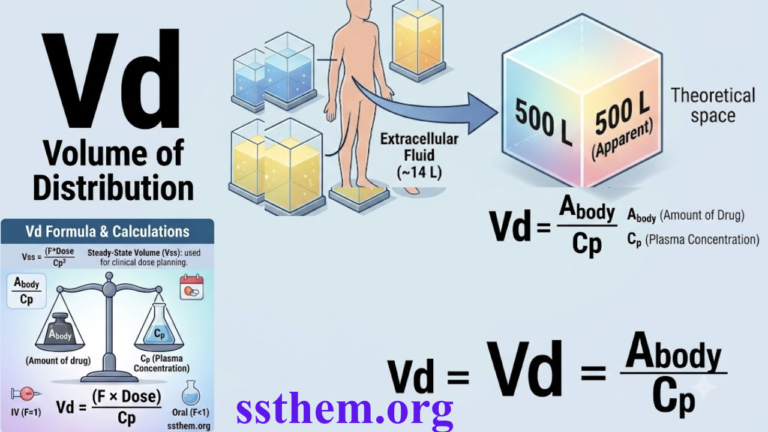
Clearance is mathematically distinct from volume of distribution (Vd), though they are related through elimination half-life:
t1/2 = 0.693 × Vd / CL
This relationship means:
– Clearance determines the rate of drug elimination
– Volume of distribution influences the duration of drug action (half-life)
– For a given clearance, a larger Vd results in a longer half-life
Clearance and Steady-State Concentration
At steady state, the rate of drug administration equals the rate of elimination. The steady-state concentration (Css) is determined by:
Css = Dosing Rate / CL
For intravenous infusion:
Css = Infusion Rate / CL
This fundamental relationship explains why:
– Patients with reduced clearance require lower dosing rates to avoid toxicity
– Loading doses (to achieve therapeutic concentrations rapidly) are based on Vd, while maintenance doses are based on CL
– Changes in clearance (due to disease, age, drug interactions) require dose adjustment
Clearance and Maintenance Dose
The maintenance dose required to achieve a desired steady-state concentration is:
Maintenance Dose = CL × Css × Dosing Interval
This calculation assumes complete bioavailability (F = 1). For oral administration:
Oral Maintenance Dose = CL × Css × Dosing Interval / F
Factors Affecting Drug Clearance
Age
Neonates: Drug clearance is reduced due to immature metabolic enzymes and renal function. Glomerular filtration, tubular secretion, and hepatic enzyme activity are lower in neonates, necessitating dose reductions for many drugs .
Older Adults: Clearance decreases with age for many drugs due to:
– Reduced renal function (GFR decreases approximately 10% per decade after age 40)
– Decreased hepatic mass and blood flow
– Altered enzyme activity
Sex : While less studied than age effects, sex differences in drug clearance exist due to hormonal influences on enzyme activity and differences in body composition .
Genetics : Genetic polymorphisms in drug-metabolizing enzymes and transporters significantly affect clearance . Examples include:
– CYP2D6 polymorphisms affecting clearance of antidepressants and antipsychotics
– CYP2C9 variants affecting warfarin clearance
– OATP transporter polymorphisms affecting statin disposition
Body Weight and Obesity
Obesity affects drug clearance through:
– Increased renal clearance for some drugs (increased renal blood flow)
– Altered hepatic enzyme activity
– Changes in body composition affecting volume of distribution
Pregnancy : During pregnancy, drug clearance changes due to:
– Increased renal blood flow and GFR (increasing renal clearance)
– Altered hepatic enzyme activity (particularly CYP3A4 and CYP2D6)
– Increased plasma volume and decreased protein binding
Liver Disease : Liver disease significantly affects hepatic clearance:
– Cirrhosis: Reduced metabolic enzyme activity and altered hepatic blood flow
– Hepatitis: Acute inflammation can reduce clearance
– Portal hypertension: Shunting reduces drug delivery to hepatocytes
For severe liver disease, maintenance doses should be reduced based on the percent of hepatic clearance of the drug .
Kidney Disease : Renal disease reduces renal clearance:
– Acute kidney injury: Decreased GFR, impaired tubular secretion
– Chronic kidney disease: Progressive loss of nephrons; clearance is related to GFR
– Nephrotic syndrome: Increased Vd due to protein loss; altered clearance
Drug companies often provide dosing guidelines for each stage of renal disease, and dose reductions are frequently necessary .
Heart Failure : Heart failure affects clearance through:
– Reduced cardiac output reducing renal and hepatic blood flow
– Decreased renal perfusion reducing GFR
– Reduced hepatic blood flow affecting high-extraction drugs
Sepsis: Sepsis alters clearance through:
– Organ dysfunction (renal, hepatic)
– Altered protein binding (acute phase response)
– Changes in tissue perfusion
Burns : Burn injuries affect clearance through:
– Increased glomerular filtration and renal clearance
– Altered protein binding
– Increased metabolic rate
Drug Interactions
Drug-drug interactions affect clearance through:
– Enzyme inhibition: Reduced metabolism (e.g., cimetidine inhibits CYP450)
– Enzyme induction: Increased metabolism (e.g., rifampin induces CYP3A4)
– Transporter competition: Reduced secretion or increased reabsorption
– Protein binding displacement: Altered free drug concentrations
High-Extraction vs Low-Extraction Drugs
This classification is crucial for predicting how disease states and drug interactions affect clearance.
High-Extraction Drugs (E > 0.7)
– Examples: Propranolol, lidocaine, morphine, verapamil
– Clearance is blood flow-limited
– Protein binding changes have minimal effect
– Reduced cardiac output or hepatic blood flow decreases clearance
– Enzyme inhibition/induction has minimal effect
Low-Extraction Drugs (E < 0.3)
– Examples: Diazepam, warfarin, phenytoin, theophylline
– Clearance is capacity-limited (enzyme-dependent)
– Protein binding changes significantly affect clearance
– Blood flow changes have minimal effect
– Enzyme inhibition/induction significantly affect clearance
Linear and Nonlinear Clearance
First-Order (Linear) Kinetics
The vast majority of drugs exhibit first-order elimination:
– A constant fraction of the drug is cleared per unit time
– Clearance is independent of concentration
– Elimination is not saturated
Characteristics:– Clearance remains constant over clinical concentration ranges
– Dosing rate increases produce proportional increases in steady-state concentration
– Most drugs follow first-order kinetics at therapeutic doses
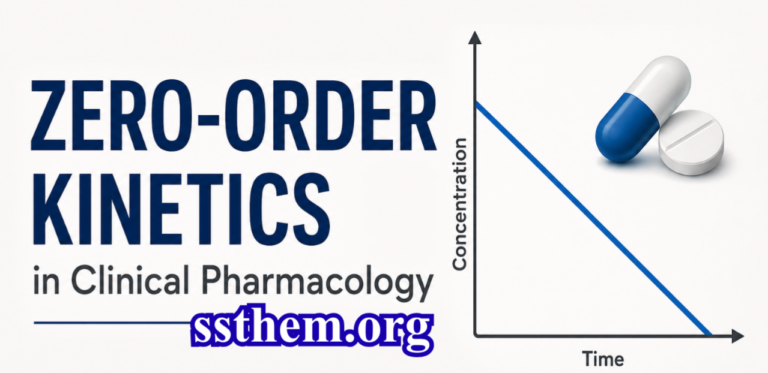
Zero-Order (Nonlinear) Kinetics
Some drugs exhibit saturable elimination:
– A constant amount of drug is eliminated per unit time
– Clearance is concentration-dependent
– Elimination pathways are saturated at therapeutic concentrations
Examples: Phenytoin, aspirin (at high doses), ethanol
Clinical Implications: – Small dose increases can cause disproportionately large increases in concentration
– Clearance decreases as concentration increases
– Therapeutic drug monitoring is essential for drugs with nonlinear kinetics
– The Michaelis-Menten equation (Vmax and Km) is used to characterize nonlinear clearance
Capacity-Limited Elimination
When elimination pathways become saturated, clearance decreases with increasing concentration. This can lead to:
– Prolonged half-life at higher doses
– Increased risk of toxicity
– Nonlinear relationship between dose and steady-state concentration
Saturable Clearance Saturable clearance occurs when drug concentration exceeds the capacity of elimination processes (enzymes or transporters). This follows Michaelis-Menten kinetics:
Rate of elimination = Vmax × C / (Km + C)
Where:
Vmax = Maximum elimination rate
Km = Concentration at which elimination is half-maximal
C = Drug concentration
Clinical Relevance: – Some drugs exhibit saturable clearance at therapeutic concentrations (e.g., phenytoin)
– Saturable clearance can lead to significant accumulation with dose increases
– TDM is essential for drugs with saturable clearance
Clearance Calculations
Creatinine Clearance : Creatinine clearance (CrCl) is used as a marker of renal function and to estimate GFR for dose adjustment. While creatinine is not a drug, its clearance provides a measure of kidney function essential for dosing drugs that are renally eliminated.
Clinical Use: CrCl is used to adjust doses of renally cleared drugs, particularly those with narrow therapeutic indices (e.g., aminoglycosides, vancomycin).
Estimated GFR : Estimated GFR (eGFR) is calculated using serum creatinine, age, sex, and race. Several equations are used clinically.
Cockcroft–Gault Equation
The Cockcroft-Gault equation is widely used for drug dosing:
CrCl (mL/min) = [(140 – age) × weight (kg)] / [72 × SCr (mg/dL)] × (0.85 for females)
This equation provides an estimate of creatinine clearance, which correlates with GFR and is used to guide dosing of renally eliminated drugs. However, it has limitations, particularly in patients with low muscle mass or extremes of weight.
MDRD Equation : The Modification of Diet in Renal Disease (MDRD) equation estimates GFR:
eGFR = 175 × (SCr)^-1.154 × (age)^-0.203 × (0.742 if female) × (1.212 if African American)
While more accurate for estimating GFR, the MDRD equation may underestimate renal function in patients with normal or near-normal kidney function.
CKD-EPI Equation: The Chronic Kidney Disease Epidemiology Collaboration (CKD-EPI) equation is increasingly preferred:
– More accurate than MDRD at higher GFR values
– Expressed as:
– For females: 144 × (SCr/0.7)^-0.329 × (0.993)^age × (1.159 if African American)
– For males: 141 × (SCr/0.9)^-0.411 × (0.993)^age × (1.159 if African American)
Clinical Importance of Drug Clearance
Therapeutic Drug Monitoring
Therapeutic Drug Monitoring (TDM) relies on clearance principles to optimize therapy for drugs with:
– Narrow therapeutic indices
– Significant pharmacokinetic variability
– Clinical effects that are difficult to monitor
Process:
1. Measure drug concentration at steady state
2. Calculate individual clearance using: CL = (Dosing Rate) / Css
3. Adjust dose to achieve desired concentration: New Dose = CL × Target Css
Drugs commonly monitored:
– Aminoglycosides (gentamicin, tobramycin)
– Vancomycin
– Digoxin
– Phenytoin
– Theophylline
– Cyclosporine and tacrolimus
Dose Adjustment in Renal Impairment
Renal impairment requires dose adjustment based on:
– The fraction of drug excreted unchanged renally (fe)
– The patient’s estimated GFR (eGFR)
– The drug’s therapeutic index
General principles:
– For drugs with high renal excretion (fe > 0.6), significant dose reduction is needed
– For drugs with low renal excretion (fe < 0.3), dose adjustment may be unnecessary
– Dosing intervals may be extended (e.g., aminoglycosides) or doses reduced (e.g., vancomycin)
Dose adjustment strategies:
– Reduce dose: For drugs with time-dependent killing (e.g., β-lactams)
– Extend interval: For concentration-dependent drugs (e.g., aminoglycosides)
– Both dose reduction and interval extension: For drugs with high toxicity risk
Dose Adjustment in Hepatic Disease
Hepatic disease requires careful consideration of:
– Drug extraction ratio (high vs. low extraction)
– Protein binding changes
– Impact of disease on metabolic capacity
General principles:
– High-extraction drugs: Dose reduction may be needed due to reduced hepatic blood flow and shunting
– Low-extraction drugs: Dose reduction may be needed due to reduced intrinsic clearance (metabolic capacity)
– Drugs with extensive protein binding: Monitor free drug concentrations
Common Drugs Requiring Clearance Monitoring
| Drug Class | Specific Drugs | Monitoring Parameter | Rationale |
|---|---|---|---|
| Antibiotics | Gentamicin, Tobramycin, Vancomycin | Serum concentrations, Renal function | Narrow therapeutic index, nephrotoxicity |
| Cardiovascular | Digoxin | Serum concentration | Narrow therapeutic index, renal elimination |
| Antiepileptics | Phenytoin, Carbamazepine | Serum concentrations, Hepatic function | Saturable kinetics, drug interactions |
| Immunosuppressants | Cyclosporine, Tacrolimus | Trough concentrations | Narrow therapeutic index, variable clearance |
| Anticoagulants | Warfarin | INR, PT | Variable clearance, drug interactions |
| Theophylline | Theophylline | Serum concentration | Saturable kinetics, variable metabolism |
Clinical Case Examples
Case 1: Aminoglycoside Dosing in Renal Impairment
Scenario: A 65-year-old male weighing 80 kg with an estimated creatinine clearance of 30 mL/min requires gentamicin for a gram-negative infection.
Pharmacokinetic principles:
– Gentamicin is primarily renally eliminated
– Standard dosing: 5-7 mg/kg/day, but dose must be adjusted for CrCl
– Extended-interval dosing is preferred (once daily) for efficacy and safety
Recommended approach:
– Use extended interval dosing: 5 mg/kg IV (for severe infections)
– Prolong the dosing interval based on CrCl (e.g., every 36-48 hours)
– Monitor serum peak and trough concentrations to guide further adjustment
Clinical rationale: Reduced GFR in this patient means decreased gentamicin clearance. Dosing according to kidney function prevents accumulation and minimizes risk of nephrotoxicity and ototoxicity.
Case 2: Hepatic Clearance and Drug Interaction
Scenario: A patient on chronic warfarin therapy (low-extraction drug, E < 0.3) is started on amiodarone, a potent CYP2C9 inhibitor.
Pharmacokinetic principles:
– Warfarin is primarily metabolized by CYP2C9 (low-extraction drug)
– Clearance is capacity-limited (enzyme-dependent)
– Amiodarone inhibits CYP2C9, reducing warfarin clearance by approximately 30-50%
Recommended approach:
– Reduce warfarin dose by approximately 40% upon initiating amiodarone
– Monitor INR closely and titrate to target range
– Adjust dose based on INR response
Clinical rationale: Enzyme inhibition reduces metabolic clearance of warfarin, increasing systemic exposure and risk of bleeding. Dose reduction is necessary to maintain therapeutic INR.
Case 3: High-Extraction Drug in Heart Failure
Scenario: A patient with congestive heart failure is prescribed propranolol (high-extraction drug, E > 0.7) for rate control.
Pharmacokinetic principles:
– Propranolol clearance is blood flow-limited
– Heart failure reduces hepatic blood flow (QH)
– Reduced QH decreases propranolol clearance
Recommended approach:
– Begin with a lower dose (e.g., 10 mg twice daily) and titrate slowly
– Monitor heart rate and blood pressure closely
– Consider using a drug with predominantly renal clearance if available
Clinical rationale: Reduced cardiac output decreases hepatic blood flow, reducing propranolol clearance and increasing systemic exposure. Dose reduction is necessary to achieve desired therapeutic effect and avoid adverse effects.
Drug Clearance vs Half-Life
While clearance and half-life are related, they represent distinct pharmacokinetic parameters:
| Parameter | Definition | Clinical Relevance |
|---|---|---|
| Clearance (CL) | Volume of plasma cleared of drug per unit time (mL/min) | Determines steady-state concentration and maintenance dose |
| Half-life (t1/2) | Time required for drug concentration to decrease by 50% (hours) | Determines time to steady state and dosing interval |
Relationship: t1/2 = 0.693 × Vd / CL
Clinical Implications:
– Changes in clearance or Vd affect half-life
– Prolonged half-life may require loading doses to reach therapeutic levels faster
– While clearance is the primary determinant of maintenance dose, half-life determines dosing frequency
Key Points:
– Drugs with large Vd and low clearance have long half-lives
– Reducing clearance (e.g., due to organ dysfunction) prolongs half-life
– Changes in Vd alone (without changes in clearance) change half-life but not steady-state concentration
Drug Clearance vs Elimination Rate Constant
| Parameter | Definition | Clinical Relevance |
|---|---|---|
| Clearance (CL) | Volume of plasma cleared per unit time (mL/min) | Independent of concentration (first-order kinetics) |
| Elimination Rate Constant (k) | Fraction of drug eliminated per unit time (hr⁻¹) | Determines elimination rate and half-life |
Relationship: k = CL / Vd
Key Points:
– Clearance is more clinically useful for dose adjustment (relates to steady-state concentration)
– The elimination rate constant determines the rate of decline in drug concentration
– Both parameters are affected by changes in organ function or drug interactions
Drug Clearance vs Bioavailability
| Parameter | Definition | Clinical Relevance |
|---|---|---|
| Clearance (CL) | Volume of plasma cleared per unit time (mL/min) | Systemic elimination rate |
| Bioavailability (F) | Fraction of dose reaching systemic circulation (%) | Extent of absorption and first-pass metabolism |
Relationship: AUC = (F × Dose) / CL
Clinical Implications: – For intravenous drugs, F = 1 (complete bioavailability)
– For oral drugs, F < 1 due to incomplete absorption and first-pass metabolism
– Changes in bioavailability (e.g., due to drug interactions) affect systemic exposure even with unchanged clearance
Drug Clearance vs Volume of Distribution
| Parameter | Definition | Clinical Relevance |
|---|---|---|
| Clearance (CL) | Volume of plasma cleared per unit time (mL/min) | Elimination rate, determines maintenance dose |
| Volume of Distribution (Vd) | Apparent volume in which drug distributes (L) | Determines loading dose, prolongs half-life |
Relationship: t1/2 = 0.693 × Vd / CL
Clinical Implications:
– Vd affects the peak concentration after a dose, while CL determines the rate of decline
– Drugs with large Vd require higher loading doses to achieve therapeutic concentrations
– Changes in Vd can affect half-life without changing CL
Drug Clearance vs Drug Metabolism
| Parameter | Definition | Clinical Relevance |
|---|---|---|
| Clearance (CL) | Volume of plasma cleared per unit time (mL/min) | Total elimination from body |
| Drug Metabolism | Chemical modification of drug to more polar metabolites | Hepatic clearance component (metabolic clearance) |
Relationship: Hepatic clearance includes metabolic clearance plus biliary excretion
Clinical Implications:
– Metabolism is only one component of drug clearance
– Other processes (renal excretion, biliary elimination) also contribute to total clearance
– Genetic polymorphisms in metabolic enzymes affect metabolic clearance
Common Misconceptions About Drug Clearance
- Myth 1: Clearance represents the amount of drug eliminated
Reality: Clearance represents the volume of plasma cleared of drug per unit time, not the actual amount eliminated . - Myth 2: Clearance is the same as excretion rate
Reality: Excretion rate is the actual amount of drug eliminated per unit time (mg/min), whereas clearance is volume per time (mL/min). - Myth 3: Drugs with longer half-life have lower clearance
Reality: Half-life depends on both clearance and volume of distribution. A long half-life can result from low clearance OR large volume of distribution. - Myth 4: Clearance is always constant
Reality: Clearance is constant only for drugs following first-order (linear) kinetics. For drugs with saturable elimination (zero-order kinetics), clearance varies with concentration. - Myth 5: Renal clearance equals GFR
Reality: Renal clearance may be greater than, equal to, or less than GFR depending on the relative contributions of secretion and reabsorption .
Key Takeaways
- Clearance Definition: Drug clearance is the volume of plasma cleared of drug per unit time (mL/min, L/h). It reflects the body’s efficiency in eliminating a drug .
- Additive Nature: Total body clearance is the sum of all organ clearances (renal, hepatic, pulmonary, biliary, and intestinal) .
- Clinical Significance: Clearance is the primary determinant of steady-state drug concentration and, consequently, dosing rate. Clearance drives dose selection and adjustment .
- Renal Clearance: Renal clearance results from glomerular filtration (fuB × GFR) plus active tubular secretion minus tubular reabsorption .
- Hepatic Clearance: Hepatic clearance is described by the well-stirred model, incorporating blood flow (QH), intrinsic clearance (CLint), and protein binding (fu) .
- Extraction Ratio: Drugs are classified as high-extraction (flow-limited) or low-extraction (capacity-limited) based on their hepatic extraction ratio .
- Disease States: Renal disease, liver disease, heart failure, and sepsis significantly affect drug clearance and require careful dose adjustment .
- Age Effects: Both neonates and older adults have reduced drug clearance, requiring careful dose selection .
- Kinetics: Most drugs follow first-order kinetics (constant clearance), but some drugs exhibit zero-order (saturable) kinetics where clearance varies with concentration .
- Clinical Application: Therapeutic drug monitoring, dose adjustment in organ impairment, and drug interaction management all rely on understanding clearance principles.
1. What is drug clearance in pharmacology?
2. How is drug clearance calculated?
3. What are the units of drug clearance?
4. What is the difference between clearance and half-life?
5. How does renal disease affect drug clearance?
6. How does liver disease affect drug clearance?
7. What is the extraction ratio?
8. What is the well-stirred model?
9. What is first-order kinetics?
10. What is zero-order kinetics?
11. How does age affect drug clearance?
12. What is the Cockcroft-Gault equation?
13. What is the MDRD equation?
14. What is the CKD-EPI equation?
15. What is the difference between renal clearance and creatinine clearance?
16. How does pregnancy affect drug clearance?
17. What is oral clearance?
18. What is the significance of protein binding in clearance?
19. What is saturable clearance?
20. What is therapeutic drug monitoring?
21. How does heart failure affect drug clearance?
22. How does obesity affect drug clearance?
23. What are high-extraction drugs?
24. What are low-extraction drugs?
25. What is the role of transporters in drug clearance?
26. How do drug interactions affect clearance?
27. What is biliary clearance?
28. How is clearance determined in clinical practice?
29. What is the relationship between clearance and bioavailability?
30. How does sepsis affect drug clearance?
31. What is the significance of drug clearance in drug development?
32. How do genetic polymorphisms affect clearance?
33. What is the difference between clearance and elimination?
34. What is the role of the kidneys in drug clearance?
35. What is the role of the liver in drug clearance?
36. How does urine pH affect renal clearance?
37. What is the effect of protein binding displacement on clearance?
38. How are clearance and AUC related?
39. What is the role of clearance in dosing decisions?
40. How does dialysis affect drug clearance?
References
- Horde, G. W., & Gupta, V. (2024). Drug Clearance. In StatPearls. StatPearls Publishing.
- Yamazaki, H. (2017). Drug-Metabolizing Enzyme Systems I. In Comprehensive Medicinal Chemistry III. Elsevier.
- Chemtob, S. (2011). Basic Pharmacologic Principles. In Fetal and Neonatal Physiology. W.B. Saunders.
- Benet, L. Z., & Zia-Amirhosseini, P. (2025). Net Influx Rather Than Directional Rates: Re-evaluating Transporter Characterization. The AAPS Journal, 28, Article 3.
- Benet, L. Z., & Zia-Amirhosseini, P. (2025). Simplifying Pharmacokinetics, Applying it to Drug and Dosage Form Development. The AAPS Journal, 27, Article 116.
- Kalant, H., & Roschlau, W. H. E. (Eds.). (1998). Principles of Medical Pharmacology (6th ed.). Oxford University Press.
- Ducharme, M. P., Wu, F., & Zhao, L. (2023). Pharmacokinetic Calculations for Drug Elimination and Clearance. In AccessPharmacy. McGraw-Hill.
- Wilkinson, G. R., & Shand, D. G. (1975). A physiological approach to hepatic drug clearance. Clinical Pharmacology and Therapeutics.
- Pang, K. S., & Rowland, M. (1977). Hepatic clearance of drugs. I. Theoretical considerations. Journal of Pharmacokinetics and Biopharmaceutics.
- Blake, M. J., Kearns, G. L., & Abdel-Rahman, S. M. (2005). Drug clearance in neonates. Seminars in Fetal and Neonatal Medicine.
- Tirona, R. G., & Kim, R. B. (2009). Clearance. In Clinical and Translational Science. Elsevier.
- Chillistone, S., & Hardman, J. G. (2017). Clearance. Anaesthesia & Intensive Care Medicine.
Medical Disclaimer: This article is for educational and informational purposes only and is not a substitute for professional medical advice, diagnosis, or treatment. Always seek the advice of your physician or other qualified healthcare provider with any questions you may have regarding a medical condition or medication dosing. Never disregard professional medical advice or delay in seeking it because of something you have read in this article. Individualized drug dosing should only be performed by licensed healthcare professionals based on complete clinical assessment and monitoring.