Drug Metabolism The Hidden Key to Safe and Effective Medicines Comprehensive Guide 2026
Drug Metabolism: A Comprehensive Guide to Biotransformation, CYP450 Enzymes, and Clinical Implications
The journey of a drug through the human body is a complex and dynamic process. Once administered, a pharmaceutical compound must navigate absorption, distribution, and ultimately, elimination. Central to this journey is drug metabolism—the biochemical modification of pharmaceutical substances by living organisms. This process is essential for converting lipophilic (fat-soluble) drugs into more hydrophilic (water-soluble) compounds that can be readily excreted by the kidneys or liver.
While many perceive metabolism simply as a means of drug inactivation, its true scope is far more nuanced. Drug metabolism is a double-edged sword: it can terminate a drug’s action, convert a pharmacologically inactive prodrug into a potent therapeutic agent, or generate toxic metabolites responsible for adverse drug reactions. The efficiency and pathway of metabolism are highly individualized, shaped by genetic makeup, age, organ function, diet, and concurrent medications, thereby explaining why a standard dose can be life-saving for one patient but ineffective or toxic to another.
Understanding the principles of drug metabolism is, therefore, a cornerstone of rational pharmacotherapy. For healthcare professionals, mastering these concepts is crucial for anticipating drug-drug interactions, personalizing dosing regimens, and minimizing adverse events. The liver is the principal site of drug metabolism, with the Cytochrome P450 (CYP450) enzyme system playing a pivotal role in the biotransformation of a vast array of drugs. Beyond hepatic metabolism, an emerging field of study highlights the significant role of the gut microbiome in altering drug pharmacokinetics and therapeutic outcomes.
This comprehensive guide will explore the fundamental processes of drug metabolism, from Phase I and Phase II reactions to the complex interplay of enzymes, genetic factors, and physiological conditions that govern how our bodies process medications. It will also address the clinical significance of these processes, offering insights into personalized medicine, drug interactions, and the management of patients with altered metabolic capacity.
1. What is Drug Metabolism?
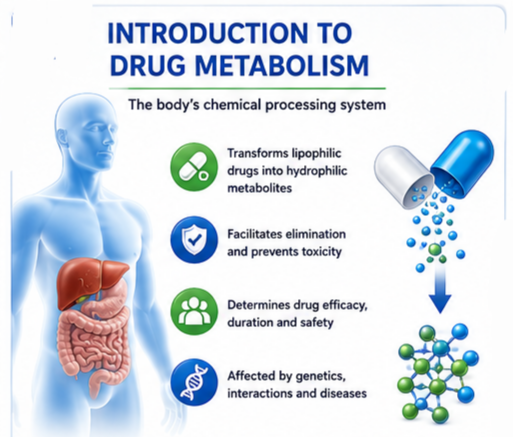 Drug metabolism, also known as xenobiotic metabolism, is the enzymatic conversion of a drug (a xenobiotic) into one or more metabolites. The primary objective of this biotransformation is to alter the chemical structure of the drug to enhance its water solubility and facilitate its excretion from the body. Most drugs are lipophilic, allowing them to cross cell membranes and reach their target sites. However, this lipophilicity also enables them to be reabsorbed in the renal tubules, preventing excretion. Metabolism converts these lipophilic compounds into more polar, water-soluble molecules that can be efficiently eliminated in urine or bile.
Drug metabolism encompasses all chemical processes that occur in the body and is mainly an enzyme-catalyzed process. Although the liver is the primary site, drug-metabolizing enzymes are also found in various other tissues, including the kidneys, gastrointestinal mucosa, lungs, brain, and skin, though they contribute less to overall systemic metabolism.
Key Objectives of Drug Metabolism
- Detoxification: Most often, metabolism reduces the pharmacological activity of a drug. It produces metabolites that are less active or inactive, thereby terminating the drug’s therapeutic effect. This prevents the drug from remaining in the body indefinitely.
- Prodrug Activation: In some cases, a drug is administered as an inactive or weakly active substance called a prodrug. Metabolism converts it into an active therapeutic agent. This strategy is often used to improve bioavailability or target drug delivery.
- Generation of Toxic Metabolites: Unfortunately, some metabolic pathways can produce reactive, toxic intermediates. This is a major cause of drug-induced liver injury (DILI) and other serious adverse drug reactions.
- Promotion of Excretion: By increasing polarity and water-solubility, metabolism makes it easier for the kidneys and liver to excrete the drug, preventing its accumulation and potential toxicity.
2. The Two Phases of Drug Metabolism: Phase I and Phase II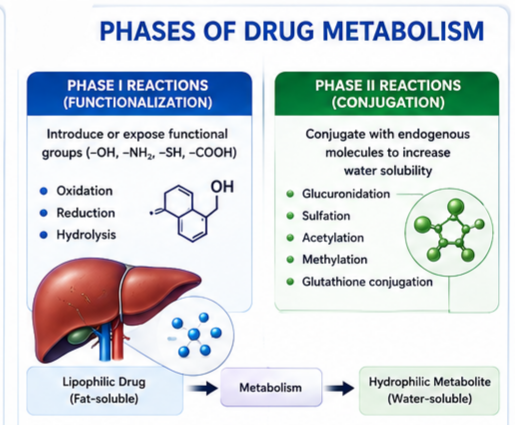
Drug metabolism is traditionally divided into two main categories: Phase I (functionalization) and Phase II (conjugation) reactions. While these classifications are not always strictly sequential, they represent the two primary strategies the body uses to modify xenobiotics.
Phase I Metabolism (Functionalization Reactions)
Phase I reactions introduce or expose a functional group (e.g., -OH, -NH₂, -SH, -COOH) on the drug molecule. This is typically achieved through three main types of reactions: oxidation, reduction, and hydrolysis. These modifications are usually nonsynthetic and aim to create a site for subsequent conjugation.
- Oxidation: This is the most common Phase I reaction. The drug molecule gains oxygen or loses hydrogen. The most significant group of enzymes catalyzing these oxidations is the Cytochrome P450 (CYP450) superfamily.
- Reduction: This involves the gain of hydrogen or loss of oxygen. It is less common than oxidation but is essential for certain drugs, particularly those containing nitro or azo groups.
- Hydrolysis: This reaction involves the cleavage of a bond by the addition of water. Esterases and amidases are enzymes that catalyze the hydrolysis of esters and amides, which are common functional groups in many drugs.
Outcome of Phase I Metabolism: The metabolites formed in Phase I reactions are often slightly more polar than the parent drug. However, this may be insufficient for complete elimination. The added or exposed functional group acts as a “handle” for Phase II conjugation reactions. While many Phase I metabolites are pharmacologically inactive, some retain a degree of activity. In rare cases, they can be more potent than the parent compound or contribute to toxicity. For example, the metabolism of diazepam in Phase I produces desmethyldiazepam and then oxazepam, both of which are active.
Phase II Metabolism (Conjugation Reactions)
Phase II metabolism involves the conjugation of the drug (or its Phase I metabolite) with an endogenous substance. These conjugation reactions are synthetic and require energy, typically in the form of activated intermediates. The addition of a large, polar molecule renders the drug highly water-soluble, facilitating its excretion in urine or bile.
- Glucuronidation: The most common Phase II reaction, it involves the addition of glucuronic acid. This reaction is catalyzed by UDP-glucuronosyltransferases (UGTs). Glucuronides are secreted in bile and eliminated in urine. Glucuronidation is a major clearance pathway for many drugs and endogenous substances. Aging does not significantly affect glucuronidation, but it is slow in neonates, potentially leading to toxicity (e.g., “gray baby syndrome” with chloramphenicol).
- Sulfation (Sulfoconjugation): This involves the transfer of sulfate from 3′-phosphoadenosine-5′-phosphosulfate (PAPS). The resulting sulfate esters are polar and readily excreted in urine. Sulfation is a common pathway for phenolic compounds and steroids.
- Acetylation: This reaction transfers an acetyl group from acetyl-CoA to the drug. Acetylation is primarily mediated by N-acetyltransferases (NATs). It is a major metabolic pathway for drugs like isoniazid and hydralazine.
- Methylation: This involves the transfer of a methyl group from S-adenosylmethionine (SAM) to the drug. Methylation is catalyzed by various methyltransferases and is significant for the metabolism of catecholamines, histamine, and certain drugs.
- Glutathione Conjugation: This is a crucial detoxification pathway for reactive electrophilic metabolites. Glutathione (GSH), a tripeptide, is conjugated to the toxic intermediate, making it less harmful and more soluble. This reaction is catalyzed by glutathione S-transferases (GSTs).
- Amino Acid Conjugation: This involves the conjugation of drugs with amino acids like glycine or glutamine. The resulting conjugates are readily excreted in urine.
Outcome of Phase II Metabolism: Conjugation generally results in the complete inactivation of the drug and the production of a highly water-soluble metabolite that is readily excreted. However, there are exceptions; for instance, certain acyl glucuronides can be reactive and contribute to toxicity.
3. The Cytochrome P450 (CYP450) Enzyme System
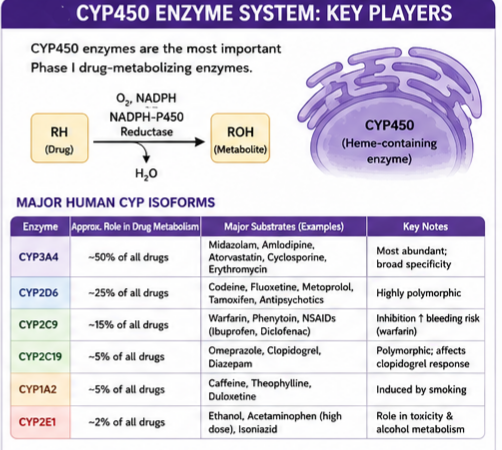 The Cytochrome P450 (CYP450) enzyme system is a superfamily of heme-containing enzymes that constitute the most crucial family of Phase I drug-metabolizing enzymes. They are primarily located in the liver and the gastrointestinal tract, acting as the body’s primary defense against xenobiotics. In humans, there are 57 functional CYP genes classified into 18 families, with the CYP1, CYP2, and CYP3 families being the most prominent in drug metabolism.
CYP450 enzymes catalyze the monooxygenation of a vast array of substrates. In these reactions, one oxygen atom is incorporated into the drug molecule, while the other is reduced to water. This requires the electron donor NADPH (nicotinamide adenine dinucleotide phosphate) and its redox partner, NADPH-P450 reductase, which transfers electrons to the CYP heme iron.
Major CYP Enzymes and Their Substrates
Drug metabolism is not catalyzed equally by all CYP enzymes. A few isoforms are responsible for the majority of drug metabolism. Understanding these enzymes and their specificities is key to predicting potential drug interactions and personalized metabolic rates.
- CYP3A4: This is the most abundant CYP enzyme in the human liver and gastrointestinal tract, responsible for metabolizing approximately 50% of all clinically used drugs. Substrates include alprazolam, amlodipine, atorvastatin, cyclosporine, erythromycin, and midazolam. Due to its broad specificity, it is highly susceptible to inhibition and induction.
- CYP2D6: Despite constituting only a small percentage of liver CYP enzymes, CYP2D6 is involved in the metabolism of about 25% of drugs. It is highly polymorphic. Substrates include antidepressants (fluoxetine, paroxetine), antipsychotics, beta-blockers (metoprolol), codeine, and tamoxifen.
- CYP2C9: A major enzyme responsible for the metabolism of warfarin, phenytoin, tolbutamide, losartan, and many NSAIDs like ibuprofen and diclofenac. Inhibition can lead to significant increases in drug concentrations.
- CYP2C19: Highly polymorphic, impacting the efficacy of proton pump inhibitors (omeprazole), clopidogrel, diazepam, and phenytoin. Genetic variants are a key factor in clopidogrel resistance.
- CYP1A2: Responsible for the metabolism of caffeine, theophylline, and duloxetine. Induced by cigarette smoking.
- CYP2E1: Notable for its role in the metabolism of small molecules and involvement in alcohol-induced liver damage. Substrates include ethanol, acetaminophen (at high doses), and isoniazid.
4. Enzyme Induction and Inhibition
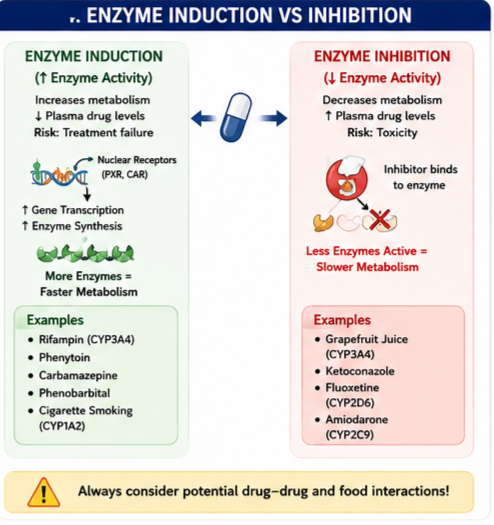 The activity of CYP450 enzymes and other drug-metabolizing enzymes is highly plastic. It can be modulated by various drugs, environmental chemicals, and endogenous factors through two primary mechanisms: enzyme induction and enzyme inhibition. These processes are the leading causes of clinically significant drug-drug interactions.
Enzyme Induction
Enzyme induction is the process by which a substance (an inducer) increases the synthesis or activity of a drug-metabolizing enzyme. This leads to an increased rate of metabolism of a substrate drug, potentially decreasing its plasma concentration and therapeutic effect.
- Mechanism: Many inducers work by activating nuclear receptors, such as PXR or CAR, stimulating transcription of metabolizing enzyme genes.
- Examples: Rifampin (potent CYP3A4 inducer), phenytoin & carbamazepine (inducers of CYP3A4, CYP2C9, CYP2C19), cigarette smoking (induces CYP1A2).
Enzyme Inhibition
Enzyme inhibition is the process by which a substance (an inhibitor) decreases the activity of a drug-metabolizing enzyme. This leads to a decreased rate of metabolism of a substrate drug, potentially increasing its plasma concentration, enhancing its effects, and increasing the risk of toxicity.
- Mechanism: Inhibitors can bind reversibly or irreversibly to the enzyme active site, preventing the substrate from being metabolized.
- Examples: Grapefruit juice (irreversibly inhibits intestinal CYP3A4), ketoconazole & itraconazole (potent CYP3A4 inhibitors), fluoxetine & paroxetine (potent CYP2D6 inhibitors), amiodarone (potent CYP2C9 inhibitor).
5. First-Pass Metabolism
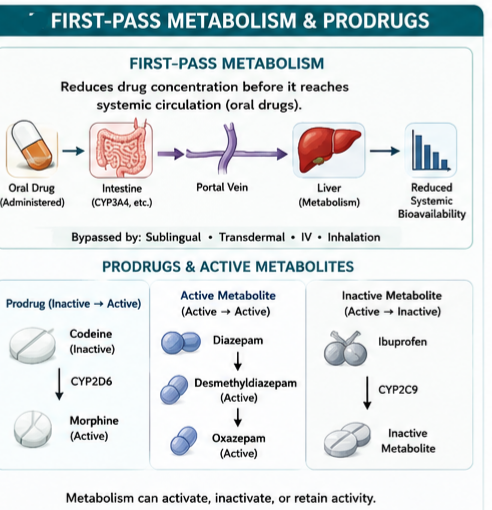
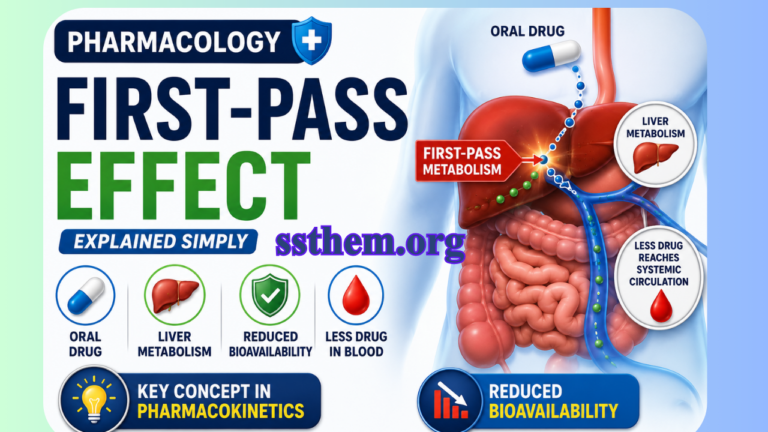
First-pass metabolism, also known as presystemic metabolism, is the phenomenon where a drug’s concentration is significantly reduced before it reaches the systemic circulation. It primarily occurs after oral administration of a drug.
The process involves two main sites: intestinal metabolism (by gut wall enzymes like CYP3A4) and hepatic metabolism (the liver via the portal vein). It is a major determinant of oral bioavailability. For prodrugs, first-pass metabolism is essential for activation (e.g., codeine to morphine). Drugs with extensive first-pass metabolism have low bioavailability and may be given via alternative routes (e.g., sublingual, transdermal, intravenous).
6. Prodrugs and Active Metabolites
Drug metabolism does not always lead to a loss of pharmacological activity. The concepts of prodrugs and active metabolites are essential to understanding the full spectrum of drug action.
- Prodrugs: Biologically inactive or weakly active compounds that are metabolized to release an active agent. Example: codeine (converted to morphine by CYP2D6).
- Active Metabolites: Some drugs are metabolized to compounds that retain or possess enhanced activity. Example: diazepam is metabolized to desmethyldiazepam and oxazepam (both active). Tamoxifen is metabolized by CYP2D6 to more active endoxifen and 4-hydroxytamoxifen.
- Inactive Metabolites: Most common outcome; the drug loses affinity for the target receptor and is cleared.
7. Factors Affecting Drug Metabolism
The rate at which a patient metabolizes a drug is highly individualized. Numerous factors contribute to this variability.
- Genetic Factors (Pharmacogenomics): Polymorphisms in genes encoding metabolizing enzymes lead to differences in activity (poor, extensive, ultrarapid metabolizers). CYP2D6 and CYP2C19 are classic examples.
- Age: Neonates have immature enzyme systems; elderly have reduced hepatic mass and blood flow, decreasing CYP activity by 30% or more.
- Liver Disease: Cirrhosis, hepatitis can significantly impair drug metabolism, requiring dose adjustments.
- Diet and Environment: Cigarette smoking (induces CYP1A2), chronic alcohol (induces CYP2E1), grapefruit juice (inhibits CYP3A4).
- Drug Interactions: Concomitant administration of inducers or inhibitors can profoundly affect metabolic clearance.
- Pregnancy: Physiological changes and hormonal shifts can induce certain CYP enzymes.
8. Clinical Significance and Drug-Drug Interactions
The clinical implications of drug metabolism are vast and touch every aspect of patient care, from prescribing to monitoring for adverse events.
- Risk of Drug Toxicity: When metabolism is inhibited, plasma concentrations can rise to toxic levels, especially for drugs with a narrow therapeutic index (warfarin, digoxin, phenytoin).
- Treatment Failure: When metabolism is induced, clearance increases, leading to subtherapeutic concentrations. Example: oral contraceptives with rifampin (CYP3A4 inducer).
- Common Interactions: Warfarin (CYP2C9) + amiodarone → increased bleeding risk; clopidogrel (CYP2C19) + omeprazole → reduced bioactivation; statins (CYP3A4) + grapefruit juice → risk of rhabdomyolysis.
- Personalized Medicine: Pharmacogenetic testing allows clinicians to adjust drug or dose based on individual metabolic capacity.
9. The Emerging Role of the Gut Microbiome
An exciting frontier in drug metabolism research is the role of the gut microbiome. The human gastrointestinal tract harbors a vast community of microorganisms whose collective genome contains approximately 100 times the number of genes compared to the human genome.
- Microbial Drug Metabolism: Gut microbes possess diverse enzymes that can metabolize drugs through reduction, hydrolysis, and other reactions. A classic example is irinotecan: the active metabolite SN-38 is glucuronidated in the liver and secreted into the bile; bacterial β-glucuronidases in the intestine cleave the conjugate, regenerating toxic SN-38 and causing severe diarrhea.
- Indirect Effects: The microbiota can influence host drug metabolism by modulating the expression of host enzymes (like CYP450s) through various signaling pathways.
- Implications: Microbiota-mediated metabolism is a major source of inter-individual variability in drug response. Diet, antibiotics, and disease states can alter the microbiome, affecting drug safety and efficacy.
10. Laboratory Assessment of Liver Function
Since the liver is the primary site of drug metabolism, assessing its function is vital in clinical practice. Common liver function tests (LFTs) include:
- Liver Enzymes (AST, ALT, ALP, GGT): Elevated ALT/AST indicate hepatocyte injury; elevated ALP/GGT suggest cholestasis.
- Albumin and Total Protein: Low albumin indicates impaired synthetic function.
- Bilirubin: High levels (jaundice) can result from impaired metabolism or excretion.
- Prothrombin Time (PT/INR): Prolonged PT indicates impaired liver function and increased bleeding risk.
11. Special Populations: Pediatric and Geriatric Considerations
- Pediatric Patients: Neonates have immature hepatic enzyme systems (reduced CYP activity, deficient glucuronidation), leading to prolonged half-lives and toxicity risk (e.g., chloramphenicol). Enzyme activity increases rapidly in the first few months, often surpassing adult levels by age 2-5.
- Geriatric Patients: Reduced hepatic volume and blood flow decrease CYP metabolism by over 30%. Polypharmacy increases the risk of drug-drug interactions. The “start low, go slow” principle is recommended.
Key Takeaways
- Purpose: Drug metabolism converts lipophilic drugs into hydrophilic compounds for excretion.
- Two Phases: Phase I (oxidation, reduction, hydrolysis) adds/exposes a functional group; Phase II (conjugation) attaches a polar molecule, inactivating and facilitating excretion.
- CYP450 Enzymes: The most crucial Phase I enzymes; CYP3A4 and CYP2D6 metabolize a majority of drugs.
- Drug-Drug Interactions: Enzyme induction (increases metabolism) and inhibition (decreases metabolism) are leading causes of therapeutic failure or toxicity.
- Individualization: Genetic polymorphisms, age, liver disease, and concurrent medications determine metabolic rate, forming the basis of personalized medicine.
- Prodrugs & Active Metabolites: Metabolism can activate prodrugs (e.g., codeine) or produce active metabolites (e.g., diazepam).
- Gut Microbiome: Gut bacteria significantly metabolize drugs, contributing to variability in response and toxicity.
- Clinical Importance: Liver function assessment is vital; special care is needed for pediatric, geriatric, and hepatically impaired patients.
Final Words: Drug metabolism is a fundamental and dynamic process that orchestrates the fate of pharmaceutical agents in the body. It is not merely a mechanism of drug inactivation but a complex interplay of enzymatic pathways, genetic predispositions, and physiological states. The liver’s Cytochrome P450 enzyme system stands at the heart of this process, governing the metabolism of a vast majority of drugs and representing a primary source of clinically significant drug-drug interactions.
A deep understanding of drug metabolism, encompassing Phase I and II reactions, enzyme induction and inhibition, and the principles of first-pass metabolism, is indispensable for healthcare professionals. It enables them to anticipate variability in drug response, personalize therapy based on individual factors like genetics and organ function, and mitigate the risks of adverse drug reactions. As research continues to unravel the complexities of pharmacogenomics and the role of the gut microbiome, the field of drug metabolism will undoubtedly continue to evolve, driving the advancement of more precise, effective, and safer therapeutic strategies.
Disclaimer: The information provided in this article is for educational and informational purposes only and does not constitute medical advice. It is not intended to replace professional medical consultation, diagnosis, or treatment. Always seek the advice of your physician or other qualified health provider with any questions you may have regarding a medical condition or treatment, and never disregard professional medical advice or delay in seeking it because of something you have read in this article. This content adheres to Google AdSense and Meta policies by providing original, accurate, non-misleading health information. It does not promote self-medication or make unsubstantiated claims.
Last Updated: July 2026 | Version: 1.0
References
1. Rang HP, Ritter JM, Flower RJ, Henderson G. Rang & Dale’s Pharmacology. 9th ed. Elsevier; 2020.
2. Brunton LL, Hilal-Dandan R, Knollmann BC, eds. Goodman & Gilman’s: The Pharmacological Basis of Therapeutics. 13th ed. McGraw-Hill; 2018.
3. Katzung BG, Vanderah TW. Basic & Clinical Pharmacology. 15th ed. McGraw-Hill; 2021.
4. Kenakin T. Pharmacology in Drug Discovery and Development: Understanding Drug Response. 2nd ed. Academic Press; 2017.
5. Neubig RR, Spedding M, Kenakin T, Christopoulos A. International Union of Pharmacology Committee on Receptor Nomenclature and Drug Classification. XXXVIII. Update on terms and symbols in quantitative pharmacology. Pharmacol Rev. 2003;55(4):597-606.
6. Holford NHG, Sheiner LB. Understanding the dose-effect relationship: clinical application of pharmacokinetic-pharmacodynamic models. Clin Pharmacokinet. 1981;6(6):429-453.
7. Rowland M, Tozer TN. Clinical Pharmacokinetics and Pharmacodynamics: Concepts and Applications. 4th ed. Lippincott Williams & Wilkins; 2011.
8. Meibohm B, Derendorf H. Basic concepts of pharmacokinetic/pharmacodynamic (PK/PD) modelling. Int J Clin Pharmacol Ther. 1997;35(10):401-13.
9. Mangoni AA, Jackson SHD. Age-related changes in pharmacokinetics and pharmacodynamics: basic principles and practical applications. Br J Clin Pharmacol. 2004;57(1):6-14.
10. FDA Guidance for Industry: Drug Metabolism/Drug Interaction Studies in the Drug Development Process (2020).
11. EMA Guideline on the Investigation of Drug Interactions (2012).
12. Lynch T, Price A. The effect of cytochrome P450 metabolism on drug response, interactions, and adverse effects. Am Fam Physician. 2007;76(3):391-396.
This article has been written with a focus on evidence-based medicine, clinical pharmacology, and practical application for medical students, residents, and practicing clinicians. The content aligns with contemporary pharmacological principles and integrates the latest concepts in drug metabolism, CYP450 enzyme systems, and personalized medicine.
One Comment